
Is Wired Security Camera Better Than Wireless? Practical Comparison for 2026
Explore if is wired security camera better than wireless for your home defense in November 2026, comparing constant power, Wi-Fi stability, and installation flexibility.
 By John R. Delaney
Updated October 28, 2026


Property owners frequently face an unsettling moment when an unexpected alert arrives, only for the camera feed to freeze or fail to load due to a weak wireless signal. Evaluating whether is wired security camera better than wireless requires looking beyond marketing promises to understand how power delivery, network bandwidth, and physical installation impact daily surveillance. While battery-powered Wi-Fi units offer quick placement without drilling holes through exterior walls, continuous monitoring demands uninterrupted operation. Deploying robust surveillance often involves choosing between the simplicity of wireless hardware and the unmatched stability of dedicated PoE security camera systems that never miss a frame.
Wired setups draw constant electrical power and transmit video data through shielded copper cabling or dedicated low-voltage wiring, which completely eliminates the frustration of dead battery cells and high-traffic notification drain. Conversely, modern wire-free units and solar-assisted cameras have advanced significantly, granting renters and homeowners the ability to secure remote fence lines, garden sheds, or detached garages without running conduit. Balancing continuous 24/7 recording against rapid DIY deployment is the central decision every homeowner must weigh. For spaces where drilling exterior penetrations is impractical, exploring versatile battery security cameras with local storage provides a viable alternative without sacrificing basic event-triggered protection.
| Award | Product | SSG Score About SSG ScoreThe SSG Score is our own rating from 0 to 10, based on performance, design and build, ease of use, and value. It reflects independent research and is never influenced by manufacturers, retailers, or affiliate commissions. Learn more › | |
|---|---|---|---|
| Best Overall |
GALAYOU R6 2K Solar Security Camera
|
9.2/10 | Buy |
| Best Premium |
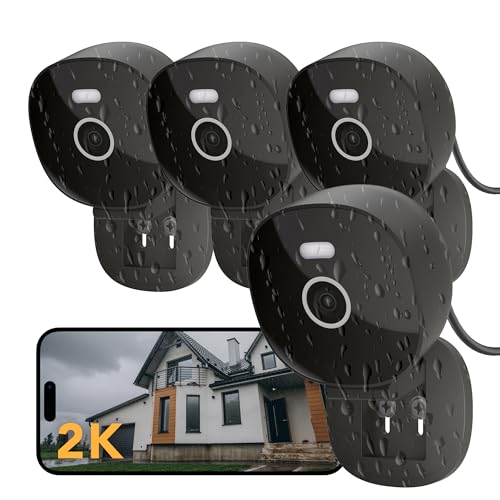 FAMVIVA 2K Wired Security Camera (4-Pack) |
9.1/10 | Buy |
 SEHMUA 2K Solar Wireless Outdoor Security Cameras |
9.1/10 | Buy | |
| Best Budget |
 DEKCO 2K Wired Outdoor Security Camera |
8.8/10 | Buy |
 HITELLARCAM 2K Wireless Outdoor Security Camera |
8.8/10 | Buy | |
 VISION WELL 2K Wireless Security Camera |
8.3/10 | Buy | |
| Best Value |
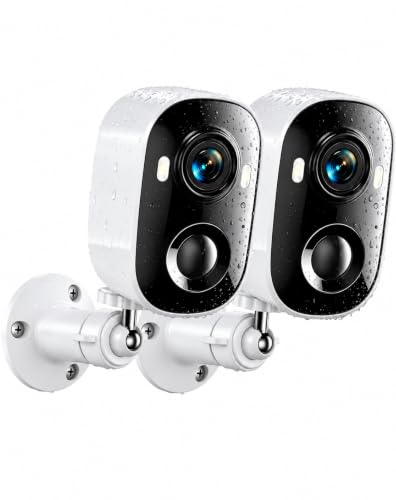 AlertSine 2K Wireless Outdoor Security Camera |
8.0/10 | Buy |
GALAYOU R6 2K Solar Security Camera
Combining continuous solar charging with sharp 2K resolution, the GALAYOU R6 provides wire-free surveillance for yards, garages, and driveways. Its motorized pan-and-tilt tracking and integrated siren deliver active property deterrence without hardwired electrical lines.
Pros
- Wire-free setup powered by continuous solar charging
- Sharp 2K resolution with color night vision
- Automated motion tracking across a wide coverage area
- Built-in siren and two-way audio for deterrence
- IP65 weather resistance handles outdoor conditions
Cons
- Limited to 2.4 GHz Wi-Fi networks only
- MicroSD card is not included in the box
- Continuous or extended cloud recording requires paid plan
FAMVIVA 2K Wired Security Camera (4-Pack)
This four-camera kit provides sharp 2K monitoring with color night vision and IP65 weather resistance for indoor or outdoor coverage. Integrated spotlights and sirens add active deterrence, though each unit requires a nearby power outlet.
Pros
- Crisp 2K video clarity with full-color night vision
- Integrated spotlight and siren deter potential intruders
- IP65 weatherproofing withstands rain and snow
- Seamless integration with Alexa and Google Home displays
Cons
- Requires a continuous wired outlet connection to operate
- MicroSD card must be purchased separately for local storage
SEHMUA 2K Solar Wireless Outdoor Security Cameras
The SEHMUA 4-pack solar security camera system provides wire-free 2K video coverage with motorized pan-and-tilt controls, color night vision, and local microSD recording. It is a solid choice for suburban homeowners and property managers looking to monitor multiple outdoor angles without running power cables or paying mandatory monthly cloud subscription fees.
Pros
- Multi-angle property coverage with four independent pan-and-tilt cameras in a single package
- Continuous solar charging setup eliminates the hassle of dismounting cameras for manual battery recharging
- Local video archiving via onboard microSD card slot up to 128GB avoids mandatory monthly cloud fees
- Spotlight-assisted color night vision and infrared LEDs provide flexible low-light surveillance
- IP65 rated weather-resistant casing supports both wall and ceiling outdoor mounting
Cons
- Operates solely on 2.4GHz Wi-Fi networks and does not support 5GHz wireless bands
- MicroSD cards for local event storage are not included in the package and must be purchased separately
- Cloud storage features require an ongoing subscription plan after the initial 30-day trial expires
DEKCO 2K Wired Outdoor Security Camera
Homeowners seeking non-stop perimeter monitoring will appreciate this hardwired DEKCO camera, which pairs continuous power with a 180-degree motorized pan. Its sharp 2K resolution, built-in spotlights, and color night vision provide clear evidence without the hassle of recharging batteries.
Pros
- Continuous wired power enables true 24/7 surveillance
- Wide 270-degree total coverage via app pan controls
- Crisp 2K resolution with color night vision
- Integrated spotlight and siren deter intruders effectively
Cons
- Requires a paid subscription for video playback
- Lacks an onboard microSD card storage slot
- Compatible only with 2.4GHz Wi-Fi networks
HITELLARCAM 2K Wireless Outdoor Security Camera
The HITELLARCAM 2K wireless outdoor security camera provides wire-free surveillance featuring dual-band Wi-Fi, full-color night vision, and flexible storage via a microSD slot or free SD-quality cloud tier. It serves as an accessible option for suburban homeowners or renters seeking budget-friendly entryway and perimeter coverage without mandatory monthly fees.
Pros
- Dual-band 2.4GHz and 5GHz Wi-Fi support provides flexible home network integration
- Free SD-quality cloud storage option provides clip access without mandatory subscription fees
- Onboard microSD card slot supports up to 256GB for zero-monthly-cost local video storage
- IP66 weather-resistant construction withstands exposure to outdoor rain and dust
- Integrated LED spotlights enable full-color night recording and visual deterrence
Cons
- Free cloud storage tier is limited to standard-definition playback unless upgraded to a paid plan
- MicroSD card is not included with the camera and must be purchased separately
- Battery runtime varies significantly based on trigger frequency, live-view streaming, and cold temperatures
VISION WELL 2K Wireless Security Camera
The VISION WELL 2K Wireless Security Camera delivers flexible, wire-free surveillance for indoor or outdoor spaces with clear 2K resolution, color night vision, and on-device AI motion filtering. It is a dependable, budget-conscious choice for homeowners and renters seeking reliable entryway deterrence without mandatory monthly fees.
Pros
- Completely wire-free battery installation with included bracket and screws, making it ideal for renters and suburban homeowners.
- Sharp 2K video clarity supported by full-color night vision and a 33-foot illumination range.
- PIR motion detection paired with smart AI filtering for people, vehicles, pets, and packages.
- Local recording support on microSD cards up to 128GB to avoid mandatory monthly subscriptions.
- IP65 weather-resistant rating suitable for exterior perimeter or sheltered entryway mounting.
Cons
- Only connects to 2.4 GHz Wi-Fi networks and does not support 5 GHz frequencies.
- Designed for motion-activated event clips rather than continuous 24/7 video recording.
- MicroSD storage card is not included in the box and must be purchased separately.
AlertSine 2K Wireless Outdoor Security Camera
The AlertSine wireless outdoor camera provides crisp 2K video clarity, full-color night vision, and responsive PIR-assisted AI human detection in an accessible wire-free format. It is a practical perimeter and entryway monitor for budget-conscious homeowners and renters comfortable with a cloud-first storage model.
Pros
- Sharp 2K video resolution delivers crisp daytime detail and full-color night viewing for entryways and perimeters.
- Completely wire-free design with a 4400mAh rechargeable battery allows flexible mounting without electrical wiring.
- PIR heat detection paired with AI human recognition helps reduce false alerts from windblown foliage and weather.
- Durable IP65 weatherproof construction provides reliable outdoor protection across changing seasons.
Cons
- Lacks an onboard microSD card slot, requiring an ongoing cloud subscription for video history once the 3-day trial expires.
- The 4400mAh battery capacity may require more frequent recharging in high-traffic mounting locations.
- Does not support continuous 24/7 video recording, capturing motion-triggered events only.
Wired vs Wireless Security Cameras: Core Architectural Differences
Deciding whether a wired security camera outperforms a wireless alternative hinges on your surveillance goals, installation appetite, and property layout. Wired cameras generally deliver superior recording reliability, continuous 24/7 video capture, and zero battery maintenance. Wireless cameras excel at rapid deployment, flexible outdoor mounting without structural alterations, and adaptable solar power. Understanding how these systems handle electrical power and network data clarifies which technology best protects your home.
Defining the Technology: Power Delivery vs Video Transmission
Many homeowners assume the term wireless applies universally to both electricity and data transfer, but surveillance hardware actually separates these functions. A truly wire-free camera operates on an internal rechargeable battery, occasionally supplemented by a continuous solar panel accessory, and communicates entirely over Wi-Fi. In contrast, plug-in wired models rely on an AC adapter or low-voltage DC transformer for constant power while still utilizing 2.4 GHz or 5 GHz Wi-Fi to push video streams to mobile apps. True hardwired systems, such as Power over Ethernet (PoE), route both electrical current and network communication through a single solid copper Cat6 Ethernet line.
Recognizing this distinction prevents significant confusion when shopping for home security hardware. A camera like the FAMVIVA 2K or DEKCO wired outdoor camera eliminates battery anxiety because it plugs into an exterior outlet, yet it still depends on local wireless routers for video delivery. Fully wireless units like the SEHMUA or AlertSine cameras cut every physical cord, providing total placement freedom at the expense of needing periodic battery management or sunny solar angles. Determining whether you want to avoid running electrical cables or avoid managing battery duty cycles establishes the baseline for your surveillance project.
Continuous 24/7 Video Recording vs Motion-Triggered Wakeups
The most significant technical gap between wired and wireless surveillance lies in their recording architecture. Wired cameras connected to constant AC or PoE electrical power support uninterrupted continuous video recording, commonly known as 24/7 CVR. These always-on devices actively analyze image frames in real time, capturing subtle occurrences such as suspicious individuals casing a property or vehicles slowly idling on the street. Because constant power flows to the optical image sensor and image signal processor, there is zero wake-up delay when an event unfolds.
Battery-powered wireless cameras operate under strict energy-conservation constraints to prevent their lithium-ion cells from depleting in a few days. These devices remain in a deep sleep state until an onboard passive infrared (PIR) sensor registers a shift in ambient thermal radiation. Waking the internal microprocessor, connecting to the local Wi-Fi access point, and initializing the optical feed takes anywhere from one to three seconds. This brief latency can occasionally result in clips that capture only the back of a fast-moving intruder or miss a rapid package drop entirely.
Property owners monitoring high-traffic driveways or public street frontages often encounter severe trade-offs with battery-powered units. Frequent vehicle traffic or sidewalk pedestrians force the camera to wake up hundreds of times each day, depleting nominal multi-month battery ratings down to mere weeks. While premium options like battery security cameras featuring color night vision offer powerful integrated spotlights and sharp event clips, they cannot replace the forensic completeness of a constant-power wired stream. If your objective is capturing every second of activity around critical perimeter gates, a wired system remains the superior technical choice.
Network Reliability, Wi-Fi Interference, and Data Bandwidth
Data transmission represents another critical battleground when evaluating surveillance stability. Wi-Fi cameras transmit compressed video streams over radio frequencies, making them susceptible to physical attenuation and electromagnetic interference. Dense building materials such as exterior brick, stucco wire lath, stone veneers, and foil-lined radiant barrier insulation dramatically degrade wireless signal strength. A camera mounted on an exterior garage wall may struggle to maintain an acceptable Received Signal Strength Indicator (RSSI) value, leading to frequent video buffering, dropped frames, or delayed smartphone notifications.
Hardwired PoE cameras bypass wireless spectrum congestion entirely by routing data through twisted-pair copper Ethernet cabling. Physical cabling delivers consistent multi-gigabit throughput unaffected by household microwave ovens, baby monitors, or neighbors operating overlapping Wi-Fi networks. Ethernet cables also support uninterrupted data streams over distances up to 328 feet (100 meters) without requiring signal repeaters or mesh network nodes. This physical link ensures that high-bitrate 2K or 4K video feeds transfer smoothly without dropping resolution or suffering packet loss during critical incidents.
Broadband bandwidth overhead is an equally vital factor for households deploying multiple cameras simultaneously. Several wireless cameras streaming high-definition video over a 2.4 GHz network can saturate home Wi-Fi bandwidth, increasing latency for other connected smart home devices. While newer wireless models incorporate dual-band Wi-Fi supporting 5 GHz frequencies for faster data transfers, higher-frequency signals have much shorter effective ranges and struggle to penetrate thick structural walls. For large suburban homes or sprawling rural properties, running physical network cable guarantees dependable data delivery that wireless radio signals simply cannot match.
Physical Installation Realities, Drilling, and Power Access
Installation complexity represents the primary area where wireless cameras hold a definitive advantage over hardwired alternatives. Mounting a wire-free, battery-powered security camera involves securing a small mounting bracket to a wall, fence, or soffit with two or three screws. Homeowners and apartment renters can install a complete four-camera setup within an hour without specialized tools, structural wall penetrations, or electrical permits. Units paired with small solar panels maintain operational autonomy without requiring ladder climbs for recharging, making them ideal for hard-to-reach perimeter locations.
Hardwired cameras demand substantially greater upfront labor, planning, and physical effort. Running Cat6 Ethernet cables or low-voltage DC wiring requires accessing attics, navigating tight crawlspaces, fishing lines through interior wall cavities, and drilling penetrations through exterior siding. Installers must properly seal exterior drill holes with silicone caulk, form low drip loops to keep moisture away from connections, and adhere to local building codes. If you lack accessible wall voids or attic space, surface-mounted conduit may become necessary, which can impact exterior home aesthetics.
Storage Topology: Local NVR and SD Cards vs Cloud Subscriptions
Video archiving architecture plays an enormous role in ongoing system costs, evidentiary security, and data privacy. Hardwired camera systems frequently pair with a centralized Network Video Recorder (NVR) equipped with multi-terabyte surveillance-grade hard drives. This topology stores weeks of continuous footage locally inside your home, operating completely free from monthly subscription fees and third-party cloud outages. When expanding an existing hardwired setup, integrating add-on cameras with an NVR allows homeowners to scale perimeter coverage across multiple vantage points without increasing recurring expenses.
Wireless cameras often depend heavily on onboard microSD card slots or remote cloud storage servers. On-device microSD cards offer low-cost local storage, but they present physical theft vulnerabilities; if an intruder steals or smashes the camera, the local evidence vanishes. High-traffic recording can also exhaust the finite write endurance of standard flash memory cards, leading to silent data corruption over time. To counter this risk, many consumers opt for cloud storage plans, which securely back up motion clips offsite via encrypted data channels.
Cloud reliance introduces ongoing operational trade-offs that buyers must carefully evaluate. Cloud storage subscriptions often require recurring monthly or annual payments per camera to unlock basic video history, intelligent human filtering, and custom activity zones. Furthermore, if your residential broadband connection drops, cloud-only cameras become incapable of saving remote backup footage during the service outage. Local NVR recording continues writing uninterrupted video streams to local hard drives regardless of whether the external internet connection remains online.
Environmental Durability, Seasonal Weather, and Battery Chemistry
Outdoor environmental extremes expose stark functional differences between hardwired power lines and chemical lithium-ion batteries. Extreme winter cold presents a severe physical hurdle for battery-powered cameras in northern climates. When ambient temperatures drop below freezing (32°F or 0°C), lithium-ion internal resistance spikes, drastically reducing effective discharge capacity and causing rapid battery percentage drops. Furthermore, integrated battery management systems intentionally prevent charging below freezing to avoid irreversible lithium plating damage, rendering solar panel accessories ineffective during cold winter snaps.
Hardwired cameras avoid these seasonal electrochemical hurdles by drawing continuous electrical power directly from AC transformers or PoE network switches. Without sensitive lithium-ion cells inside the casing, hardwired cameras maintain stable operating temperatures and continuous recording throughout severe blizzards and scorching summer heat waves. Durable enclosures carrying IP65 or IP66 weatherproof ratings shield internal optical components and image sensors against windblown dust and driving rain. For properties subjected to harsh winter freezes or extended sub-zero temperatures, wired power architectures offer vastly superior physical resilience.
Smart Home Integration, Detection AI, and Legal Boundaries
Modern surveillance systems integrate sophisticated software capabilities, but hardware architectures dictate how effectively these features operate. Both wired and wireless cameras support voice platform integration with Amazon Alexa and Google Home, allowing users to view live streams on compatible smart displays. However, hardwired cameras generally support open networking standards like RTSP and ONVIF Profile S or T, enabling integration with advanced home automation hubs and third-party video management software. Most battery cameras rely on closed, proprietary cloud ecosystems that restrict local network streaming to preserve battery reserves.
Edge-based artificial intelligence has significantly improved false alert filtering across both camera formats, yet power budgets influence processing capabilities. Wired cameras continuously run powerful neural processing algorithms that instantly differentiate between human figures, moving vehicles, and wandering pets. Battery cameras must conserve power, often relying on basic PIR thermal triggers before activating onboard AI or offloading image recognition tasks to remote cloud servers. This two-step process can introduce notification delays on wireless devices when immediate alerting is essential.
Homeowners deploying outdoor surveillance must also respect residential legal standards and privacy boundaries. Under US federal wiretap statutes (18 U.S.C. § 2511) and various state-level one-party or all-party consent laws, recording private oral conversations without permission can carry strict legal liabilities. While video monitoring of your driveway or front porch is generally lawful, pointing high-resolution lenses into neighbor windows or recording clear backyard audio across fence lines can violate reasonable expectations of privacy. Disabling two-way audio recording features or utilizing software privacy masks helps maintain legal compliance regardless of whether your cameras are wired or wireless.
Decision Framework: Choosing the Right Setup for Your Property
Selecting between wired and wireless security cameras ultimately depends on your housing situation, technical proficiency, and surveillance priorities. Renters, condominium occupants, and homeowners seeking rapid perimeter coverage without permanent modifications will find battery-powered and solar-assisted wireless cameras ideal. These units provide dependable event-based detection, straightforward smartphone management, and flexible mounting options for driveways, backyards, and detached outbuildings. For rental units where drilling through exterior walls is forbidden, wireless technology delivers accessible protection that moves with you when your lease ends.
For permanent homeowners seeking comprehensive, commercial-grade security, wired cameras remain the superior architectural standard. A hardwired PoE or continuous AC system delivers uninterrupted 24/7 video recording, total immunity from Wi-Fi congestion, and complete independence from recurring cloud subscription fees. You never have to worry about replacing dead battery packs, troubleshooting signal drops through masonry walls, or missing critical events due to PIR wake-up lag. By aligning your property layout and monitoring expectations with the distinct strengths of each technology, you can build a dependable surveillance system that keeps your household protected.
About the author
John R. Delaney is a veteran technology editor and product reviewer specializing in home security, smart home devices, and wireless networking. With extensive experience evaluating connected security systems, cameras, smart locks, sensors, and networking equipment, he brings a practical testing mindset to consumer technology. His work emphasizes usability, performance, connectivity, and long-term value for homeowners building reliable smart security systems.