
What Is the Best Light Bulb Security Camera: Practical Guide for 2026
Explore what is the best light bulb security camera options in November 2026 with analysis on socket fit, dual-band Wi-Fi connectivity, and 2K video clarity.
 By Tyler Lacoma
Updated November 20, 2026
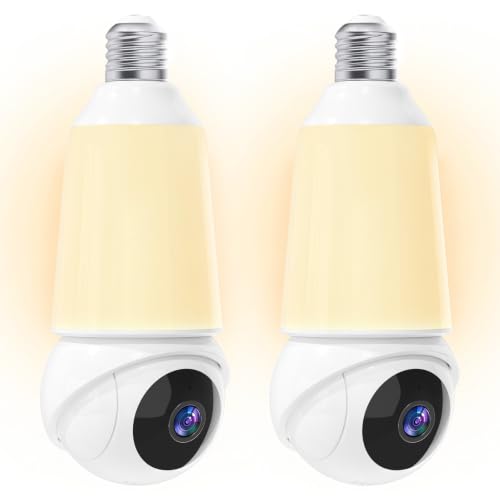

Exterior lighting fixtures offer one of the most accessible installation points for residential video surveillance. Determining what is the best light bulb security camera involves evaluating how well a device integrates into standard light fixtures without demanding invasive electrical wiring or ladder work. Unlike standalone pan-tilt security cameras for driveways that demand dedicated mounting brackets, a light socket camera draws continuous power straight from an existing E26 or E27 lamp socket. This continuous AC power supply eliminates the chronic charging cycles and low-temperature throttling commonly seen in battery security cameras with local storage.
Selecting an optimal unit requires balancing mechanical rotation capabilities against fixture dimensions and optical performance. Many modern fixtures feature enclosed glass sconces that restrict bulky camera housings, making physical dimensions and clearance measurements critical before purchasing. Beyond physical fit, property owners must assess networking capabilities such as dual-band wireless support, onboard storage capacity, and integrated spotlight brightness. A well-matched socket camera provides seamless perimeter surveillance while preserving functional outdoor illumination for walkways and entryways.
| Award | Product | SSG Score About SSG ScoreThe SSG Score is our own rating from 0 to 10, based on performance, design and build, ease of use, and value. It reflects independent research and is never influenced by manufacturers, retailers, or affiliate commissions. Learn more › | |
|---|---|---|---|
| Best Overall |
WESECUU 2K Light Bulb Security Camera
|
9.1/10 | Buy |
| Best Value |
 Wyze Bulb Cam 2K HD Security Camera |
8.4/10 | Buy |
| Best Premium |
 Wyze Bulb Cam 2K Security Camera (2-Pack) |
8.3/10 | Buy |
 Poleeye 2K Dual-Band Light Bulb Camera |
8.1/10 | Buy | |
| Best Budget |
 WESECUU 2K Dual-Band Light Bulb Camera |
8.0/10 | Buy |
 Chpuss 2K Dual-Band Light Bulb Camera |
8.0/10 | Buy |
WESECUU 2K Light Bulb Security Camera
Screwing directly into a standard E27 socket, this dual-band camera pairs a 2K sensor with an integrated 1000-lumen light to illuminate and monitor entryways. It offers motorized 355-degree pan tracking, two-way audio, and color night vision for users seeking wire-free installation.
Pros
- Supports both 2.4GHz and 5GHz Wi-Fi networks
- Bright 1000-lumen integrated illumination
- Installs directly into standard E27 light sockets
- Local microSD storage supported up to 128GB
Cons
- Cloud video storage requires a paid subscription
- Requires continuous power to the light socket
- Relies on the third-party EseeCloud mobile app
Wyze Bulb Cam 2K HD Security Camera
Screwing directly into standard E26 light sockets, the Wyze Bulb Cam integrates an 800-lumen warm light with a 2K surveillance camera. It provides a convenient entryway monitoring solution featuring continuous local recording and a wide 160-degree field of view.
Pros
- Simple installation into standard E26 light sockets
- Crisp 2K resolution with color night vision
- Continuous local recording without mandatory subscriptions
- Wide 160-degree field of view minimizes blind spots
- Integrated 800-lumen dimmable LED fixture
Cons
- Pan and tilt adjustments must be made manually
- Cannot be used with existing dimmer switches
- Advanced AI object detection requires a paid subscription
Wyze Bulb Cam 2K Security Camera (2-Pack)
Screwing directly into standard E26 sockets, this dual-purpose security device combines an 800-lumen floodlight with a sharp 2K camera to illuminate and monitor entryways without wiring. It is well suited for homeowners seeking 24/7 local recording and straightforward porch surveillance without mandatory monthly fees.
Pros
- Simple installation into standard E26 sockets without wiring
- Sharp 2K video with full color night vision
- Continuous 24/7 local recording without mandatory subscriptions
- Built-in dimmable 800-lumen LED light and siren
- Wide 160-degree viewing angle minimizes blind spots
Cons
- Pan and tilt require manual adjustment, not app control
- Incompatible with dimmer switches and 5GHz Wi-Fi networks
- Smart AI object detection requires an optional paid plan
Poleeye 2K Dual-Band Light Bulb Camera
Screwing directly into standard light sockets, this outdoor dome camera provides crisp 2K video with motorized auto-tracking. Its dual-band Wi-Fi support makes it an easy setup for monitoring porches or garages without running power cords.
Pros
- Fits directly into standard E26 or E27 light sockets
- Dual-band Wi-Fi supports 2.4GHz and 5GHz networks
- Wide 355-degree pan and tilt with auto-tracking
- Full-color night vision reaches up to 33 feet
- Free basic features without a mandatory subscription
Cons
- MicroSD card for local storage is sold separately
- Requires constant light socket power to stay active
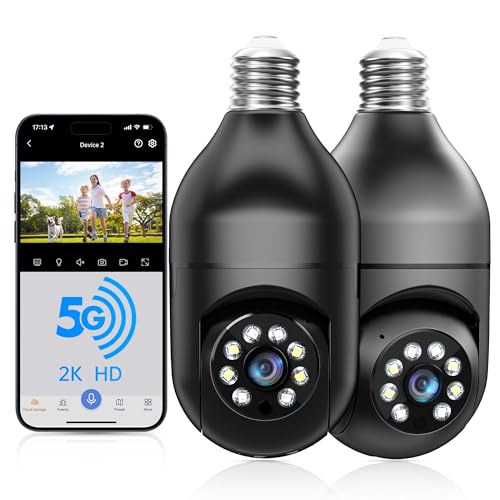
WESECUU 2K Dual-Band Light Bulb Camera
Screwing directly into standard E27 light sockets, this outdoor PTZ camera delivers 2K surveillance with dual-band Wi-Fi for steady streaming. It provides an accessible security upgrade for homeowners wanting pan-and-tilt monitoring without running dedicated electrical lines.
Pros
- Simple installation into standard E27 sockets
- Dual-band Wi-Fi enhances connection stability
- Full-range pan and tilt minimizes blind spots
- Color night vision reaches up to 33 feet
- Supports local recording via microSD cards
Cons
- Video clarity degrades during extreme weather conditions
- Cloud storage requires an ongoing paid subscription
- Requires constant power supply from the light fixture
Chpuss 2K Dual-Band Light Bulb Camera
Screwing directly into standard light sockets, this outdoor camera delivers 2K video and full-color night vision without requiring hardwired electrical installation. Dual-band Wi-Fi and 360-degree motion tracking make it a practical option for monitoring porches and entryways.
Pros
- Works on both 2.4GHz and 5GHz Wi-Fi networks
- Screw-in design avoids complex electrical wiring
- Clear 2K resolution with color night vision
- Extensive coverage with motorized pan and tilt
- Built-in spotlight and audible siren alert
Cons
- MicroSD card is not included
- Cloud video storage requires a paid subscription
- Requires constant power to the light fixture
Evaluating Light Socket Cameras: Architecture, Hardware, and Selection Criteria
Finding the right light socket camera requires looking past basic marketing claims and evaluating core mechanical, optical, and networking specifications. Because these cameras operate directly inside decorative luminaires, their real-world utility depends on how effectively they handle structural clearances, continuous line voltage, and wireless data transmission. Homeowners must decide whether an automated motorized pan-and-tilt gimbal or a fixed wide-angle optical lens better serves their specific perimeter layout. Examining these hardware differences ensures that the chosen camera delivers reliable surveillance without compromising outdoor lighting or residential Wi-Fi stability.
Motorized Pan-Tilt Tracking Versus Fixed Wide-Angle Optics
Mechanical movement separates socket cameras into two distinct hardware categories: motorized pan-and-tilt units and fixed wide-angle lenses. Models from WESECUU, Poleeye, and Chpuss incorporate internal motors that provide 355 degrees of horizontal rotation and 90 degrees of vertical tilt. These motorized mechanisms allow the camera to physically pan across a wide driveway or porch, actively tracking human movement as it occurs. Remote pan-and-tilt controls inside mobile applications like EseeCloud enable property owners to reorient the lens dynamically without climbing a ladder.
In contrast, cameras like the WYZE Bulb Cam utilize a fixed-position lens with a broad 160-degree field of view paired with manual adjustment. Users set the 360-degree pan and 90-degree tilt by hand during installation, after which the camera remains stationary. While stationary designs lack automated subject tracking, they eliminate mechanical motor lag and reduce physical wear points inside the housing. Furthermore, a fixed wide-angle lens maintains constant coverage over primary entryway choke points without ever turning its sensor away from an incoming visitor. Wide Dynamic Range processing on these fixed lenses also balances harsh sunlight and deep shadows across high-contrast porch environments.
Electrical Architecture and Socket Compatibility in Exterior Fixtures
Socket-based cameras rely on standardized light bulb threads, typically utilizing standard North American E26 bases or international E27 sockets. The WYZE Bulb Cam requires a dedicated 120V 60Hz E26 socket, while models from Poleeye, WESECUU, and Chpuss support wide-voltage ranges between 110V and 240V AC. This wide-voltage compatibility allows certain cameras to function smoothly on diverse residential wiring circuits or included plug-in socket adapters. Proper thread contact is essential because poor physical contact can generate electrical resistance, intermittent power dropouts, and sudden offline resets.
A critical electrical constraint for every light socket camera is the type of wall switch controlling the fixture circuit. These surveillance units require uninterrupted line power to maintain wireless network links and record continuous video feeds. Installing a socket camera on a circuit connected to a dimmer switch can damage internal power supply components and cause camera failure. Property owners should install physical switch guards or smart switch locks to prevent household members from accidentally cutting electrical power to the camera.
Enclosure Dimensions and Sconce Clearance Challenges
Sconce clearance represents one of the most frequent installation obstacles for light socket cameras. Exterior lanterns often feature narrow glass panes, enclosed bottom panels, or shallow decorative metal caps that restrict oversized camera bodies. For example, the WYZE Bulb Cam includes a telescoping rod extending up to 1.2 inches to help position the lens beyond fixture rims. Even with this adjustment, the manufacturer specifies that sconces must have an interior depth under 7.8 inches and a bottom opening exceeding 2.5 inches.
Motorized dome models such as the WESECUU camera measure approximately 7.0 centimeters in diameter and 15.5 centimeters in total height. Placing a bulb camera of this size inside an enclosed carriage light requires enough clearance so the rotating gimbal never strikes decorative metal frames. Restricted air volume inside fully enclosed glass fixtures can also cause heat buildup during intense summer weather, potentially accelerating electronic component aging. Measuring the interior dimensions of the light fixture before buying ensures that the camera body screws in flush and rotates freely without physical obstruction.
Wireless Bandwidth: 2.4 GHz Range Versus 5 GHz Throughput
Network connectivity dictates video streaming reliability, live-view latency, and timely push notifications. Many traditional smart home devices operate exclusively on 2.4 GHz Wi-Fi frequencies, as seen with the single-band WYZE Bulb Cam. The 2.4 GHz spectrum offers superior radio frequency penetration through dense building materials such as exterior brick, stucco, and wood siding. However, residential 2.4 GHz bands are frequently congested by neighbor routers, Bluetooth peripherals, and household smart appliances, which can induce packet loss.
Dual-band models from WESECUU, Poleeye, and Chpuss support both 2.4 GHz and 5 GHz wireless frequencies. Connecting to a 5 GHz network provides significantly higher data throughput and lower transmission latency, delivering smoother real-time 2K video streams. The limitation of 5 GHz signals is their reduced range and poor penetration through dense exterior wall substrates. For outdoor porch installations located far from the main router, the 2.4 GHz band remains the recommended choice for link stability. For light sockets installed inside garages, covered breezeways, or near interior access points, 5 GHz connectivity delivers ultra-responsive remote operation.
Continuous Local MicroSD Storage Versus Subscription Cloud Vaults
Video storage architecture determines both long-term ownership costs and operational resilience during internet service outages. Unlike battery cameras that sleep between motion events, hardwired socket cameras can maintain continuous 24/7 video recording directly to local storage. The WYZE Bulb Cam and Chpuss models support microSD cards up to 256GB, while WESECUU and Poleeye units accommodate cards up to 128GB. Continuous local recording preserves comprehensive minute-by-minute timelines, allowing users to scrub back and inspect incidents that motion sensors failed to trigger. Property owners wanting centralized archives can also evaluate add-on security cameras for NVR systems for multi-channel video management.
Cloud storage services offer an off-site safety net if a light bulb camera is stolen or damaged by an intruder. Optional cloud tiers like Wyze Cam Plus provide 14-day rolling video clip history and advanced cloud-based artificial intelligence recognition. Similarly, EseeCloud-compatible bulb cameras offer optional paid cloud packages alongside standard onboard local storage. Relying purely on cloud storage, however, creates recurring monthly expenses and consumes continuous upstream home broadband bandwidth. Utilizing high-endurance microSD cards rated for continuous surveillance writing ensures dependable video retention without mandatory monthly subscriptions.
Illumination Performance and Color Night Vision Dynamics
A light socket camera must function effectively as an exterior luminaire while serving as a perimeter surveillance sensor. The WESECUU 2K model features an integrated 1000-lumen dimmable light, providing substantial illumination for front walkways and patio areas. High-lumen output deters trespassers and provides the ambient light required for full-color video capture in pitch-black conditions. Comparing illumination outputs with dedicated color night vision security cameras reveals how integrated spotlights dramatically enhance nighttime forensic clarity.
When auxiliary spotlights remain turned off, these cameras utilize built-in infrared LEDs to illuminate objects within a 33-foot radius. Infrared mode produces detailed black-and-white images without casting visible glare that might disturb sleeping family members or adjacent neighbors. Smart night vision modes can remain in infrared standby and automatically activate white LED spotlights when human motion is detected. Property owners should angle camera lenses away from nearby white siding or reflective gutters to avoid near-field infrared washout.
Edge-Based Human Detection and False Trigger Mitigation
Porch and driveway environments present significant motion detection challenges due to windblown trees, passing insects, and vehicle headlights. Basic pixel-luminance motion detection triggers chronic false alarms, leading to rapid notification fatigue for homeowners. Light bulb cameras utilize on-device computer vision algorithms specifically trained to identify human body shapes and silhouettes. When human body detection is activated in the companion application, the camera ignores minor environmental shifts and alerts owners only to meaningful presence.
Tuning the motion sensitivity slider inside the camera software prevents nuisance alerts caused by nocturnal moths hovering near the warm lens. Companion applications allow users to designate specific motion detection zones, masking busy public sidewalks or nearby street traffic. On motorized tracking models, fine-tuning detection sensitivity ensures the lens follows walking pedestrians rather than erratic wind gusts. Combining software detection zones with human-filtering algorithms preserves situational awareness while keeping smartphone notifications manageable.
Acoustic Hardware, Siren Output, and US Audio Recording Laws
Built-in acoustic hardware enables real-time communication between homeowners and delivery couriers or unexpected visitors. Integrated noise-canceling microphones and miniature speakers allow full two-way audio conversations through mobile smartphone applications. In addition to voice communication, these cameras incorporate audible sirens that can trigger automatically upon motion or activate manually via the app. Emitting a loud siren alongside flashing white spotlights creates a powerful active deterrent against porch package theft.
Recording outdoor audio introduces important legal considerations under United States federal and state surveillance regulations. Under federal wiretap law, codified at 18 U.S.C. Section 2511, recording oral communications where individuals possess a reasonable expectation of privacy carries strict restrictions. While front porches typically feature a reduced expectation of privacy, state-level one-party and all-party consent statutes govern audio recording practices. Twelve states require all parties in a conversation to consent to audio recording, making public-facing microphone feeds potentially sensitive. Property owners should review municipal and state surveillance statutes and consider disabling audio recording features if camera microphones capture sidewalk conversations.
Operational Verification, DORI Standards, and Long-Term Reliability
Evaluating installed camera performance requires objective measurement using IEC EN 62676-4 international DORI standards. DORI metrics define distinct pixel density thresholds required for Detection, Observation, Recognition, and personal Identification. With a native 2K high-definition sensor, a properly focused socket camera provides clear facial recognition within approximately 10 to 15 feet. Beyond 25 feet, 2K resolution delivers reliable general observation of clothing colors, vehicle outlines, and directional movement paths. Positioning the camera between 7 and 9 feet from the ground optimizes facial capture angles without exposing the unit to easy physical tampering.
Sustained operational reliability requires routine physical inspection and preventive hardware maintenance. Exterior dust, spider webs, and pollen accumulate on the optical dome over time, causing blurry daytime footage and nighttime infrared flare. Gently cleaning the camera lens and LED housing with a soft microfiber cloth restores crisp optical clarity and prevents night vision distortion. Furthermore, reformatting onboard microSD cards every few months helps maintain flash memory health and avoids file write corruption. Checking the silicone weather seals around the bulb socket adapter ensures environmental moisture cannot penetrate electrical contacts during heavy windblown rainstorms.
Ultimately, identifying the best light socket camera comes down to matching your fixture geometry, wireless environment, and storage preferences. Motorized pan-and-tilt units excel in open porch settings where active 360-degree tracking adds value, while fixed wide-angle lenses suit compact sconces requiring dependable continuous coverage. Choosing dual-band Wi-Fi support and installing a high-endurance microSD card guarantees stable video performance without locking your household into expensive monthly subscriptions. By verifying physical socket clearances and dialing in human detection zones, homeowners can establish an effective, low-maintenance surveillance perimeter straight from an existing light fixture.
About the author
Tyler Lacoma is a smart home and home security technology expert with more than a decade of hands-on experience testing connected devices. His expertise includes security cameras, smart locks, home security systems, privacy features, smart-home compatibility, and emerging AI technology. He focuses on translating technical features into practical guidance that helps homeowners understand which security solutions truly fit their homes and everyday needs.