
Who Makes the Best Light Bulb Security Camera: Practical Brand Guide for 2026
Learn who makes the best light bulb security camera for November 2026 by comparing socket sizing, dual-band Wi-Fi reliability, onboard storage, and brand ecosystems.
 By John Carlsen
Updated November 5, 2026
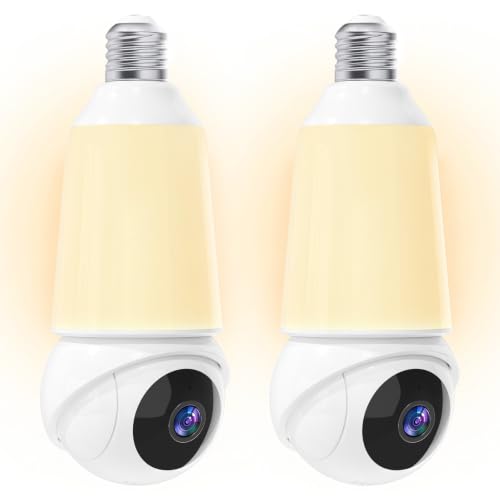

Standard exterior lighting fixtures offer an underutilized pathway to property surveillance, transforming standard light sockets into continuous power sources without drilling or running dedicated low-voltage wiring. Evaluating who makes the best light bulb security camera requires property owners to balance brand software stability against mechanical flexibility and physical fixture clearances. Established consumer smart home brands such as WYZE approach socket-based monitoring with dedicated app ecosystems and fixed wide-angle optics, whereas specialty manufacturers like WESECUU, Poleeye, and Chpuss focus on motorized pan-tilt tracking and dual-band wireless reception. Exploring these form factors requires understanding how socket-mounted hardware compares to traditional cameras with color night vision that rely on separate mounting plates.
Light socket surveillance cameras draw uninterrupted power from standard standard E26 or E27 fixtures, eliminating the continuous battery charging cycles associated with wire-free units. Selecting the appropriate brand depends heavily on whether a residence requires native dual-band Wi-Fi connectivity, integration with platforms like Amazon Alexa or Google Home, or self-contained footage archiving via high-endurance microSD cards. Many budget-friendly models utilize shared video platforms like the EseeCloud application, while platform-centric options prioritize continuous recording timelines without cloud subscription paywalls. Property owners seeking dependable exterior coverage often pair these socket cameras alongside dedicated battery security cameras with local storage to safeguard property perimeters against network drops and environmental blind spots.
| Award | Product | SSG Score About SSG ScoreThe SSG Score is our own rating from 0 to 10, based on performance, design and build, ease of use, and value. It reflects independent research and is never influenced by manufacturers, retailers, or affiliate commissions. Learn more › | |
|---|---|---|---|
| Best Overall |
WESECUU 2K Light Bulb Security Camera
|
9.1/10 | Buy |
| Best Value |
 Wyze Bulb Cam 2K HD Security Camera |
8.4/10 | Buy |
| Best Premium |
 Wyze Bulb Cam 2K Security Camera (2-Pack) |
8.3/10 | Buy |
 Poleeye 2K Dual-Band Light Bulb Camera |
8.1/10 | Buy | |
| Best Budget |
 WESECUU 2K Dual-Band Light Bulb Camera |
8.0/10 | Buy |
 Chpuss 2K Dual-Band Light Bulb Camera |
8.0/10 | Buy |
WESECUU 2K Light Bulb Security Camera
Screwing directly into a standard E27 socket, this dual-band camera pairs a 2K sensor with an integrated 1000-lumen light to illuminate and monitor entryways. It offers motorized 355-degree pan tracking, two-way audio, and color night vision for users seeking wire-free installation.
Pros
- Supports both 2.4GHz and 5GHz Wi-Fi networks
- Bright 1000-lumen integrated illumination
- Installs directly into standard E27 light sockets
- Local microSD storage supported up to 128GB
Cons
- Cloud video storage requires a paid subscription
- Requires continuous power to the light socket
- Relies on the third-party EseeCloud mobile app
Wyze Bulb Cam 2K HD Security Camera
Screwing directly into standard E26 light sockets, the Wyze Bulb Cam integrates an 800-lumen warm light with a 2K surveillance camera. It provides a convenient entryway monitoring solution featuring continuous local recording and a wide 160-degree field of view.
Pros
- Simple installation into standard E26 light sockets
- Crisp 2K resolution with color night vision
- Continuous local recording without mandatory subscriptions
- Wide 160-degree field of view minimizes blind spots
- Integrated 800-lumen dimmable LED fixture
Cons
- Pan and tilt adjustments must be made manually
- Cannot be used with existing dimmer switches
- Advanced AI object detection requires a paid subscription
Wyze Bulb Cam 2K Security Camera (2-Pack)
Screwing directly into standard E26 sockets, this dual-purpose security device combines an 800-lumen floodlight with a sharp 2K camera to illuminate and monitor entryways without wiring. It is well suited for homeowners seeking 24/7 local recording and straightforward porch surveillance without mandatory monthly fees.
Pros
- Simple installation into standard E26 sockets without wiring
- Sharp 2K video with full color night vision
- Continuous 24/7 local recording without mandatory subscriptions
- Built-in dimmable 800-lumen LED light and siren
- Wide 160-degree viewing angle minimizes blind spots
Cons
- Pan and tilt require manual adjustment, not app control
- Incompatible with dimmer switches and 5GHz Wi-Fi networks
- Smart AI object detection requires an optional paid plan
Poleeye 2K Dual-Band Light Bulb Camera
Screwing directly into standard light sockets, this outdoor dome camera provides crisp 2K video with motorized auto-tracking. Its dual-band Wi-Fi support makes it an easy setup for monitoring porches or garages without running power cords.
Pros
- Fits directly into standard E26 or E27 light sockets
- Dual-band Wi-Fi supports 2.4GHz and 5GHz networks
- Wide 355-degree pan and tilt with auto-tracking
- Full-color night vision reaches up to 33 feet
- Free basic features without a mandatory subscription
Cons
- MicroSD card for local storage is sold separately
- Requires constant light socket power to stay active
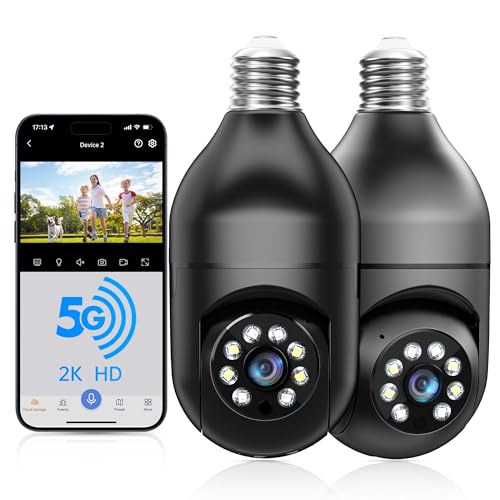
WESECUU 2K Dual-Band Light Bulb Camera
Screwing directly into standard E27 light sockets, this outdoor PTZ camera delivers 2K surveillance with dual-band Wi-Fi for steady streaming. It provides an accessible security upgrade for homeowners wanting pan-and-tilt monitoring without running dedicated electrical lines.
Pros
- Simple installation into standard E27 sockets
- Dual-band Wi-Fi enhances connection stability
- Full-range pan and tilt minimizes blind spots
- Color night vision reaches up to 33 feet
- Supports local recording via microSD cards
Cons
- Video clarity degrades during extreme weather conditions
- Cloud storage requires an ongoing paid subscription
- Requires constant power supply from the light fixture
Chpuss 2K Dual-Band Light Bulb Camera
Screwing directly into standard light sockets, this outdoor camera delivers 2K video and full-color night vision without requiring hardwired electrical installation. Dual-band Wi-Fi and 360-degree motion tracking make it a practical option for monitoring porches and entryways.
Pros
- Works on both 2.4GHz and 5GHz Wi-Fi networks
- Screw-in design avoids complex electrical wiring
- Clear 2K resolution with color night vision
- Extensive coverage with motorized pan and tilt
- Built-in spotlight and audible siren alert
Cons
- MicroSD card is not included
- Cloud video storage requires a paid subscription
- Requires constant power to the light fixture
Evaluating Socket-Based Surveillance: Brands, Hardware Architecture, and Practical Performance
Answering who produces the premier socket-based security hardware requires looking beyond basic product titles and examining how different manufacturers approach wireless stability, mechanical articulation, and software maintenance. While mass-market smart home developers focus on cohesive mobile applications and broad platform interoperability, specialized direct-to-consumer manufacturers prioritize motorized pan-tilt coverage and dual-band networking hardware. Choosing the right manufacturer involves identifying whether your installation requires automated physical panning or whether a stationary wide-angle lens with sophisticated software algorithms better protects your entryway.
The Manufacturing Landscape: Mainstream Ecosystems Versus Independent Hardware
In the current smart security marketplace, brands producing light socket cameras fall into two distinct philosophical categories. Mainstream brands such as WYZE develop proprietary firmware, maintain direct cloud infrastructures, and offer unified mobile applications that control entire smart home ecosystems. These companies invest heavily in application refinement, regular security patching, and standardized integration with platforms like Google Home and Amazon Alexa. Opting for an established developer generally guarantees a smoother mobile user experience and ongoing software support over multi-year device lifecycles.
Independent manufacturers such as WESECUU, Poleeye, and Chpuss follow an alternative hardware-centric approach by delivering feature-dense units at accessible price points. These brands frequently utilize third-party mobile frameworks such as the EseeCloud application to manage device streaming and motion configuration. While third-party software interfaces may occasionally feel less polished than proprietary ecosystems, these manufacturers often lead in hardware versatility by packing motorized pan-tilt mechanisms and dual-band wireless chips into standard bulb housings. Homeowners prioritizing extensive physical articulation often find that these independent hardware specialists deliver substantial mechanical capability.
Form Factor Mechanics: Motorized Pan-Tilt Gimbals Versus Fixed Wide-Angle Optics
Mechanical engineering represents a primary operational dividing line between competing light socket cameras. Models from WESECUU, Poleeye, and Chpuss incorporate internal servo motors that deliver 355-degree horizontal panning and 90-degree vertical tilting directly from a smartphone screen. This mechanical freedom allows a single light fixture to sweep across wide driveways, porches, and perimeter walkways without requiring multiple static cameras. Automated motion tracking in these motorized units continuously follows moving subjects, keeping activity centered within the optical frame as visitors approach an entryway.
WYZE takes a fundamentally distinct architectural approach by utilizing a stationary optical assembly paired with an ultra-wide 160-degree viewing angle. Users manually aim the camera during initial installation across a 360-degree pan and 90-degree tilt axis, after which the hardware remains physically fixed in place. Eliminating internal drive motors removes mechanical points of failure, gear stripping, and motor noise that can alert intruders during tracking routines. A wide stationary field of view also ensures that the camera never gets caught pointing in the wrong direction when a critical event unfolds elsewhere within the frame.
Socket Dimensions, Sconce Depths, and Physical Clearances
Physical installation compatibility varies significantly across different brands, making exterior fixture measurements essential before selecting a model. Standard residential sockets in North America adhere to the E26 medium base standard, which shares threading compatibility with international E27 fittings. However, the physical body of a light bulb camera extends considerably farther than a standard incandescent or LED bulb. Motorized models like those from Chpuss and WESECUU feature cylindrical bodies that require ample radial clearance around the socket to rotate freely without colliding with decorative sconce metalwork or glass panels.
Fixture depth creates another common installation obstacle that specific manufacturers solve through mechanical adjustment. The WYZE Bulb Cam features a telescoping rod that extends the camera body up to 1.2 inches downward, allowing the lens to clear deep exterior lantern sconces that measure under 7.8 inches deep with bottom openings wider than 2.5 inches. Furthermore, these cameras require standard 110V to 240V AC power circuits that provide continuous line voltage. Connecting any light bulb camera to a light circuit governed by an inline dimmer switch can starve the internal voltage regulators, causing continuous boot loops or premature component failure.
Wireless Transmission Architecture: 2.4 GHz Versus 5 GHz Dual-Band Performance
Reliable video streaming from exterior fixtures depends heavily on how a camera negotiates radio frequency barriers. Traditional smart home devices operate exclusively on the 2.4 GHz wireless band, which provides superior physical penetration through exterior brick, wood siding, and stucco walls. However, the 2.4 GHz frequency spectrum in dense residential neighborhoods frequently suffers from severe signal congestion caused by neighboring routers, Bluetooth devices, and household appliances. When RF congestion spikes, single-band cameras can suffer from high video latency, dropped frames, and delayed motion alert transmissions.
Addressing this wireless vulnerability, brands including WESECUU, Poleeye, and Chpuss integrate dual-band Wi-Fi radios supporting both 2.4 GHz and 5 GHz networks. Operating on the 5 GHz band unlocks significantly higher data throughput and reduced channel interference, which proves advantageous when an exterior light fixture sits in close proximity to an interior mesh router node. Conversely, WYZE limits its hardware to 2.4 GHz networks, relying instead on Bluetooth pairing routines to simplify initial network handshakes. Property owners must evaluate their exterior received signal strength indicator levels to determine whether dual-band flexibility is necessary for stable connectivity.
Sensor Clarity, Dynamic Range, and Nighttime Illumination Outputs
Image sensor specifications across modern socket cameras consistently deliver 2K resolution, but real-world optical performance depends on light management and illumination hardware. High-contrast exterior lighting environments, such as bright sunlight striking concrete driveways while deep shadows shroud a porch, demand robust dynamic range processing. WYZE integrates wide dynamic range capabilities into its 2K sensor, evening out overexposed hot spots and underexposed shadows to preserve facial details. Without adequate dynamic range processing, license plates and visitor faces can easily wash out into indistinct white silhouettes.
Nighttime illumination strategies also diverge substantially between manufacturers. WESECUU incorporates an ultra-bright 1000-lumen dimmable security spotlight directly into its bulb assembly, effectively replacing standard porch illumination while powering full-color night vision. Other models, including options from Poleeye and Chpuss, utilize lower-output auxiliary LEDs alongside traditional 850nm infrared illuminators. While lower-lumen spotlights still enable color night recording up to approximately 33 feet, a 1000-lumen integrated light acts as an active physical deterrent. High-output lighting dramatically improves contrast, ensuring recorded night footage provides identifiable details rather than murky monochrome shapes.
Storage Topologies: MicroSD Endurance and Subscription Paywall Tradeoffs
Storage architecture is a major consideration when deciding which company manufactures the most suitable camera for your budget. Models produced by Chpuss and WYZE support onboard microSD cards up to 256GB in capacity, whereas WESECUU and Poleeye generally cap expandable local storage at 128GB. Continuous round-the-clock recording places substantial write stress on memory cards, necessitating specialized high-endurance flash cards to avoid card corruption. Operating a camera with local storage allows homeowners to scrub through complete 24/7 video timelines directly within the mobile app without incurring recurring monthly cloud service fees.
Cloud storage subscriptions introduce ongoing operational costs that alter the total value of each brand. WYZE offers optional Cam Plus subscriptions starting at modest monthly rates to unlock 14-day cloud video history and advanced artificial intelligence detection filters. Cameras utilizing the EseeCloud platform, such as those from WESECUU and Chpuss, also provide optional proprietary cloud backup plans for off-site clip preservation. While cloud archives safeguard critical evidence if an intruder destroys the light fixture, many users prefer pairing socket cameras with dedicated pan-tilt-zoom security cameras for driveways to ensure comprehensive multi-angle property coverage without compounding subscription costs.
Smart Home Ecosystem Integration and Voice Platform Handshakes
Interoperability with broader smart home ecosystems separates mainstream developers from budget-oriented hardware manufacturers. WYZE provides deep integration with Amazon Alexa and Google Assistant, allowing homeowners to call up live video streams on smart displays like the Echo Show or Nest Hub using voice commands. In addition, the WYZE platform supports custom automation rules and IFTTT triggers, enabling the bulb camera to activate auxiliary lights or sound remote chimes throughout the home. This level of smart ecosystem harmony creates a responsive security network that reacts dynamically to perimeter events.
Independent manufacturers like WESECUU, Poleeye, and Chpuss list compatibility with Amazon Alexa for basic live feed display, but often lack deeper Google Home or third-party automation hooks. Furthermore, consumer light bulb cameras across all brands almost universally lack support for open local streaming protocols like RTSP or ONVIF Profile S and T. Homeowners seeking centralized storage across a network video recorder typically require dedicated hardwired PoE security systems rather than consumer socket-mounted Wi-Fi units. Understanding these protocol limitations prevents frustrating integration bottlenecks when building out an advanced residential surveillance network.
Motion Analytics, Auto-Tracking, and Nuisance Notification Mitigation
Nuisance motion alerts represent one of the most frustrating aspects of exterior residential surveillance. Because light socket cameras are mounted near entryway illumination, they frequently attract nocturnal insects, swaying tree branches, and passing vehicular headlights. Basic pixel-luminance motion detection triggers notifications whenever lighting values shift across the optical sensor, quickly resulting in severe notification fatigue. To combat this issue, manufacturers implement software-based human body detection algorithms that analyze geometric shapes before dispatching push alerts to the user’s mobile device.
Brands implement motion analytics with varying degrees of precision and cost. Poleeye, WESECUU, and Chpuss build basic on-device AI human shape filtering directly into their firmware without requiring an active monthly subscription. Conversely, WYZE provides basic sound and motion alerts for free, but gates sophisticated AI categorization for people, pets, vehicles, and packages behind its Cam Plus cloud subscription tier. Users relying on motorized cameras must also account for tracking latency, as fast-moving visitors can occasionally outpace the pan-tilt servo speed, causing tracking routines to momentarily lose the target.
Electrical Safety, Wall Switch Management, and Long-Term Reliability
Operating a security camera from a standard residential light socket introduces distinct electrical and physical considerations that standard hardwired cameras avoid. The primary operational vulnerability involves the controlling interior wall switch, which supplies continuous AC power to the exterior fixture. If a family member or guest accidentally flips the switch off, the camera immediately loses power, terminating video recording, motion sensing, and network connectivity. Homeowners frequently resolve this issue by installing clear plastic switch guard covers over interior wall toggles, ensuring continuous electrical delivery to the socket.
Heat dissipation represents another critical reliability factor that affects socket-mounted camera hardware over extended deployments. Exterior light sconces, particularly enclosed carriage fixtures or lanterns with glass panes, trap substantial ambient heat generated by internal transformers and camera processors. Operating high-output spotlights in unventilated exterior fixtures during hot summer months can elevate internal temperatures, potentially shortening the operational lifespan of the CMOS sensor and wireless chipset. Verifying that an exterior sconce provides adequate ambient airflow helps maintain safe operating temperatures and ensures consistent long-term video capture.
Legal Compliance and Privacy Boundaries for Street-Facing Fixtures
Installing exterior surveillance cameras in front-facing light fixtures requires careful attention to residential privacy expectations and local wiretap statutes. Under United States privacy law, individuals generally possess no reasonable expectation of privacy in open outdoor areas visible from public streets, sidewalks, or shared driveways. However, aiming a motorized pan-tilt camera directly toward a neighbor’s side windows, fenced backyard, or private living quarters can generate contentious neighbor disputes and potential civil privacy claims. Utilizing software privacy masking or manually locking down pan angles ensures surveillance coverage remains strictly confined to your own property curtilage.
Audio surveillance introduces an entirely separate layer of statutory compliance that homeowners must navigate cautiously. Under the federal wiretap statute (18 U.S.C. Section 2511) and state-level eavesdropping laws, recording oral communications without proper consent can carry severe legal penalties. In one-party consent states, capturing conversations where at least one participant consents is generally permissible, but twelve states enforce strict all-party consent rules. If your socket camera captures clear neighborhood pedestrian conversations along a public sidewalk, disabling the microphone in the mobile app settings provides an effective safeguard against inadvertent statutory violations.
Determining the Right Socket Camera Brand for Your Security Setup
Selecting the premier socket camera manufacturer ultimately comes down to matching specific hardware characteristics to your property layout and smart home preferences. Property owners seeking dependable software stability, seamless Google Home or Alexa streaming, and a fixed wide-angle view without moving parts find that WYZE offers a remarkably well-engineered package. Its telescoping base and compact profile ensure compatibility with deep decorative lanterns where larger motorized bodies cannot physically fit. For users who prioritize a polished app experience and continuous local microSD playback, WYZE represents a premier option in the socket space.
Conversely, homeowners requiring active physical coverage across expansive porches, wrap-around decks, or wide driveways benefit substantially from the motorized hardware built by WESECUU, Poleeye, or Chpuss. The inclusion of dual-band 5 GHz Wi-Fi connectivity and high-output spotlights, such as the 1000-lumen illumination on select WESECUU models, makes these independent brands exceptionally powerful for standalone perimeter defense. Assessing your exterior sconce dimensions, your home network frequency structure, and whether you require automated pan-tilt tracking will guide you to the ideal manufacturer for your residential security needs.
About the author
John Carlsen is a home security and smart home specialist with more than a decade of experience researching and testing security technology. His expertise covers DIY security systems, security cameras, smart devices, pricing, contracts, and connected-home technology. He combines hands-on product testing with detailed research to explain strengths, limitations, ownership costs, and real-world value in straightforward terms for homeowners and renters.