
What Are the Best Wireless Security Cameras for Home: A Practical Guide for 2026
Review What Are The Best Wireless Security Cameras For Home for November 2026 with key facts on solar power, local storage, and motion detection.
 By Tyler Lacoma
Updated November 5, 2026


Homeowners frequently struggle with erratic motion alerts, dead rechargeable batteries in freezing weather, and spotty Wi-Fi coverage across exterior perimeters. When property owners evaluate what are the best wireless security cameras for home, the goal centers on achieving dependable property awareness without pulling high-voltage wiring through exterior walls. Modern wire-free systems rely on low-power sensor architectures, high-efficiency video compression, and integrated solar harvesting to maintain perimeter surveillance. Selecting an effective setup requires looking closely at image sensor resolutions, physical ingress protection ratings, and local video archiving capabilities.
Balancing battery preservation against detection speed represents one of the most critical decisions for residential monitoring. Many households prioritize battery security cameras with local storage to avoid recurring monthly cloud subscription fees while protecting user privacy. Hardware with advanced passive infrared detection and onboard AI computer vision filters out environmental distractions like windblown tree branches or passing pets. As network connectivity evolves, understanding how dual-band wireless frequencies and centralized hub storage safeguard video evidence ensures your perimeter stays secure year-round.
| Award | Product | SSG Score About SSG ScoreThe SSG Score is our own rating from 0 to 10, based on performance, design and build, ease of use, and value. It reflects independent research and is never influenced by manufacturers, retailers, or affiliate commissions. Learn more › | |
|---|---|---|---|
| Best Overall |
GALAYOU R6 2K Solar Security Camera
|
9.2/10 | Buy |
| Best Premium |
 Gianteye 2K Solar Wireless Security Cameras |
9.2/10 | Buy |
 aosu D1 Classic 4-Cam Wireless Outdoor Security |
9.2/10 | Buy | |
| Best Value |
 GMK 4-Pack Wireless Outdoor Security Camera |
8.6/10 | Buy |
| Best Budget |
 Vimtag 2.5K Indoor Outdoor Security Camera 2-Pack |
8.4/10 | Buy |
 VISION WELL 2K Wireless Security Camera |
8.3/10 | Buy | |
 Fazoxo 2K Wireless Outdoor Security Camera |
8.0/10 | Buy |
GALAYOU R6 2K Solar Security Camera
Combining continuous solar charging with sharp 2K resolution, the GALAYOU R6 provides wire-free surveillance for yards, garages, and driveways. Its motorized pan-and-tilt tracking and integrated siren deliver active property deterrence without hardwired electrical lines.
Pros
- Wire-free setup powered by continuous solar charging
- Sharp 2K resolution with color night vision
- Automated motion tracking across a wide coverage area
- Built-in siren and two-way audio for deterrence
- IP65 weather resistance handles outdoor conditions
Cons
- Limited to 2.4 GHz Wi-Fi networks only
- MicroSD card is not included in the box
- Continuous or extended cloud recording requires paid plan
Gianteye 2K Solar Wireless Security Cameras
The Gianteye 2K Solar Wireless Security Camera 4-Pack delivers comprehensive outdoor surveillance with motorized 360-degree pan-tilt coverage, dual-band Wi-Fi flexibility, and continuous solar charging. It is an ideal multi-camera system for homeowners seeking expansive perimeter monitoring without running cables or paying forced monthly subscription fees.
Pros
- Four-camera package provides multi-angle coverage across driveways, yards, and entryways with motorized 360-degree pan-tilt mobility.
- Dual-band 2.4GHz and 5GHz Wi-Fi connectivity provides reliable connection options depending on router placement and wall interference.
- Detachable solar panels provide continuous trickle-charging, eliminating the chore of dismounting cameras for manual battery recharging.
- Subscription-free local video storage via onboard MicroSD slots allows homeowners to retain private event footage without recurring fees.
- IP65 weather-resistant rating ensures dependable performance through harsh seasonal rain, snow, and heat.
Cons
- MicroSD storage cards are not included in the package and must be purchased separately for each camera.
- Like most battery and solar-powered surveillance units, it operates on motion-activated recording and does not support continuous 24/7 video capture.
- Smart home voice integration is limited to Amazon Alexa, lacking native support for Apple HomeKit or Google Home.
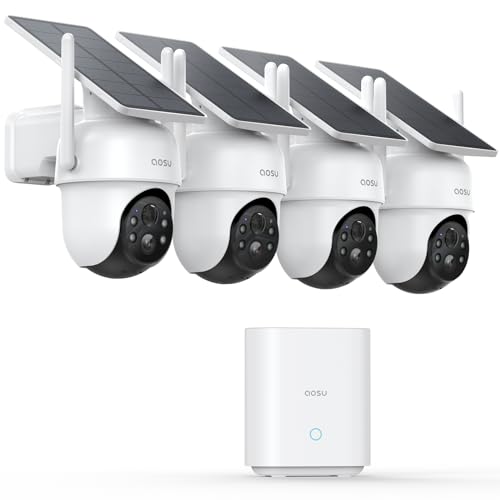
aosu D1 Classic 4-Cam Wireless Outdoor Security
The aosu D1 Classic 4-Cam Kit delivers complete perimeter visual defense using solar-powered 2K pan-and-tilt cameras paired with a dedicated aosuBase hub for subscription-free encrypted local storage. It is an ideal zero-monthly-fee security solution for suburban homeowners looking to monitor entryways, yards, and driveways without wiring hassles.
Pros
- Subscription-free residential security with 32GB of encrypted local loop recording housed safely inside the aosuBase hub.
- Continuous solar charging requires only three hours of sunlight daily, minimizing the need for manual battery recharging.
- 360-degree pan-tilt coverage with automatic motion tracking ensures subjects are actively followed across the camera view.
- Simultaneous four-camera split-screen live viewing and cross-camera event sequencing simplify outdoor perimeter monitoring.
Cons
- Requires sufficient daily sunlight exposure (at least three hours), which may limit optimal placement under deep soffits or shaded tree canopies.
- Lacks cellular backup and relies entirely on local wireless connectivity, meaning remote push alerts depend on home internet uptime.
- Permanent exterior installation requires drilling mounting holes, making it less adaptable for strict drill-free rental balconies.
GMK 4-Pack Wireless Outdoor Security Camera
The GMK 4-Pack 2K Wireless Security Camera System provides multi-point perimeter surveillance with PIR motion sensing, integrated siren deterrence, and color night vision without mandatory monthly fees. It offers an adaptable security setup for suburban homeowners and apartment renters seeking flexible, wire-free coverage on standard 2.4 GHz Wi-Fi networks.
Pros
- Four-camera multi-point bundle covers front porches, driveways, backyards, and interior entryways out of the box
- Active deterrent hardware combines flashing white spotlights and an audible siren to warn off intruders
- Supports zero-subscription local video storage via an optional memory card slot alongside cloud backup options
- Flexible mounting design includes standard exterior wall mounts and flat freestanding bases for rental apartments
- Hybrid power capability accommodates cord-free battery operation or continuous DC plug-in power
Cons
- Restricted to 2.4 GHz Wi-Fi networks with no support for 5 GHz router bands
- Manufacturer does not publish a standardized decibel (dBA) sound rating for the built-in siren
- Requires manual unmounting for periodic battery recharging if not using continuous plug-in power
Vimtag 2.5K Indoor Outdoor Security Camera 2-Pack
The Vimtag 2.5K Indoor/Outdoor Security Camera 2-Pack offers 4MP video clarity, dual-band Wi-Fi flexibility, and color night vision backed by a built-in spotlight and siren. It provides a versatile, cost-effective monitoring solution for homeowners and renters seeking reliable indoor or perimeter coverage with local microSD storage support.
Pros
- Dual-band 2.4 GHz and 5 GHz Wi-Fi compatibility provides greater connection flexibility than standard 2.4 GHz-only cameras
- Solid 2.5K video resolution paired with spotlight illumination ensures clear daytime and nighttime video capture
- IP66-rated enclosure allows seamless transition between indoor nursery monitoring and exposed outdoor surveillance
- Local microSD slot enables subscription-free video storage without forcing an ongoing monthly cloud fee
- Convenient plug-and-play setup supports freestanding tabletop placement or permanent wall mounting with included screws
Cons
- MicroSD card is not included in the box and must be purchased separately for local recording
- Continuous AC power connection is required, limiting placement to areas near electrical outlets
- Advanced cloud video recording and extended alert history require an optional paid Vimtag Cloud subscription
VISION WELL 2K Wireless Security Camera
The VISION WELL 2K Wireless Security Camera delivers flexible, wire-free surveillance for indoor or outdoor spaces with clear 2K resolution, color night vision, and on-device AI motion filtering. It is a dependable, budget-conscious choice for homeowners and renters seeking reliable entryway deterrence without mandatory monthly fees.
Pros
- Completely wire-free battery installation with included bracket and screws, making it ideal for renters and suburban homeowners.
- Sharp 2K video clarity supported by full-color night vision and a 33-foot illumination range.
- PIR motion detection paired with smart AI filtering for people, vehicles, pets, and packages.
- Local recording support on microSD cards up to 128GB to avoid mandatory monthly subscriptions.
- IP65 weather-resistant rating suitable for exterior perimeter or sheltered entryway mounting.
Cons
- Only connects to 2.4 GHz Wi-Fi networks and does not support 5 GHz frequencies.
- Designed for motion-activated event clips rather than continuous 24/7 video recording.
- MicroSD storage card is not included in the box and must be purchased separately.
Fazoxo 2K Wireless Outdoor Security Camera
Designed for wire-free outdoor surveillance, this 2K camera combines solar charging with spotlight-assisted color night vision. It serves as a practical monitoring option for homeowners seeking flexible local storage and human motion detection.
Pros
- Solar panel provides continuous supplemental power
- Color night vision via built-in spotlight
- Human motion filtering requires no subscription
- Supports local microSD cards up to 128GB
Cons
- Operates exclusively on 2.4GHz Wi-Fi networks
- MicroSD card is not included in the package
- Extended cloud storage requires a paid subscription
Evaluating Wire-Free Home Surveillance: Architecture, Performance, and Practical Trade-Offs
Determining an optimal wireless camera system for residential security requires examining how hardware components interact under variable outdoor conditions. A wireless security camera must balance energy conservation, reliable motion sensing, rapid video transmission, and clear image capture without permanent physical cables. Homeowners often face unexpected challenges when cameras fail to wake up quickly enough to catch fast-moving intruders or when batteries drain prematurely. Understanding the engineering behind wireless power delivery, edge artificial intelligence, and storage architecture enables homeowners to select a surveillance setup that delivers dependable property protection.
Power Architectures: Battery Endurance and Solar Harvesting Cycles
Wireless security cameras operate on finite battery reserves, which dictates their operational behavior and sleep-to-wake recording cycles. Unlike hardwired surveillance cameras that record continuously, wire-free models remain in an ultra-low-power standby mode until an external event wakes the primary processor. High-capacity lithium-ion battery cells allow cameras to function for several months under standard trigger frequencies of ten to twenty events daily. However, frequent live-view streaming, weak Wi-Fi signal retries, and high-traffic pathways can deplete an internal cell in a fraction of that time.
Integrating dedicated solar panels significantly alters the maintenance equation by delivering continuous supplemental trickle charging during daylight hours. High-efficiency monocrystalline solar panels with adjustable brackets capture ambient sunlight, often needing only two to three hours of direct exposure daily to maintain operation. During extended overcast weather or snow accumulation, the internal rechargeable battery acts as a dependable buffer to prevent surveillance dropouts. Selecting hardware equipped with weather-sealed charging ports ensures that supplemental solar lines remain protected from moisture ingress and corrosion over years of exposure.
Optical Resolution, Sensor Formats, and DORI Identification Standards
Image resolution in residential surveillance has expanded beyond standard 1080p, with 2K and 2.5K quad-high-definition CMOS sensors offering substantially higher pixel density. Higher resolution becomes critical when homeowners need to magnify specific regions of interest, such as facial features, courier delivery labels, or vehicle license plates. Pixel count alone does not determine visual clarity; optical sensor size and high dynamic range processing prevent harsh backlighting from washing out shadowed entryways. Cameras equipped with a 3.3mm focal length lens provide a balanced field of view that minimizes fisheye distortion while maintaining expansive horizontal coverage.
Evaluating optical effectiveness requires referencing the international IEC EN 62676-4 standard, which defines Detection, Observation, Recognition, and Identification parameters. Detection requires approximately 25 pixels per meter to confirm human presence, while formal Recognition demands 125 pixels per meter to distinguish familiar individuals. Forensic Identification, the threshold necessary to positively verify an unknown subject, requires at least 250 pixels per meter across the target plane. When selecting a 2K resolution wire-free camera, recognizing that digital zoom degrades pixel density helps property owners establish realistic expectations for target distances along driveways.
Night Vision Technologies: Infrared Illumination Versus Active Spotlights
Navigating nighttime surveillance requires understanding the differences between non-visible infrared illumination and active white-light spotlight projection. Traditional infrared systems utilize 850nm LED arrays that emit a subtle red glow, casting an invisible infrared beam to produce high-contrast, black-and-white video footage. Infrared night vision excels at stealth monitoring up to thirty-three feet, illuminating outdoor spaces without drawing attention to the camera housing. The primary limitation of infrared illumination lies in its inability to record color data, which can obscure critical details like clothing hue or vehicle paint finish.
Modern residential installations increasingly favor integrated white-light spotlights that activate automatically upon detecting motion to deliver full-color video in pitch darkness. Many property owners review battery cameras with color night vision to verify visitor clothing colors and vehicle details that traditional monochrome footage routinely misses. Beyond enhancing optical clarity, sudden illumination acts as an immediate psychological deterrent against opportunistic trespassing on porches and driveways. Combining high-output LED spotlights with high-sensitivity CMOS sensors allows wireless cameras to generate crisp nighttime documentation while discouraging unwanted activity.
Motion Detection Mechanics: Passive Infrared Sensors Versus Edge AI Analysis
Accurate motion detection separates dependable security cameras from systems that generate constant nuisance notifications and exhaust their batteries prematurely. Basic pixel-based motion detection analyzes frame-by-frame changes in light levels, which frequently misinterprets shifting tree shadows, headlight reflections, or rain droplets as genuine threats. To eliminate these false alarms, wire-free cameras incorporate hardware passive infrared (PIR) sensors that detect subtle shifts in thermal radiation across split optical zones. Because PIR sensors only trigger when warm objects cross their thermal detection fields, the camera remains asleep during benign environmental changes.
Advancements in edge artificial intelligence further refine detection by executing computer vision algorithms directly on the camera hardware or through a paired local hub. Once the PIR sensor awakens the system, onboard AI models classify whether the detected shape matches a person, animal, vehicle, or package. Filtering notifications at the hardware level prevents notification fatigue and ensures homeowners receive alerts only when actionable events occur within designated zones. Pairing AI human detection with custom privacy sleep schedules also lets occupants schedule low-power hibernation states when family members are active in the yard.
Pan-Tilt Mechanics and Dynamic Perimeter Coverage
Fixed-lens cameras inevitably introduce optical blind spots along wide residential boundaries, requiring multiple units to cover expansive yards or wrap-around porches. Motorized pan-and-tilt security cameras address this coverage limitation by offering 344 degrees or more of horizontal rotation paired with vertical articulation. Integrated stepper motors allow homeowners to scan large outdoor perimeters remotely through a smartphone application, eliminating unmonitored corners around garages and detached sheds. This mechanical versatility transforms a single mounted device into a wide-area surveillance hub capable of inspecting multiple entry choke points.
Automated motion tracking takes motorized hardware a step further by actively following identified human subjects as they navigate across the monitored perimeter. Homeowners seeking comprehensive coverage often deploy pan-tilt-zoom driveway cameras to trace visitor movements from the curbside approach directly to the garage threshold. The camera software identifies motion vectors, commands the internal motors to rotate smoothly, and keeps the subject centered within the recorded video frame. Once the moving target exits the operational field of view, the camera automatically returns to its designated home monitoring position.
Wireless Network Protocols: 2.4 GHz Range Versus 5 GHz Throughput
Wireless camera performance depends heavily on the underlying radio frequency protocol connecting the optical unit to the local home network router. Most outdoor battery cameras rely on the 2.4 GHz Wi-Fi spectrum because lower frequencies travel greater distances and penetrate dense exterior building materials like brick, concrete, and stucco. A robust 2.4 GHz radio link provides the structural penetration needed to reach exterior fence lines, detached garages, and front gates where Wi-Fi signals weaken. However, the 2.4 GHz band suffers from high spectrum congestion caused by neighboring routers and household electronics, which can introduce live-view latency.
Dual-band wireless cameras support both 2.4 GHz and 5 GHz networks, granting users greater deployment flexibility based on camera distance from the primary router. Operating on the 5 GHz band delivers higher data throughput and reduced channel interference, which results in faster video streaming speeds and lower buffering latency. For cameras mounted close to interior access points, 5 GHz connections provide exceptionally smooth video playback and rapid alert delivery. Measuring the received signal strength indicator (RSSI) at the physical mounting location ensures the camera maintains a stable signal, with values stronger than -65 dBm recommended for reliable streaming.
Storage Topologies: Local MicroSD Cards, Base Stations, and Cloud Ecosystems
Video storage architecture directly impacts ongoing ownership costs, recording reliability during network outages, and personal data privacy. Local on-device storage utilizing high-endurance microSD cards allows cameras to write motion-triggered clips directly to flash memory without requiring an active internet connection. If broadband service drops, the camera continues recording events locally, preserving critical evidence that purely cloud-dependent systems would lose. High-endurance microSD cards engineered for surveillance applications withstand repetitive overwrite cycles, offering up to 128GB of local capacity for extensive historical video playback.
Centralized local base stations offer an intermediate architecture by storing encrypted footage inside the home rather than on exposed exterior camera bodies. Storing footage on an interior hub protects recorded data from loss if an outdoor camera is physically damaged, stolen, or tampered with by an intruder. In contrast, cloud storage plans provide convenient off-site archiving and remote access backups, but they frequently require recurring monthly subscriptions to access recorded video history. Evaluating your tolerance for recurring subscription fees versus local hardware management helps determine whether an onboard memory card, centralized hub, or hybrid cloud architecture best suits your household.
Environmental Durability, Weatherproofing, and Thermal Operating Boundaries
Exterior security cameras face harsh environmental conditions, requiring durable enclosures that prevent dust and moisture from compromising delicate internal circuitry. Ingress Protection (IP) ratings indicate the level of physical sealing, with IP65-rated enclosures providing dust tightness and resistance to water jets from driving rain. Upgraded IP66 housings deliver enhanced protection against powerful water spray, ensuring reliable performance during severe thunderstorms and coastal wind events. Sealed rubber gaskets around memory card slots, reset buttons, and charging interfaces are essential for preserving weatherproofing integrity over multiple seasons of exposure.
Extreme ambient temperatures present unique physical challenges for wire-free cameras powered by internal rechargeable lithium-ion cells. In sub-freezing winter weather below 32 degrees Fahrenheit, internal battery chemistry slows down, causing temporary voltage drops and accelerated capacity depletion. Furthermore, modern battery management systems intentionally disable solar charging below freezing to prevent permanent dendritic lithium damage within the battery cell. In hot climates, direct southern solar exposure can push internal camera temperatures beyond safe operating thresholds, highlighting the importance of mounting cameras beneath protective roof eaves or soffits.
Legal Frameworks, Audio Surveillance, and Residential Privacy Expectations
Deploying outdoor surveillance cameras involves navigating complex legal frameworks that govern residential privacy rights and audio recording consent. In the United States, Fourth Amendment jurisprudence and state privacy torts establish that individuals hold no reasonable expectation of privacy in plain public view, such as driveways, front sidewalks, or street approaches. However, angling cameras directly into neighboring interior living spaces, second-story bedroom windows, or fenced backyard recreation zones can generate civil liability for invasion of privacy. Utilizing customizable software privacy masks allows homeowners to black out adjacent residential windows directly within the camera application, respecting neighboring boundaries while maintaining perimeter security.
Audio surveillance introduces distinct legal requirements governed by the federal wiretap statute under 18 U.S.C. Section 2511 as well as varied state eavesdropping statutes. While many states operate under one-party consent rules, several jurisdictions enforce strict all-party consent laws that prohibit recording oral conversations without the explicit knowledge of all participants. Because sensitive microphone arrays can capture private conversations occurring on public sidewalks or adjacent yards, enabling continuous audio recording can introduce compliance risks. Homeowners should verify state-level wiretap statutes, utilize two-way talk primarily for active visitor interaction, and disable ambient background audio recording if monitoring areas near shared property lines.
Installation Best Practices: Mounting Geometry, Signal Auditing, and Verification
Physical placement geometry directly determines the evidentiary value of captured surveillance footage and the reliability of passive infrared detection. Mounting cameras between eight and ten feet above the ground provides the ideal compromise between broad coverage, tamper resistance, and natural facial identification angles. Positioning a camera too high creates steep downward perspectives that capture only the tops of visitor hats rather than facial features compliant with DORI identification standards. Additionally, angling the lens slightly downward prevents the sensor from facing direct morning or late afternoon horizon sunlight, which can blind CMOS sensors and cause severe backlight silhouette effects.
Performing a pre-installation Wi-Fi signal audit at the intended mounting location prevents connection drops and sluggish live-view streaming after permanent installation. Homeowners should verify that wireless signal strength registers stronger than -65 dBm using a smartphone or network analyzer before drilling mounting holes. When securing mounting brackets into masonry, brick, or vinyl siding, using proper wall anchors and forming a downward drip loop on any external solar cabling prevents water from tracking into connection ports. Following installation, walking across the monitored perimeter while reviewing live event triggers allows users to calibrate PIR sensitivity, test spotlight illumination, and verify audio intercom clarity.
Achieving dependable home protection with wire-free security hardware requires balancing physical placement, optical performance, and ongoing storage preferences. While solar-assisted power delivery and high-capacity rechargeable batteries eliminate complex wiring, optimizing motion detection zones and Wi-Fi signal strength remains vital for sustained operational reliability. Evaluating local base station storage against cloud services ensures that your video recordings remain accessible, secure, and free from unexpected recurring fees. By aligning camera capabilities with the specific layout and environmental demands of your property, you can establish an effective, low-maintenance surveillance perimeter that keeps your household safe.
About the author
Tyler Lacoma is a smart home and home security technology expert with more than a decade of hands-on experience testing connected devices. His expertise includes security cameras, smart locks, home security systems, privacy features, smart-home compatibility, and emerging AI technology. He focuses on translating technical features into practical guidance that helps homeowners understand which security solutions truly fit their homes and everyday needs.