
What Is the Highest Resolution Security Camera Available: Practical Guide for 2026
Examine What Is The Highest Resolution Security Camera Available and how ultra-high pixel density balances optical clarity and storage demands in November 2026.
 By Rebecca Edwards
Updated November 20, 2026


Pixelated facial features and unreadable license plates often leave property owners questioning their perimeter coverage when reviewing critical security footage. When evaluating modern surveillance hardware, homeowners and business operators frequently ask what is the highest resolution security camera available for reliable day and night monitoring. While specialized enterprise facilities deploy multi-sensor panoramic enclosures that combine several sensors to reach 32 megapixels or higher, mainstream consumer systems generally peak at native 4K Ultra HD powered by an 8-megapixel optical sensor. Moving to higher pixel counts requires balancing raw detail against local network bandwidth and continuous storage capacity, especially when configuring hardwired multi-camera systems engineered for continuous monitoring.
High megapixel ratings do not automatically guarantee forensic clarity if an optical sensor struggles in low-light environments or relies on artificial digital upscaling. A truly effective security deployment pairs native sensor resolution with balanced high dynamic range, capable optical glass, and efficient video compression codecs. Whether you are considering compact indoor monitoring units, wire-free battery cameras, or solar-assisted models, understanding how pixel density functions in real-world environments prevents unnecessary storage bloat and notification fatigue. Exploring optical capabilities alongside electrical and storage requirements ensures your security setup delivers clear, actionable evidence when you need it most.
| Award | Product | SSG Score About SSG ScoreThe SSG Score is our own rating from 0 to 10, based on performance, design and build, ease of use, and value. It reflects independent research and is never influenced by manufacturers, retailers, or affiliate commissions. Learn more › | |
|---|---|---|---|
| Best Overall |
Gianteye 2K Solar Wireless Security Cameras
|
9.2/10 | Buy |
| Best Budget |
 Blink Mini 2K+ Plug-In Indoor Smart Security |
9.1/10 | Buy |
| Best Premium |
 ZEEPORTE 2K Solar Wireless Outdoor Security Camera |
9.1/10 | Buy |
 VISION WELL 2K Wireless Security Camera |
8.3/10 | Buy | |
| Best Value |
 LongPlus 4K Wireless Outdoor Camera |
8.1/10 | Buy |
 GNCC 2K Indoor Pan-Tilt Security Camera |
8.0/10 | Buy | |
 AlertSine 2K Wireless Outdoor Security Camera |
8.0/10 | Buy |
Gianteye 2K Solar Wireless Security Cameras
The Gianteye 2K Solar Wireless Security Camera 4-Pack delivers comprehensive outdoor surveillance with motorized 360-degree pan-tilt coverage, dual-band Wi-Fi flexibility, and continuous solar charging. It is an ideal multi-camera system for homeowners seeking expansive perimeter monitoring without running cables or paying forced monthly subscription fees.
Pros
- Four-camera package provides multi-angle coverage across driveways, yards, and entryways with motorized 360-degree pan-tilt mobility.
- Dual-band 2.4GHz and 5GHz Wi-Fi connectivity provides reliable connection options depending on router placement and wall interference.
- Detachable solar panels provide continuous trickle-charging, eliminating the chore of dismounting cameras for manual battery recharging.
- Subscription-free local video storage via onboard MicroSD slots allows homeowners to retain private event footage without recurring fees.
- IP65 weather-resistant rating ensures dependable performance through harsh seasonal rain, snow, and heat.
Cons
- MicroSD storage cards are not included in the package and must be purchased separately for each camera.
- Like most battery and solar-powered surveillance units, it operates on motion-activated recording and does not support continuous 24/7 video capture.
- Smart home voice integration is limited to Amazon Alexa, lacking native support for Apple HomeKit or Google Home.
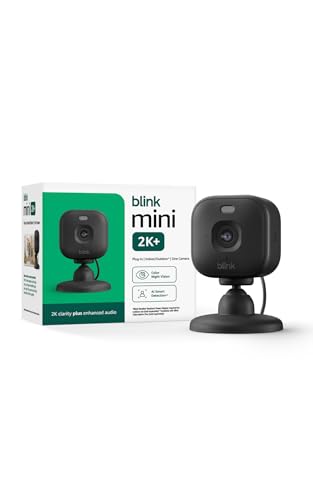
Blink Mini 2K+ Plug-In Indoor Smart Security
The Blink Mini 2K+ is a compact plug-in indoor security camera that delivers crisp 2K video resolution, clear two-way audio with noise cancellation, and seamless Alexa compatibility. It is an ideal surveillance solution for apartment renters, pet owners, and homeowners seeking straightforward, dependable indoor monitoring.
Pros
- Sharp 2K video resolution with up to 4x zoom provides clear daytime and low-light indoor coverage.
- Upgraded two-way audio with noise cancellation makes communicating with pets or visitors clear and intelligible.
- Ultra-compact and lightweight design fits easily onto shelves or mounts to walls with the included hardware.
- Doubles as an indoor plug-in chime when paired with an optional Blink Video Doorbell.
- Plug-in AC operation ensures continuous surveillance without battery recharge cycles.
Cons
- Advanced person and vehicle AI detection features require an optional paid Blink Subscription Plan.
- Requires proximity to an electrical wall outlet, limiting placement options away from AC power.
- Exterior placement requires purchasing a separate weather-resistant power adapter.
ZEEPORTE 2K Solar Wireless Outdoor Security Camera
The ZEEPORTE 2K Solar Wireless Outdoor Security Camera provides flexible 355-degree pan and 120-degree tilt coverage powered by an included 2W solar panel and rechargeable battery. It is an affordable, wire-free option for homeowners and renters seeking color night vision and local microSD storage without mandatory monthly fees.
Pros
- Includes a 2W solar panel and rechargeable battery for convenient, wire-free exterior installation
- Expansive viewing flexibility with motorized 355-degree pan and 120-degree tilt controls via the app
- Flexible storage options supporting up to 256GB microSD cards alongside free 7-day rolling 6-second cloud clips
- Integrated spotlight provides full-color night vision alongside a flashing LED and siren alarm for perimeter deterrence
- IP65 weather-resistant enclosure engineered to withstand typical outdoor rain and weather conditions
Cons
- Advanced AI detection for people, vehicles, pets, and packages requires a paid cloud subscription
- Does not support 24/7 continuous video recording or automated subject motion tracking
- Operates exclusively on 2.4 GHz Wi-Fi bands with no support for 5 GHz networks
VISION WELL 2K Wireless Security Camera
The VISION WELL 2K Wireless Security Camera delivers flexible, wire-free surveillance for indoor or outdoor spaces with clear 2K resolution, color night vision, and on-device AI motion filtering. It is a dependable, budget-conscious choice for homeowners and renters seeking reliable entryway deterrence without mandatory monthly fees.
Pros
- Completely wire-free battery installation with included bracket and screws, making it ideal for renters and suburban homeowners.
- Sharp 2K video clarity supported by full-color night vision and a 33-foot illumination range.
- PIR motion detection paired with smart AI filtering for people, vehicles, pets, and packages.
- Local recording support on microSD cards up to 128GB to avoid mandatory monthly subscriptions.
- IP65 weather-resistant rating suitable for exterior perimeter or sheltered entryway mounting.
Cons
- Only connects to 2.4 GHz Wi-Fi networks and does not support 5 GHz frequencies.
- Designed for motion-activated event clips rather than continuous 24/7 video recording.
- MicroSD storage card is not included in the box and must be purchased separately.
LongPlus 4K Wireless Outdoor Camera
Featuring 4K resolution and dual-band Wi-Fi connectivity, this compact LongPlus outdoor camera delivers crisp daytime detail alongside full-color night vision. Its versatile setup supports both continuous battery capture and PIR motion alerts, making it well suited for flexible perimeter surveillance.
Pros
- Crisp 4K video resolution with color night vision
- Dual-band Wi-Fi minimizes connection dropouts
- Supports high-capacity microSD cards up to 512GB
- Integrated spotlight and siren deter intruders
- Flexible continuous and event-based battery recording modes
Cons
- Continuous recording significantly increases battery drain
- MicroSD card must be purchased separately
- Cloud video history requires an ongoing paid subscription
GNCC 2K Indoor Pan-Tilt Security Camera
The GNCC 2K Indoor Security Camera delivers motorized 340-degree pan and 80-degree tilt coverage with flexible dual-band Wi-Fi and 10-meter night vision. It is a practical indoor choice for apartment renters, pet owners, and parents seeking continuous local recording without mandatory subscription fees.
Pros
- Dual-band 2.4GHz and 5GHz Wi-Fi connectivity reduces network congestion and improves indoor streaming reliability.
- Motorized 340-degree pan and 80-degree tilt provide extensive room coverage with automated motion tracking.
- Supports continuous 24/7 local recording on microSD cards up to 128GB without requiring a monthly subscription.
- Quick pairing via Bluetooth streamlines the initial connection process through the Osaio mobile app.
Cons
- Accessing recorded video playback requires either purchasing a separate microSD card or paying for a cloud storage subscription.
- Designed strictly for indoor environments, lacking weatherproofing or water-ingress resistance for exterior use.
- Requires a continuous wired power source and does not feature an internal backup battery.
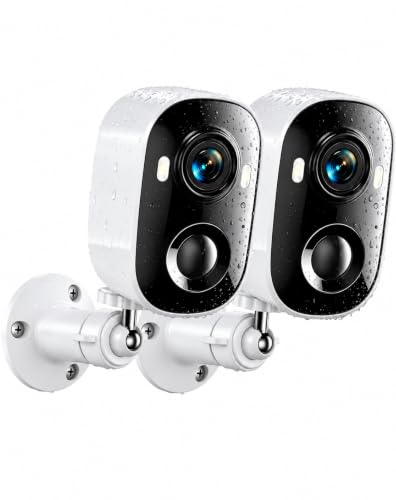
AlertSine 2K Wireless Outdoor Security Camera
The AlertSine wireless outdoor camera provides crisp 2K video clarity, full-color night vision, and responsive PIR-assisted AI human detection in an accessible wire-free format. It is a practical perimeter and entryway monitor for budget-conscious homeowners and renters comfortable with a cloud-first storage model.
Pros
- Sharp 2K video resolution delivers crisp daytime detail and full-color night viewing for entryways and perimeters.
- Completely wire-free design with a 4400mAh rechargeable battery allows flexible mounting without electrical wiring.
- PIR heat detection paired with AI human recognition helps reduce false alerts from windblown foliage and weather.
- Durable IP65 weatherproof construction provides reliable outdoor protection across changing seasons.
Cons
- Lacks an onboard microSD card slot, requiring an ongoing cloud subscription for video history once the 3-day trial expires.
- The 4400mAh battery capacity may require more frequent recharging in high-traffic mounting locations.
- Does not support continuous 24/7 video recording, capturing motion-triggered events only.
Navigating Security Camera Resolutions: From 1080p and 2K to 4K and Enterprise Sensors
Consumer residential security cameras reach their practical maximum at 4K Ultra High Definition, which delivers an image resolution of 3840 by 2160 pixels through an 8-megapixel sensor. Specialized enterprise and industrial surveillance installations can deploy panoramic multi-sensor enclosures that combine several image sensors to output 12-megapixel, 16-megapixel, or even 32-megapixel panoramic streams. For typical residential and small-business properties, standard hardware balances resolution against network throughput, low-light visibility, and continuous data archiving requirements. Understanding how pixel density translates into real-world clarity helps property owners select appropriate surveillance hardware without overspending on unusable bandwidth or storage overhead.
Consumer Versus Commercial Resolution Thresholds
In the residential market, resolution categories generally fall into 1080p Full HD, 2K Quad HD, and 4K Ultra HD. While entry-level and compact indoor cameras often feature 1080p or 2K sensors with 2304 by 1296 pixels, higher-tier outdoor models offer native 4K imaging with 8 megapixels of optical detail. Commercial systems occasionally employ ultra-high-resolution sensors exceeding 12 megapixels for wide-area coverage in sports arenas, municipal squares, and commercial airport terminals. However, deploying enterprise-grade sensors in a home setting introduces significant diminishing returns due to physical lens limitations and processing overhead.
The primary advantage of moving from 2K to 4K resolution is the ability to utilize digital zoom without immediately degrading the image into blurry pixel blocks. A 4K camera captures roughly four times the pixel count of a standard 1080p feed, providing substantially more detail for cropping into critical areas. This expanded canvas allows security cameras to monitor wide areas such as multi-car driveways or large backyards while preserving critical features. Even so, property owners must differentiate between native optical sensor resolution and software-interpolated upscaling, which artificially expands pixel grids without capturing genuine forensic information.
Sensor Dimensions and the Megapixel Trade-Off
Megapixel counts represent only one element of overall optical clarity, with physical sensor dimensions playing an equally vital role. Most consumer security cameras use CMOS image sensors sized between 1/3-inch and 1/1.8-inch formats. When a manufacturer places eight million pixels onto a tiny 1/3-inch sensor, each individual pixel, or photosite, must become significantly smaller to fit the microscopic silicon space. Smaller pixels capture less ambient light, which can degrade low-light imaging and generate noticeable digital noise during nighttime surveillance.
Larger optical sensors, such as 1/1.8-inch formats, offer greater surface area to gather incoming photons, resulting in cleaner video feeds and superior dynamic range. Cameras equipped with larger sensors maintain sharper clarity when transitioning between bright sunlight and deep shadows across an entryway. In contrast, low-quality sensors packed with excessive megapixels often produce noisy, muddy video when ambient illumination drops. Homeowners evaluating hardware should consider sensor dimensions alongside resolution ratings to ensure dependable footage throughout the day.
Applying the IEC DORI Standard to Forensic Video Quality
Evaluating the practical utility of security camera footage requires standard measurement criteria rather than subjective marketing claims. The international standard IEC EN 62676-4 defines surveillance effectiveness through four distinct DORI tiers: Detection, Observation, Recognition, and Identification. Detection requires 25 pixels per meter to determine if a human or vehicle is present within the monitored zone. Observation increases the density requirement to 63 pixels per meter, allowing an operator to see characteristic details like clothing color or vehicle classification.
Achieving reliable forensic identification demands significantly higher pixel densities that standard 1080p cameras can only deliver at close range. The Recognition tier specifies 125 pixels per meter to confirm identity with high probability, while positive Identification mandates at least 250 pixels per meter. A native 4K sensor maintains that critical 250 pixels per meter threshold over a considerably greater distance than a 2K or 1080p camera equipped with an identical focal length lens. Consequently, higher resolution cameras enable property owners to establish identification zones farther out along driveways and perimeter boundary lines.
Night Vision Performance and Optical Aperture Dynamics
Low-light monitoring represents the ultimate stress test for any high-resolution surveillance camera. Infrared night vision utilizes 850-nanometer LEDs to project invisible illumination that the camera sensor reads as monochrome imagery. Because tiny pixels on high-megapixel sensors struggle to absorb infrared wavelengths efficiently, cameras often rely on wider lens apertures such as f/1.6 or f/1.4 to maximize light transmission. When cameras combine large apertures with starlight-grade sensors, they can capture usable color video in low ambient lighting without switching immediately to infrared mode.
Integrated spotlights have become a popular enhancement for outdoor cameras, providing active white light to trigger full-color night recording upon motion detection. Property owners monitoring outdoor perimeters often consider color night vision security cameras to preserve critical forensic details such as jacket shades and vehicle paint colors. However, high-resolution cameras require clean lighting to avoid severe motion blur when subjects move across the frame after dark. Selecting cameras with balanced illumination prevents dark-zone pixel smear and ensures nighttime evidence remains legally and operationally actionable.
Compression Codecs, Bitrate Demands, and Network Bandwidth
Streaming high-resolution video places heavy demands on local wireless networks and home broadband connections. An uncompressed 4K video stream generates massive amounts of data that would quickly overwhelm standard Wi-Fi routers and internet upload pipes. Surveillance manufacturers utilize advanced video compression codecs, primarily H.264 (Advanced Video Coding) and H.265 (High Efficiency Video Coding), to reduce file sizes before transmission. H.265 compression reduces required bitrates by roughly forty to fifty percent compared to legacy H.264 while maintaining equivalent perceptual image quality.
Network stability depends directly on managing continuous and burst bitrates across all active cameras on a residential network. A single 4K camera operating at 15 to 20 frames per second using H.265 typically consumes 4 to 8 megabits per second of continuous network throughput. When multiple high-resolution cameras stream simultaneously, households with asymmetric broadband connections may experience upload saturation and dropped video frames. Dual-band wireless support allows cameras to connect across both 2.4 GHz and 5 GHz Wi-Fi frequencies, balancing wall penetration against high-speed data transmission needs.
Storage Architecture: Local MicroSD Cards Versus Cloud Vaults
Storing high-resolution surveillance footage requires substantial memory capacity and high write endurance. Because 4K streams generate large video files, continuous 24/7 recording quickly fills standard storage drives and memory cards. For wire-free outdoor cameras, property owners frequently turn to battery cameras with local storage to avoid recurring monthly fees and maintain operational privacy. When recording to local microSD media, utilizing high-endurance cards rated for continuous overwriting is essential to prevent flash memory corruption.
Cloud storage subscriptions offer the convenience of off-site backup, protecting footage even if a camera is stolen or damaged by an intruder. However, streaming 4K video continuously to remote cloud servers can exhaust monthly ISP data caps and introduce recurring service expenses. Many property owners adopt a hybrid approach by storing high-resolution continuous streams locally on an on-premise Network Video Recorder while uploading short, event-triggered clips to secure cloud servers. This dual-path architecture preserves forensic detail locally while ensuring instant remote notification access via mobile apps.
Power Architectures and Real-Time Processing Constraints
Delivering power to high-resolution cameras involves structural trade-offs between physical installation convenience and continuous surveillance performance. Hardwired systems using Power over Ethernet (PoE) deliver uninterrupted electrical power and high-speed network communication through a single Cat6 cable. These continuous power architectures allow 4K sensors and onboard processors to run without power-saving sleep cycles. As a result, hardwired cameras can capture continuous 24/7 video and pre-roll buffers that record events seconds before physical motion triggers an alert.
Battery-powered and solar-assisted cameras offer true wire-free placement flexibility, making them popular for rental properties and detached perimeter structures. To preserve internal battery reserves, these cameras remain in a low-power sleep state until an onboard passive infrared sensor detects thermal movement. Running a high-resolution 4K sensor and video encoder requires significant peak electrical current, which can deplete battery reserves rapidly in high-traffic zones. Solar charging accessories help offset this energy drain, but operating temperatures below freezing can temporarily throttle lithium-ion charging cycles.
Edge AI Processing and False Motion Mitigation
High-resolution imaging becomes counterproductive if homeowners face constant notification fatigue from irrelevant environmental triggers. Early security cameras relied on basic pixel-change detection, which generated endless false alerts from swaying branches, shifting cloud shadows, and flying insects. Modern cameras integrate onboard Neural Processing Units (NPUs) that run computer vision algorithms directly at the network edge. These edge-AI models analyze video frames in real time to classify specific subjects, distinguishing between people, vehicles, pets, and package deliveries.
Combining edge-based computer vision with dual-element passive infrared (PIR) sensors creates a highly accurate two-stage motion verification system. The hardware PIR sensor wakes the camera only when it detects a moving thermal heat signature across its split monitoring zones. Once awake, the optical sensor and AI processor verify whether the heat signature matches a human or vehicular profile before dispatching a push notification. This processing pipeline filters out nuisance triggers, saves valuable battery life, and ensures users respond promptly when genuine security events occur.
Residential Privacy Boundaries and Audio Recording Regulations
Installing high-resolution surveillance cameras requires careful attention to legal boundaries and neighbor privacy expectations. Under United States privacy torts and constitutional principles, individuals hold a reasonable expectation of privacy inside their living quarters, enclosed backyards, and bathroom spaces. Pointing a high-resolution camera with advanced zoom capabilities directly into a neighbor’s interior windows or fenced private patio can invite civil liability for invasion of privacy. Property owners should configure software privacy masks or physically adjust mounting angles to keep monitoring fields restricted to their own property boundaries.
Audio surveillance introduces another layer of strict legal oversight that differs from optical video recording. The Federal Wiretap Act (18 U.S.C. 2511) and state-level eavesdropping statutes govern the interception of spoken communication where participants hold an expectation of privacy. Roughly a dozen US states enforce all-party or two-party consent laws, making it illegal to record conversations without the explicit knowledge of everyone involved. Property owners using two-way talk cameras along public sidewalks or property lines should consult local statutes and consider disabling audio recording functions where consent cannot be guaranteed.
Practical Surveillance Deployment Guidelines
Selecting the highest appropriate resolution depends on finding harmony between optical clarity, physical placement, and system infrastructure. While 4K cameras offer outstanding detail for wide-area outdoor perimeters, 2K cameras often deliver ample resolution for enclosed indoor rooms and entry vestibules. Mounting cameras between eight and ten feet from the ground achieves optimal angles for facial recognition while keeping the hardware safe from casual physical tampering. Ensuring robust Wi-Fi signal strength at the installation site prevents video stutter and minimizes latency during live view streaming.
Before finalizing an installation, property owners should walk their property lines and run test clips during both bright midday sun and complete nighttime darkness. Verifying that the chosen resolution captures identifiable facial features at expected interaction points confirms the camera operates within target DORI parameters. By pairing capable optical sensors with efficient H.265 compression, dependable power delivery, and disciplined privacy zone masking, users can maintain a reliable, high-resolution security network that protects their property effectively.
About the author
Rebecca Edwards is a veteran journalist and home safety expert with decades of editorial experience and more than a decade focused on home and personal security. She researches and tests security systems, smart gadgets, safety technology, and crime-related data to turn complicated topics into practical advice. Her consumer-focused approach helps families evaluate security products based on real needs rather than marketing claims alone.