
What Is the Best 4k Security Camera System: Practical Guide for 2026
Evaluating what is the best 4k security camera system requires checking sensor resolution, PoE power, and local storage limits. Here is your setup guide for November 2026.
 By Tyler Lacoma
Updated November 20, 2026

Capturing clear surveillance footage often hinges on balancing raw optical pixel density with dependable network infrastructure and continuous power delivery. Many property owners struggle with blurry night captures or dropped wireless video feeds when monitoring critical perimeter zones like driveways and exterior entryways. Determining what is the best 4k security camera system involves understanding whether hardwired Ethernet lines, coaxial BNC cabling, or wire-free solar setups match your property layout. For homeowners seeking uninterrupted perimeter coverage without recurring cloud subscription fees, eight-camera PoE security networks provide dedicated local video recording that continues operating even during complete broadband outages. High-resolution 8MP image sensors capture roughly four times the detail of traditional 1080p hardware, allowing for readable facial details and vehicle identification at standard residential distances.
Choosing between continuous video recording and motion-triggered capture also dictates your storage hardware requirements, especially when managing multiple 4K video streams compressed under H.265 protocols. While wire-free alternatives such as battery security cameras with local storage offer rapid installation for rental properties, multi-channel wired systems deliver the sustained data throughput required for uninterrupted property surveillance. Local Network Video Recorders (NVR) and Digital Video Recorders (DVR) equipped with multi-terabyte surveillance drives eliminate monthly cloud fees while protecting sensitive footage from external network exposure. Analyzing optical resolution, power architecture, and on-device artificial intelligence helps property owners find a balanced surveillance system that minimizes false alerts while maintaining dependable evidence retention.
| Award | Product | SSG Score About SSG ScoreThe SSG Score is our own rating from 0 to 10, based on performance, design and build, ease of use, and value. It reflects independent research and is never influenced by manufacturers, retailers, or affiliate commissions. Learn more › | |
|---|---|---|---|
| Best Overall |
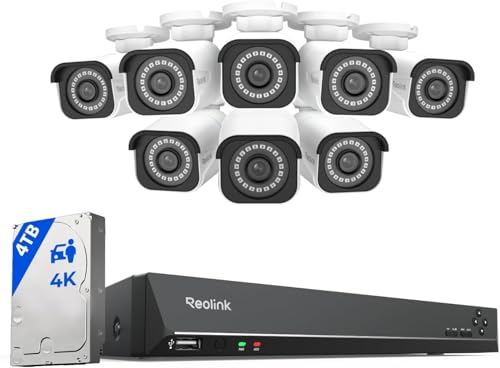
REOLINK 16CH 4K PoE Home Security Camera System
|
9.2/10 | Buy |
| Best Premium |
 REOLINK 16-Channel 4K PoE Security Dome Camera |
9.1/10 | Buy |
| Best Budget |
 Hiseeu 4K Wired Security Camera System with 4 8MP |
8.4/10 | Buy |
| Best Value |
 Hiseeu 8-Channel 4K Wired Security System |
8.4/10 | Buy |
 Anlapus 4K 4-Camera Security System (1TB) |
8.3/10 | Buy | |
 Reolink RLK8-800D4 4K PoE Security System |
8.0/10 | Buy | |
 ELYSOO 4K Solar Security Cameras Wireless Outdoor |
7.8/10 | Buy |
REOLINK 16CH 4K PoE Home Security Camera System
The REOLINK RLK16-800B8 is a hardwired 16-channel 4K PoE security system featuring an NVR with a pre-installed 4TB hard drive and AI-powered person, vehicle, and animal detection. It is an ideal zero-monthly-fee video intrusion defense system for suburban homeowners and large properties requiring reliable 24/7 local recording without Wi-Fi dropouts.
Pros
- Crisp 4K Ultra HD (8MP) resolution delivers detailed video for identifying intruders and vehicles
- Zero monthly monitoring or cloud storage fees with the built-in 4TB hard drive expandable to 16TB
- Onboard smart AI detection categorizes people, vehicles, and animals to prevent nuisance notifications
- PoE architecture delivers power and high-bandwidth video over a single Ethernet cable up to 330 feet
- Local NVR recording continues 24/7 uninterrupted even during home broadband internet outages
Cons
- Requires running physical Ethernet cables through walls or attics, making it unsuitable for drill-free rental installations
- Kit cameras cannot integrate with smart home platforms like Amazon Alexa and require the proprietary Reolink PoE NVR
- The NVR does not contain an internal battery backup, requiring an external UPS to stay online during electrical blackouts
REOLINK 16-Channel 4K PoE Security Dome Camera
The REOLINK RLK16-800D8 is a complete 16-channel PoE surveillance system delivering 8MP 4K video clarity, intelligent person and vehicle detection, and a pre-installed 4TB hard drive for continuous 24/7 local recording. It is ideal for property owners seeking comprehensive coverage without recurring monthly subscription fees.
Pros
- Native 8MP 4K Ultra HD resolution delivers exceptional image detail when zooming in on critical areas
- Pre-installed 4TB hard drive supports out-of-the-box continuous 24/7 recording with zero subscription fees
- Single-cable PoE architecture eliminates the need for nearby exterior electrical outlets at each camera drop
- Smart shape-based AI detection filters out nuisance triggers from small animals and environmental movement
- Expands up to 16TB total storage capacity to retain weeks of high-bitrate continuous video footage
Cons
- Running dedicated Ethernet cables through attics, crawlspaces, or walls requires more physical labor than wireless setups
- Dome camera form factor offers a fixed perspective without motorized pan-and-tilt tracking
- Requires a 4K display or high-resolution monitor to experience the full visual benefit of native 8MP video feeds
Hiseeu 4K Wired Security Camera System with 4 8MP
The Hiseeu 4K Wired Security Camera System delivers reliable 8MP surveillance with an included 1TB hard drive DVR, dual-mode spotlight night vision, and AI person and vehicle detection without subscription fees. It is a practical fit for homeowners and property managers seeking dependable, round-the-clock wired perimeter monitoring without recurring cloud costs.
Pros
- True 4K (8MP) resolution delivers crisp daytime video and clear subject definition across broad coverage areas.
- Includes a pre-installed 1TB hard drive for subscription-free local recording and playback right out of the box.
- AI-assisted human and vehicle filtering helps minimize unwanted motion notifications on mobile devices.
- Can operate entirely offline using a direct TV or monitor connection for privacy-minded property owners.
- Weather-sealed IP66 camera housings provide dependable exterior durability against heavy rain and moisture.
Cons
- BNC coaxial cable routing requires drilling and manual wiring through attics, crawlspaces, or walls during setup.
- Audio is limited to one-way listening, meaning you cannot speak back to visitors through the cameras.
- Included cable lengths (two 96-foot and two 58-foot) may require extensions for sprawling properties or detached structures.
Hiseeu 8-Channel 4K Wired Security System
Designed for complete property coverage, this Hiseeu wired setup delivers sharp 4K recording alongside onboard person and vehicle detection. It includes a pre-installed 3TB hard drive and durable IP67 weatherproof cameras that can operate completely offline.
Pros
- Sharp 4K video resolution across eight cameras
- Includes a pre-installed 3TB local storage drive
- Accurate AI detection for people and vehicles
- Rugged IP67 weather resistance for extreme climates
- Can function locally without an active internet connection
Cons
- Color spotlight mode only supports up to four channels
- Supports one-way audio without two-way talk
- BNC wired setup requires running physical cables
Anlapus 4K 4-Camera Security System (1TB)
This wired 4K surveillance setup pairs four 8MP cameras with a pre-installed 1TB hard drive for continuous, subscription-free recording. It delivers reliable night vision and AI motion filtering, making it a solid choice for homeowners prioritizing local storage.
Pros
- Sharp 4K video resolution provides clear identification
- Pre-installed 1TB drive offers ample local storage
- Smart AI alerts reduce unwanted motion notifications
- Remote viewing app requires no monthly subscription
- Weatherproof IP66 build handles harsh outdoor conditions
Cons
- Lacks two-way audio talk functionality
- Wired setup requires physical cable routing
Reolink RLK8-800D4 4K PoE Security System
This plug-and-play surveillance kit pairs crisp 4K cameras with a pre-installed 2TB NVR for continuous 24/7 recording. Onboard person and vehicle detection reduces false notifications, making it a reliable hardwired setup for comprehensive home monitoring.
Pros
- Crisp 4K resolution with clear digital zoom
- Intelligent person and vehicle detection alerts
- Straightforward single-cable PoE connection
- Pre-installed 2TB drive expandable up to 16TB
Cons
- Requires routing physical Ethernet cables through the property
- Initial network and app setup needed for remote viewing
ELYSOO 4K Solar Security Cameras Wireless Outdoor
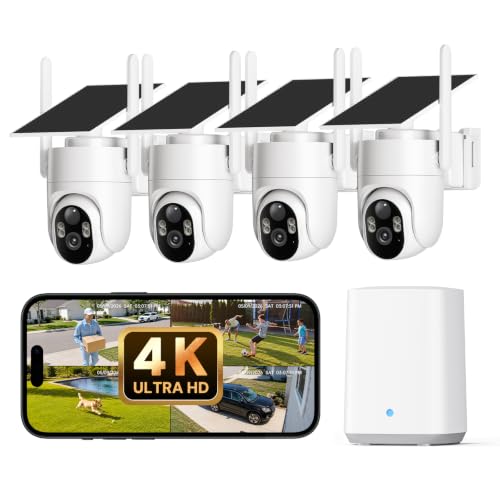
The ELYSOO 4K Solar Security Camera System pairs four solar-powered PTZ cameras with the ElysooBase hub for 360-degree perimeter protection without ongoing subscription costs. It is an ideal wireless setup for suburban homeowners seeking AI-driven tracking, local video encryption, and flexible Home and Away modes.
Pros
- Local encrypted storage on the ElysooBase hub eliminates mandatory cloud subscription fees
- Solar power panels and internal batteries provide wire-free outdoor installation in roughly five minutes per camera
- AI classification identifies people, vehicles, and animals to reduce false alarms from wind and outdoor motion
- IP65 weatherproof construction operates reliably in extreme temperatures from -4°F to 122°F
- Dual-band 2.4 GHz and 5 GHz Wi-Fi support improves hub connectivity compared to single-band coordinators
Cons
- Lacks automated cellular backup fallback during broadband internet outages
- Digital zoom up to 8x magnifies the image digitally rather than through optical zoom lenses
- Self-monitored system does not include automated municipal police dispatch or central station monitoring
Engineering Standards and Deployment Strategies for 4K Surveillance Systems
Answering what is the best 4k security camera system requires looking beyond raw resolution marketing and examining your property’s physical wiring pathways, storage throughput, and detection mechanics. High-resolution surveillance depends on sustained video bitrate delivery, balanced dynamic range under harsh sunlight, and local storage arrays capable of handling continuous multi-channel writes. Sprawling residential properties require different wiring standards and power architectures than compact townhomes. Matching your property layout to the right transmission standard and detection engine ensures dependable surveillance evidence without monthly subscription fees.
Transmission Architectures: Power over Ethernet, Analog BNC, and Solar Wireless
Power over Ethernet remains the premier standard for wired residential surveillance due to its unified data and power transmission. Operating under IEEE 802.3af and 802.3at standards, a single Ethernet cable delivers low-voltage DC power while transmitting full 4K digital video streams up to 330 feet without signal degradation. Multi-channel platforms like the REOLINK 16CH and 8CH systems utilize this plug-and-play architecture to streamline attic and crawlspace wiring runs. Hardwired Ethernet cables isolate camera data from home Wi-Fi traffic, creating a stable local network immune to wireless interference.
Analog high-definition systems running over Siamese BNC coaxial cables provide a practical, cost-effective alternative for properties with existing coaxial wiring. Kits from Hiseeu and Anlapus supply pre-made BNC cables measuring 58 feet and 96 feet to connect 8MP cameras directly to a centralized digital recorder. These coaxial connections separate video signals and low-voltage power along dedicated split leads, delivering reliable local live feeds to a television monitor without internet connectivity. Coaxial systems lack the modular data integration of Ethernet networks, but they provide dependable continuous surveillance without consuming router bandwidth.
Wire-free solar camera systems eliminate physical cabling challenges across areas where trenching conduit or drilling exterior walls is impractical. The ELYSOO solar kit pairs an indoor base station with wireless cameras that require just two hours of daily sunlight to sustain operation. Operating across dual-band 2.4 GHz and 5 GHz wireless networks, these systems communicate with a central hub while keeping all encrypted video stored locally. Solar systems rely on event-triggered motion schedules rather than continuous video streams, making them well-suited for perimeter gates, detached garages, or rental homes.
Optical Resolution, Image Sensors, and the IEC DORI Standard
True 4K video resolution utilizes an 8-megapixel image sensor delivering 3840 by 2160 pixels, which yields four times the image clarity of standard 1080p sensors. This elevated pixel density allows property owners to zoom in digitally during playback without turning critical footage into pixelated blur. Security investigations depend on identifying small evidentiary features such as vehicle license plates, facial details, and clothing logos at practical distances. Deploying native 8MP image sensors ensures that fine details remain sharp and usable for law enforcement identification.
Forensic surveillance quality is formally evaluated using the international IEC EN 62676-4 DORI standard, which outlines specific pixel densities for Detection, Observation, Recognition, and Identification. Detection requires 25 pixels per meter to confirm the presence of a human figure within the frame. Observation demands 63 pixels per meter to distinguish clothing color and posture, while Recognition needs 125 pixels per meter to confirm a known individual. Identification represents the gold standard at 250 pixels per meter, supplying unambiguous facial evidence that can withstand forensic scrutiny in court.
Achieving forensic identification also requires selecting optimal streaming bitrates and compatible display hardware. Enabling Clear stream settings on high-resolution cameras preserves sharp edge definition by preventing the video compression artifacts common to low-bitrate streams. Viewing recorded 4K surveillance footage on a native 4K display reveals minute textures that standard high-definition monitors compress. Ensuring that display resolution matches camera sensor output guarantees that property owners see every piece of captured visual evidence.
Local Storage Topologies and Continuous Video Retention
Managing the dense data stream generated by continuous 4K video requires surveillance-grade hard drives engineered for nonstop write cycles. Kits from REOLINK and Hiseeu provide pre-installed SATA hard drives ranging from 1TB to 4TB, with total expansion capacity reaching up to 16TB. Consumer desktop drives cannot handle the constant heat and vibration of multi-channel surveillance recording, making specialized surveillance drives necessary for hardware longevity. Dedicated internal drives guarantee that unexpected incidents outside normal motion boundaries remain recorded and accessible.
Long-term video retention depends on modern compression standards such as H.265 and H.265+ encoding. These codecs analyze temporal changes across frames, compressing static background details to reduce storage demands by nearly fifty percent compared to legacy H.264 formats. An eight-camera wired system using a 3TB drive can comfortably retain multiple weeks of continuous recordings before cycling over older footage. Property owners seeking to expand system capacity over time can integrate compatible add-on cameras for an NVR without exceeding local network bandwidth limits.
Base-station systems like the ELYSOO solar kit take a different approach by utilizing solid-state local memory cards. The pre-installed 32GB card can be upgraded to 256GB, providing local loop recording that keeps encrypted video safe inside the house even if an outdoor camera is damaged. Solid-state cards run silently and consume minimal power, making them ideal companions for energy-efficient wireless hubs. For wired systems, integrated USB ports allow quick exports of relevant incident clips to flash drives for local backup.
Low-Light Illumination: Infrared Night Vision versus Spotlight Color Modes
Reliable nighttime surveillance requires an illumination strategy that balances stealth perimeter monitoring with accurate color capture. Standard infrared night vision uses 850-nanometer LEDs to project invisible light, producing clear monochrome images without revealing camera positions. Wired systems from Anlapus feature high-output infrared arrays capable of illuminating subjects up to 80 feet in complete darkness. Infrared mode penetrates shadowy yards effectively, but monochrome imagery cannot record vehicle colors or clothing shades.
Color night vision relies on integrated white-light spotlights that activate automatically when intelligent motion sensors detect human activity. Systems from Hiseeu offer switchable night vision modes, allowing cameras to remain in discrete infrared until an AI trigger illuminates the scene. The ELYSOO solar camera uses four bright LEDs with smart infrared sensors to deliver full-color video up to 25 feet at night. This sudden burst of white light provides crucial color evidence while startling potential intruders approaching entryways.
Poor camera placement often creates infrared back reflection that washes out low-light images completely. Mounting cameras flush against reflective vinyl siding, gutters, or window panes causes infrared beams to bounce into the lens, blinding the image sensor. Installers should angle camera housings slightly away from adjacent walls and overhangs to maintain even light distribution across open areas. Keeping optical lenses clean from dust and spiderwebs also prevents night vision flare and maintains sharp focus across seasons.
Edge AI Analytics and False Alert Mitigation
Early motion detection systems relied on simple pixel-change triggers that generated constant nuisance alerts from rain, insects, and swaying branches. Modern 4K surveillance platforms feature on-device artificial intelligence that evaluates subject silhouettes directly on the camera hardware. By distinguishing human, vehicle, and animal shapes from environmental movement, systems from REOLINK, Hiseeu, and Anlapus dramatically reduce notification fatigue. Homeowners can customize push notifications to alert them only when a person or car crosses into monitored zones.
Customizable detection zones and privacy masks allow users to define exact surveillance boundaries across their property. Homeowners can exclude public sidewalks and busy roadways from motion triggers, preventing passing traffic from filling storage drives with false events. High-priority areas like front porches and driveway gates can maintain high sensitivity settings for immediate event capture. Incorporating motorized pan-tilt-zoom cameras for driveway monitoring allows systems to track moving subjects across broad areas while keeping them centered in the frame.
Cross-camera tracking features link motion events detected across separate viewpoints into a cohesive narrative. When an individual walks from a driveway toward a backyard gate, synchronized playback arranges the sequential clips into a single chronological timeline. This organized playback eliminates the frustration of manually searching through separate video channels to reconstruct an intruder’s path. On-device processing ensures these tracking analytics operate instantly without waiting for cloud server responses.
Form Factors, Ingress Protection, and Physical Mounting Standards
Choosing between bullet and dome camera housings depends on the mounting location and desired level of tamper resistance. Bullet cameras, like those in the REOLINK RLK16-800B8 system, provide a visible deterrent with simple horizontal and vertical articulation for long perimeters. Dome cameras, such as the REOLINK RLK16-800D8, hide the lens orientation behind a protective glass shell that resists intentional vandalism. Dome designs are ideal for low porch ceilings, overhangs, and entryways where physical accessibility poses a tampering risk.
Weatherproofing ratings determine how well camera enclosures survive moisture, dirt, and severe temperature fluctuations over years of outdoor service. The ELYSOO solar camera features an IP65 housing that shields internal electronics from rain showers, while IP66 ratings on Anlapus and Hiseeu units resist powerful water jets. For harsh winter climates, the IP67-rated Hiseeu 8-camera kit operates across an extreme temperature range from -40°F to 140°F. Checking ingress protection ratings ensures reliable operation through sub-zero winter blizzards and scorching summer heat.
Proper mounting height establishes the correct balance between broad coverage and recognizable facial angles. Positioning cameras between 8 and 10 feet above ground level provides an optimal downward angle that captures facial features rather than the tops of hats. Installers should always incorporate a downward drip loop on exterior cable runs just before the line enters the wall. Sealing cable wall penetrations with exterior-grade silicone caulk prevents moisture intrusion and protects structural framing.
Network Privacy, Audio Surveillance, and Legal Regulations
Maintaining security camera privacy requires sound local network configuration and strict access controls. Wired PoE and analog systems provide superior network isolation because they can operate completely offline without internet connectivity. Recorders from REOLINK and Hiseeu allow direct HDMI connections to a television monitor for local management without external cloud accounts. When remote app viewing is desired, placing the surveillance recorder on an isolated virtual local area network (VLAN) shields other home devices from potential network vulnerabilities.
Audio recording features require careful legal consideration under United States federal and state privacy statutes. Built-in microphones on Anlapus and Hiseeu cameras record ambient sound and nearby speech alongside high-resolution video streams. Federal wiretap law under 18 U.S.C. § 2511 mandates at least one-party consent for recording oral communications, but several states enforce all-party consent laws that ban audio recording without mutual permission. Property owners should disable audio recording near shared property boundaries and review local statutes to maintain legal compliance.
Visual surveillance boundaries must respect common law principles regarding reasonable expectations of privacy. While property owners are legally permitted to record their own driveways and exterior yards from unobstructed viewpoints, directing lenses into neighboring bedroom windows can trigger civil liability. Using digital privacy masking tools allows installers to block out adjacent properties while maintaining full coverage over their own perimeters. Clearly visible surveillance signage also deters trespassers while establishing transparent recording practices across the neighborhood.
Selecting the best 4K surveillance system ultimately depends on matching your property’s physical wiring paths with your continuous recording needs and local network preferences. Hardwired PoE networks provide maximum bandwidth stability and expansive hard drive capacity for complete twenty-four-seven property monitoring. Analog wired systems offer straightforward local television monitoring without network congestion, while solar-assisted wireless systems provide flexible placement where running physical cable is impractical. Calibrating camera mounting angles, setting intelligent detection masks, and verifying local storage drives ensures your property remains protected with dependable, high-resolution evidence.
About the author
Tyler Lacoma is a smart home and home security technology expert with more than a decade of hands-on experience testing connected devices. His expertise includes security cameras, smart locks, home security systems, privacy features, smart-home compatibility, and emerging AI technology. He focuses on translating technical features into practical guidance that helps homeowners understand which security solutions truly fit their homes and everyday needs.