
Where to Plug in Outdoor Security Camera: Safe Power Options and Placement for 2026
Learn where to plug in outdoor security camera systems safely, explore exterior GFCI requirements, and protect wiring for November 2026.
 By Alina Bradford
Updated November 20, 2026


Outdoor surveillance cameras deliver round-the-clock perimeter awareness, but finding an accessible and weather-resistant electrical outlet often creates significant installation friction. Many property owners struggle to decide where to plug in outdoor security camera hardware without exposing fragile low-voltage transformers to rainfall, high winds, or deliberate physical tampering. Running standard power cords loosely across exterior walls can compromise both physical home security and building weather seals. Selecting an appropriate electrical source requires balancing National Electrical Code safety standards with optimal lens positioning for entryways, detached garages, and driveway PTZ surveillance setups.
Understanding the distinction between line-voltage outdoor receptacles and the stepped-down direct current power cords used by modern cameras is critical before drilling any exterior walls. Typical plug-in surveillance cameras rely on small direct current adapters that convert standard alternating current electricity into five or twelve volts of direct current. When these power supplies are left unprotected in open damp environments, corrosion and electrical ground faults can disable continuous recording capabilities without warning. Evaluating safe receptacle locations, attic routing pathways, and dedicated exterior enclosures ensures your residential surveillance deployment maintains uninterrupted power while staying fully code-compliant.
| Award | Product | SSG Score About SSG ScoreThe SSG Score is our own rating from 0 to 10, based on performance, design and build, ease of use, and value. It reflects independent research and is never influenced by manufacturers, retailers, or affiliate commissions. Learn more › | |
|---|---|---|---|
| Best Overall |
LETSCEE 4K 8MP Outdoor PTZ Security Camera
|
9.2/10 | Buy |
| Best Value |
 CiKiKWXO 2.5K Outdoor PTZ Security Camera |
9.2/10 | Buy |
| Best Premium |
 VSMAHOME 4MP PTZ Outdoor Camera (2-Pack) |
8.9/10 | Buy |
| Best Budget |
 Ebitcam 2K Security Camera (2-Pack) |
8.8/10 | Buy |
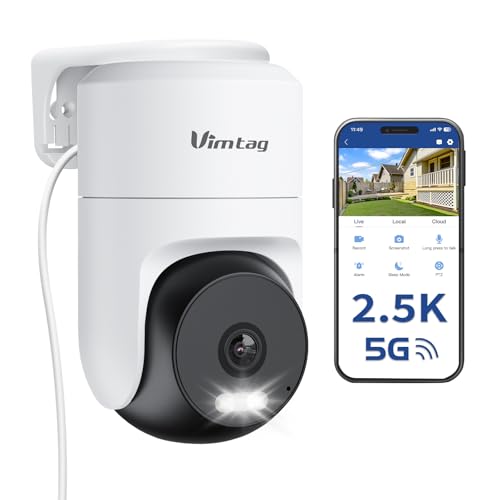 VIMTAG 2.5K Pan-Tilt Wired Outdoor Security Camera |
8.4/10 | Buy | |
 Vimtag 2.5K Indoor Outdoor Security Camera 2-Pack |
8.4/10 | Buy | |
 Camcamp 4-Camera Wireless PTZ NVR System |
8.3/10 | Buy |
LETSCEE 4K 8MP Outdoor PTZ Security Camera
Delivering sharp 4K resolution with motorized pan and tilt tracking, the LETSCEE outdoor camera monitors expansive yards and entryways continuously. It suits property owners seeking reliable plug-in surveillance with customizable detection zones and local recording options.
Pros
- Sharp 4K video capture
- Automated AI tracking for people and vehicles
- Supports continuous 24/7 recording
- Compatible with NVR and DVR setups
- Configurable motion detection zones without subscription fees
Cons
- Only supports 2.4GHz Wi-Fi frequencies
- Requires nearby electrical outlet for DC power
- MicroSD card is not included
CiKiKWXO 2.5K Outdoor PTZ Security Camera
This outdoor camera pairs sharp 2.5K video with motorized pan and tilt for comprehensive perimeter coverage. Dual-band Wi-Fi and color night vision make it a dependable option for continuous property monitoring.
Pros
- Supports dual-band 2.4GHz and 5GHz Wi-Fi
- Full-color and infrared night vision modes
- Wide 355-degree pan and 90-degree tilt range
- Supports continuous 24/7 local recording
- Integrated siren and spotlight for active deterrence
Cons
- Requires access to a constant wired power outlet
- MicroSD card is not included in the package
- Local storage capacity is capped at 128GB
VSMAHOME 4MP PTZ Outdoor Camera (2-Pack)
This dual-camera kit delivers comprehensive 360-degree coverage with motorized auto-tracking and dual-band Wi-Fi. It is designed for homeowners who prefer constant, continuous wired surveillance over battery-powered upkeep.
Pros
- Dual-band Wi-Fi ensures stable video streaming
- Continuous plug-in power eliminates battery recharging downtime
- Smart AI distinguishes people, pets, and packages
- Full 360-degree tracking leaves virtually no blind spots
Cons
- Requires access to an electrical outlet outdoors
- MicroSD card must be purchased separately
- Full cloud storage features require ongoing subscription
Ebitcam 2K Security Camera (2-Pack)
Designed for versatile indoor or outdoor surveillance, this wired camera delivers detailed 2K video alongside dual-band Wi-Fi connectivity. It suits homeowners who want continuous plug-in power and flexible local storage options without mandatory cloud subscription fees.
Pros
- Dual-band 2.4GHz and 5GHz Wi-Fi connectivity
- Detailed 2K video with full-color night vision
- Local recording support without required monthly subscription fees
- Sturdy IP66 weatherproof rating for outdoor reliability
Cons
- Requires a continuous wired power outlet connection
- MicroSD card is not included in the box
- Alexa integration is limited to live streaming only
VIMTAG 2.5K Pan-Tilt Wired Outdoor Security Camera
The VIMTAG 2.5K Pan/Tilt Wired Outdoor Security Camera delivers 2560x1440 QHD video, motorized 360-degree coverage, and dual-band Wi-Fi for dependable residential surveillance. It is a practical choice for homeowners and renters seeking continuous plug-in perimeter monitoring without recurring monthly cloud fees.
Pros
- Motorized 360-degree pan and 90-degree tilt with real-time motion tracking eliminates blind spots.
- Dual-band 2.4GHz and 5GHz Wi-Fi support ensures flexible and stable wireless network pairing.
- AI detection for people, pets, and vehicles functions without requiring a paid subscription.
- Generous local storage capacity supporting microSD cards up to 512GB for 24/7 continuous recording.
- IP66 weather-resistant housing withstands outdoor rain, dust, and exterior environmental exposure.
Cons
- Requires access to an electrical outlet via the 9.8-foot power cord, restricting wire-free placement.
- High digital zoom levels up to 8x crop the image rather than using optical glass magnification.
- Smart home ecosystem compatibility is limited to Amazon Alexa without Google Home or HomeKit support.
Vimtag 2.5K Indoor Outdoor Security Camera 2-Pack
The Vimtag 2.5K Indoor/Outdoor Security Camera 2-Pack offers 4MP video clarity, dual-band Wi-Fi flexibility, and color night vision backed by a built-in spotlight and siren. It provides a versatile, cost-effective monitoring solution for homeowners and renters seeking reliable indoor or perimeter coverage with local microSD storage support.
Pros
- Dual-band 2.4 GHz and 5 GHz Wi-Fi compatibility provides greater connection flexibility than standard 2.4 GHz-only cameras
- Solid 2.5K video resolution paired with spotlight illumination ensures clear daytime and nighttime video capture
- IP66-rated enclosure allows seamless transition between indoor nursery monitoring and exposed outdoor surveillance
- Local microSD slot enables subscription-free video storage without forcing an ongoing monthly cloud fee
- Convenient plug-and-play setup supports freestanding tabletop placement or permanent wall mounting with included screws
Cons
- MicroSD card is not included in the box and must be purchased separately for local recording
- Continuous AC power connection is required, limiting placement to areas near electrical outlets
- Advanced cloud video recording and extended alert history require an optional paid Vimtag Cloud subscription
Camcamp 4-Camera Wireless PTZ NVR System
This plug-in Camcamp bundle pairs four dual-lens PTZ cameras with a dedicated 10-channel NVR for complete local property monitoring. It provides continuous 24/7 recording and automated motion tracking without requiring recurring cloud subscriptions.
Pros
- Dual-lens design eliminates blind spots using auto tracking
- Continuous 24/7 recording without subscription fees
- Three distinct night vision modes with spotlights
- Storage capacity expands up to 6TB on NVR
- Durable IP66 weatherproofing against extreme temperatures
Cons
- Each outdoor camera requires nearby plug-in power access
- Base 500GB hard drive fills quickly with four feeds
- Local storage design lacks native cloud backup integration
Comprehensive Electrical Planning and Safe Outlet Options for Outdoor Cameras
Determining the safest power connection point for an exterior surveillance camera requires understanding structural layout, moisture mitigation, and electrical safety standards. Most residential plug-in security cameras operate on low-voltage direct current supplied by an alternating current adapter, which cannot simply hang unprotected from an open exterior wall. Property owners generally choose between connecting directly to an exterior ground fault receptacle equipped with an extra-duty weatherproof cover, routing low-voltage cables indoors through soffits and attics, or tapping into interior receptacles located inside garages or outbuildings. Each installation pathway presents specific trade-offs regarding physical tamper resistance, weather vulnerability, cable length limits, and building envelope integrity.
Locating and Utilizing Exterior GFCI Outlets Safely
Connecting an exterior camera to an outside outlet requires a Ground Fault Circuit Interrupter (GFCI) receptacle to protect against shock hazards caused by moisture intrusion. The National Electrical Code requires outdoor outlets in residential spaces to feature GFCI protection, which instantly trips the circuit if water bridges an electrical contact. Plugging an indoor-rated power adapter directly into an open outdoor receptacle is an immediate electrical hazard and frequently results in short circuits. Property owners must ensure any outdoor outlet chosen for surveillance is seated firmly in a weatherproof box that prevents water from contacting the electrical contacts.
Outdoor receptacles also mandate the use of a while-in-use weatherproof cover, commonly referred to as an extra-duty bubble cover. Unlike flat metal spring-loaded flip covers that only seal when nothing is plugged in, bubble covers provide a deep, gasketed housing that shields both the plugged-in adapter and the cord while electricity flows. When selecting an exterior outlet, you must verify that the transformer brick of your camera physically fits inside the enclosure without pinching the low-voltage lead. Securing the perimeter of the outlet box with a small padlock or tamper-resistant screw prevents unauthorized disconnection while keeping environmental moisture completely sealed out.
Routing Power Cords Through Soffits, Eaves, and Attics
Routing the camera power cable upward into the roofline offers substantial security and aesthetic advantages over exterior wall plugs. Soffit and eave spaces provide natural shelter from driving rain, snow, and direct ultraviolet solar degradation. By passing the thin low-voltage power cord through a perforated soffit vent or a small drilled pilot hole, you can keep the sensitive power adapter entirely inside an unconditioned attic space. This installation approach eliminates visible exterior cords, leaving intruders with no accessible wires to snip or disconnect from ground level.
Attic spaces frequently contain standard electrical junction boxes or convenience outlets dedicated to attic fans, lighting, or heating equipment. Plugging the camera adapter into an interior attic outlet keeps the sensitive electronics within a dry, sheltered environment that dramatically extends transformer lifespan. Technicians always recommend forming a downward drip loop in the low-voltage wire just before it enters the exterior hole so rainwater drips off the bend rather than following the wire into the structure. Any drilled hole through fascia boards or exterior stucco must be thoroughly sealed with exterior-grade silicone caulk or electrical duct seal compound.
Tapping Into Garages, Covered Porches, and Outbuildings
Attached garages and outbuildings serve as ideal power distribution hubs for exterior security cameras mounted on driveways or side yards. Garages typically feature multiple interior wall outlets wired to standard general-purpose branch circuits. Running a thin direct current power wire through an exterior garage door frame or through a siding seam allows the camera to stay outdoors while the power plug remains safely indoors. This configuration isolates the plug from weather exposure, eliminates the need for bulky exterior covers, and makes tampering virtually impossible from outside the home.
Covered front porches and back patios also offer semi-protected outdoor receptacles that sit sheltered beneath substantial roof overhangs. While porch receptacles benefit from overhead weather protection, they still require GFCI protection and moisture-resistant covers under residential building codes. Light socket plug adapters represent a quick power alternative for covered porches, but they come with significant operational limitations. Because these adapters only supply power when the controlling wall switch remains energized at all times, an accidental flip of the light switch instantly disables camera recording.
Managing Direct Current Extension Cables and Voltage Drop
Plug-in Wi-Fi security cameras typically include manufacturer power cables measuring approximately nine to ten feet in length. Models such as the VIMTAG pan-tilt camera and the VSMAHOME outdoor camera provide factory leads around ten feet, which rarely reach distant exterior outlets on larger residential properties. Many property owners resolve this spatial limitation by purchasing thin aftermarket direct current barrel extension cables. While direct current extension cords are simple to install, extending low-voltage lines over significant distances introduces electrical resistance challenges that affect camera stability.
Low-voltage direct current experiences rapid voltage drop when transmitted over long lengths of small-gauge copper wire. A five-volt or twelve-volt direct current power supply operating over a twenty-foot or thirty-foot extension cord may suffer substantial voltage loss before reaching the camera terminal. Insufficient voltage causes erratic device behavior, such as sudden reboot loops when motorized pan-tilt-zoom motors engage or night vision infrared LEDs activate. When long runs are unavoidable, selecting a heavier wire gauge, such as eighteen-gauge direct current extensions, minimizes resistance and stabilizes voltage delivery.
Power over Ethernet as an Alternative to Standard Plugs
Homeowners facing severe power placement limitations often discover that traditional plug-in cameras are less efficient than hardwired network power architectures. If you are comparing centralized surveillance options, reviewing a PoE security camera system design reveals how Power over Ethernet delivers both continuous electrical power and high-speed data over a single Category 6 network cable. Standard PoE systems comply with IEEE 802.3af and 802.3at specifications, transmitting forty-eight volts of direct current safely across distances up to three hundred and twenty-eight feet without noticeable voltage drop.
For property owners who prefer localized storage without running independent power cords to each location, centralized NVR setups provide clean installations. Exploring compatible add-on cameras for NVR setups demonstrates how hardwired Ethernet lines simplify system expansion across distant outbuildings and perimeter fence lines. The network cable originates from a centralized PoE network switch or Network Video Recorder located safely inside an interior equipment rack or home office. By removing the dependency on exterior alternating current wall plugs, PoE network architecture delivers exceptional surveillance reliability and electrical safety.
Protecting Electrical Connectors Against Moisture and Ingress
Even when a camera is rated IP65 or IP66 for weather resistance, the connection point where the camera pigtail mates with the power cable remains highly vulnerable to water ingress. Most plug-in cameras feature exposed direct current barrel jacks or modular micro-USB and USB-C power ports that corrode quickly if moisture reaches internal pins. Galvanic corrosion between dissimilar conductive metals causes sudden electrical resistance spikes, resulting in intermittent device shutdowns or permanent hardware failure. Ensuring these sensitive connection joints remain sealed is just as important as selecting a reliable wall outlet.
Professional surveillance installers utilize self-amalgamating silicone tape or heat-shrink tubing lined with waterproof adhesive to encase all exterior power joints. Unlike standard vinyl electrical tape that unravels and leaves sticky residue under hot summer sunlight, self-fusing silicone tape forms a continuous, seamless rubber barrier that excludes water and airborne dust. Installing a compact exterior round or square junction box behind the camera mounting plate provides an additional protective enclosure for cable splices. Weatherproof junction boxes feature sealed rubber grommets and compression gaskets that completely enclose all excess wiring and power connectors within a dry chamber.
Physical Cable Fastening and Tamper Mitigation Strategies
Loose, sagging exterior power cords invite physical tampering and suffer accelerated mechanical wear from wind vibration and environmental hazards. When securing the wire run from the camera mounting position down to the selected power outlet, technicians use UV-stabilized screw-in cable clips spaced every twelve to eighteen inches along building trim. Avoid using standard metal staples from a manual staple gun, as pinching or piercing the thin low-voltage insulation can create internal short circuits that ruin the power supply. Securing the cable tightly against masonry or wood siding prevents wind whipping and maintains a neat appearance.
Rigid or flexible non-metallic electrical conduit provides superior protection for power cables running within reach of ground level. Sliding the camera power wire through half-inch PVC conduit or exterior-rated wiremold raceways prevents vandals from cutting the line with simple hand shears. Conduit also shields low-voltage insulation from gnawing rodents, climbing animals, and accidental strikes from weed trimmers or landscape equipment around foundation perimeters. Painting the protective conduit to match exterior house paint blends the security installation cleanly into your residential architecture.
Legal Compliance and Neighbor Privacy Boundaries Near Power Points
The physical location of your available outdoor power outlets often dictates where you choose to mount your security cameras, but electrical convenience must not override legal privacy boundaries. Under United States legal frameworks, individuals maintain a reasonable expectation of privacy within their private living spaces, fenced backyards, and bedroom windows. When mounting cameras near power points located on side yards or shared alleyways, you must angle the lens downward to focus strictly on your property curtilage rather than aiming across adjacent neighbor property lines. Digital privacy masking features in camera software can also black out sensitive areas on live feeds.
Audio surveillance capabilities present additional compliance obligations when installing plug-in cameras equipped with high-sensitivity microphones. Federal wiretap law under 18 U.S.C. Section 2511 and state-level eavesdropping statutes govern the interception of oral communications. In states with all-party or two-party consent laws, recording private conversations occurring outdoors without the knowledge and consent of all participants can create severe civil and criminal legal liability. If an outdoor camera powered near a property boundary captures conversations on an adjacent porch or patio, homeowners should disable audio recording in the camera settings or verify local statutory requirements.
Verification Testing and Routine Maintenance Audits
After selecting your power outlet and securing all exterior wiring, performing a thorough electrical and operational verification audit ensures long-term system stability. Test the camera during daytime and nighttime conditions to confirm that peak power draws do not trigger unexpected brownouts. When integrated infrared spotlights illuminate and pan-tilt motors rotate simultaneously at night, the camera draws its maximum amperage. If the camera reboots, drops Wi-Fi connectivity, or exhibits video stutter during night testing, the power supply or direct current extension cord is experiencing unacceptable voltage loss.
Conducting seasonal inspections of all exterior electrical components preserves system integrity across harsh winter freezes and summer heatwaves. Every six months, inspect the rubber gaskets on your while-in-use bubble covers and junction boxes to confirm they remain flexible and watertight without cracking. Press the test and reset buttons on your outdoor GFCI receptacles to ensure the ground fault protection mechanism trips and resets smoothly. Clearing spider webs, leaves, and dirt from outlet enclosures prevents conductive debris from bridging contacts and tripping circuit breakers.
Establishing a well-planned power pathway transforms a vulnerable plug-in camera into a reliable, permanent surveillance installation. By prioritizing protected GFCI outlets with extra-duty covers, exploring attic and soffit pass-throughs, and safeguarding low-voltage connections against moisture and voltage drops, you ensure your outdoor cameras record continuously without downtime. Taking the time to execute code-compliant electrical connections protects both your property investment and your home safety year-round.
About the author
Alina Bradford is a safety and security expert with more than two decades of experience researching consumer technology and personal safety. She has tested hundreds of security and safety products and brings first-responder training to her practical approach. Her expertise spans home security equipment, cameras, connected safety devices, apps, and emerging security technology, with a focus on making complex products easier for everyday consumers to understand.