
What Is the Best Wireless Outdoor Security Camera Without Subscription: Practical Guide for 2026
Eliminate recurring cloud fees in November 2026 while identifying what is the best wireless outdoor security camera without subscription for your home.
 By Rachel Cericola
Updated November 19, 2026

Homeowners often find themselves overwhelmed by the ongoing expenses of cloud storage plans and mandatory alert fees. Mounting recurring costs can quickly outstrip the initial purchase price of home surveillance hardware, creating persistent subscription fatigue. Determining what is the best wireless outdoor security camera without subscription requires prioritizing hardware that retains video locally while delivering dependable perimeter protection. Modern wireless systems now utilize encrypted base stations, onboard memory cards, and built-in solar panels to provide continuous home awareness without recurring financial lock-in. Many users seeking wire-free convenience turn to battery security cameras with local storage to preserve recordings directly on their own property.
Eliminating monthly service charges does not require sacrificing critical monitoring capabilities like high-resolution imaging, motorized tracking, or instant smartphone alerts. Modern stand-alone setups deliver sharp daytime details and illuminated night views, allowing homeowners to monitor vulnerable entryways and property lines effectively. Selecting the proper equipment also involves balancing battery longevity, wireless transmission strength, and motion detection accuracy to prevent constant false notifications. Properties with expansive frontage often benefit from installing driveway PTZ security cameras to eliminate physical blind spots while retaining local control of video data. Understanding these core hardware distinctions ensures your perimeter defense remains secure, responsive, and completely free from recurring monthly invoices.
| Award | Product | SSG Score About SSG ScoreThe SSG Score is our own rating from 0 to 10, based on performance, design and build, ease of use, and value. It reflects independent research and is never influenced by manufacturers, retailers, or affiliate commissions. Learn more › | |
|---|---|---|---|
| Best Overall |
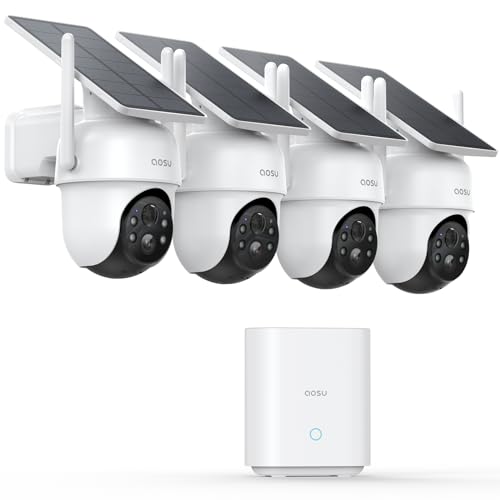
aosu D1 Classic 4-Cam Wireless Outdoor Security
|
9.2/10 | Buy |
| Best Value |
 AUKIN 4G LTE Solar Cellular Security Camera |
9.1/10 | Buy |
| Best Budget |
 HITELLARCAM 2K Wireless Outdoor Security Camera |
8.8/10 | Buy |
| Best Premium |
 Vivideye 4MP Solar Wireless Security Camera System |
8.8/10 | Buy |
 CEMANTA 2.5K 355° PTZ Security Camera |
8.3/10 | Buy | |
 Realhide 2K Wireless Outdoor Security Camera |
8.1/10 | Buy | |
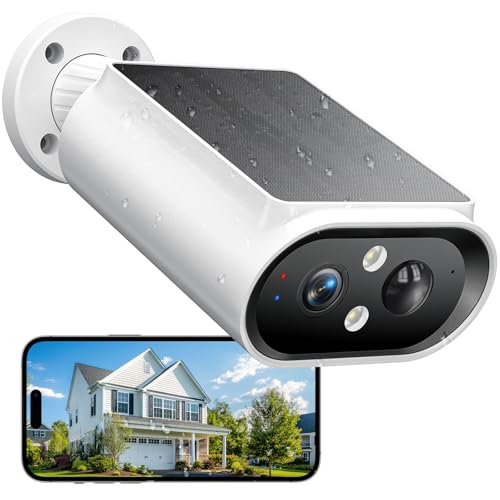 AlkiVision 2K Wireless Solar Security Camera |
8.1/10 | Buy |
aosu D1 Classic 4-Cam Wireless Outdoor Security
The aosu D1 Classic 4-Cam Kit delivers complete perimeter visual defense using solar-powered 2K pan-and-tilt cameras paired with a dedicated aosuBase hub for subscription-free encrypted local storage. It is an ideal zero-monthly-fee security solution for suburban homeowners looking to monitor entryways, yards, and driveways without wiring hassles.
Pros
- Subscription-free residential security with 32GB of encrypted local loop recording housed safely inside the aosuBase hub.
- Continuous solar charging requires only three hours of sunlight daily, minimizing the need for manual battery recharging.
- 360-degree pan-tilt coverage with automatic motion tracking ensures subjects are actively followed across the camera view.
- Simultaneous four-camera split-screen live viewing and cross-camera event sequencing simplify outdoor perimeter monitoring.
Cons
- Requires sufficient daily sunlight exposure (at least three hours), which may limit optimal placement under deep soffits or shaded tree canopies.
- Lacks cellular backup and relies entirely on local wireless connectivity, meaning remote push alerts depend on home internet uptime.
- Permanent exterior installation requires drilling mounting holes, making it less adaptable for strict drill-free rental balconies.
AUKIN 4G LTE Solar Cellular Security Camera
The AUKIN 4G LTE Solar Cellular Security Camera delivers wire-free off-grid surveillance for remote properties, farms, and job sites without requiring Wi-Fi or recurring monthly data plans. Featuring 2K full-color night vision, 360-degree motorized pan-tilt tracking, and an integrated 7000mAh battery continuously refreshed by solar power, it offers dependable coverage in areas where traditional network cameras cannot function.
Pros
- Embedded multi-carrier VSIM provides lifetime free 4G LTE connectivity with zero recurring monthly data fees or subscription contracts.
- Independent cellular operation connects via AT&T, T-Mobile, and Verizon coverage, making it ideal for remote properties lacking Wi-Fi.
- Motorized 360-degree pan-tilt coverage with automated human tracking and crisp 2K full-color night vision.
- Solar panel generates substantial daily replenishment power to support the internal 7000mAh battery under adequate sunlight.
- Includes a pre-installed 32GB microSD card for out-of-the-box local event recording without cloud storage paywalls.
Cons
- Embedded VSIM card is dedicated exclusively to this camera and cannot be swapped or transferred to other cellular data plans.
- Solar recharging depends heavily on unobstructed direct sunlight and may experience reduced charging efficiency during prolonged overcast or winter weather.
- Lacks native compatibility with third-party NVR storage arrays, desktop RTSP streams, or Home Assistant network setups.
HITELLARCAM 2K Wireless Outdoor Security Camera
The HITELLARCAM 2K wireless outdoor security camera provides wire-free surveillance featuring dual-band Wi-Fi, full-color night vision, and flexible storage via a microSD slot or free SD-quality cloud tier. It serves as an accessible option for suburban homeowners or renters seeking budget-friendly entryway and perimeter coverage without mandatory monthly fees.
Pros
- Dual-band 2.4GHz and 5GHz Wi-Fi support provides flexible home network integration
- Free SD-quality cloud storage option provides clip access without mandatory subscription fees
- Onboard microSD card slot supports up to 256GB for zero-monthly-cost local video storage
- IP66 weather-resistant construction withstands exposure to outdoor rain and dust
- Integrated LED spotlights enable full-color night recording and visual deterrence
Cons
- Free cloud storage tier is limited to standard-definition playback unless upgraded to a paid plan
- MicroSD card is not included with the camera and must be purchased separately
- Battery runtime varies significantly based on trigger frequency, live-view streaming, and cold temperatures
Vivideye 4MP Solar Wireless Security Camera System
The Vivideye 4-Camera Solar Security System delivers perimeter intrusion deterrence with 4MP pan-tilt coverage and a 128GB local storage hub that eliminates monthly fees. It is a practical choice for suburban homeowners wanting wire-free exterior protection with zero recurring subscriptions.
Pros
- Dedicated 128GB local storage hub keeps video recordings safe indoors without requiring recurring cloud subscriptions
- Dual-band 2.4 GHz and 5 GHz Wi-Fi 6 compatibility helps avoid interference on crowded household routers
- Efficient 5W solar panels and 8000mAh battery capacities provide wire-free power without ladder climbs for recharging
- Motorized pan-tilt mechanics and cross-camera event tracking deliver wide perimeter coverage across exterior entry points
Cons
- Auto motion tracking is deactivated by default out of the box and must be manually enabled in the mobile app
- Three-hole permanent screw mounting makes this hardware less practical for drill-restricted apartment rentals
- Lacks integrated cellular backup, meaning remote smartphone push notifications depend on active home broadband
CEMANTA 2.5K 355° PTZ Security Camera
Equipped with 2.5K resolution and 355-degree horizontal panning, this wire-free security camera delivers broad property coverage without mandatory subscription fees. Dual-band Wi-Fi support and IP66 weatherproofing make it a flexible option for outdoor perimeters and indoor spaces alike.
Pros
- Detailed 2.5K video with color night vision
- 355-degree horizontal panning via mobile app
- Supports fast dual-band 2.4GHz and 5GHz Wi-Fi
- Includes free cloud storage without subscription fees
- Weatherproof IP66 rating for outdoor durability
Cons
- Does not support automatic motion tracking
- MicroSD card must be purchased separately
- Rotation is restricted to horizontal movement only
Realhide 2K Wireless Outdoor Security Camera
Equipped with dual-band Wi-Fi and full-color night vision, this compact bullet camera delivers wire-free outdoor monitoring with flexible storage choices. It is a solid pick for homeowners seeking basic perimeter coverage without mandatory subscription fees.
Pros
- Sharp 2K clarity with color night vision
- Dual-band Wi-Fi ensures flexible network compatibility
- Includes free rolling cloud option without subscriptions
- Rugged IP66 rating for outdoor weather resistance
- Compact footprint allows versatile mounting locations
Cons
- Battery endurance decreases with frequent motion triggers
- Fixed bullet housing lacks motorized pan and tilt
AlkiVision 2K Wireless Solar Security Camera
The AlkiVision Wireless Solar Security Camera combines 2K resolution, spotlight-assisted color night vision, and an IP67-rated exterior powered by a 5000mAh battery and solar panel. It suits budget-conscious homeowners and renters seeking wire-free perimeter monitoring with local microSD storage, though smart AI filtering requires a paid subscription.
Pros
- 2K video resolution paired with spotlight-assisted full-color night vision for enhanced low-light clarity
- Bundled solar panel and 5000mAh internal battery enable convenient wire-free exterior placement
- Certified IP67 weatherproofing provides dependable resistance against rain and dust
- Onboard microSD slot accommodates up to 128GB cards for subscription-free local event recording
Cons
- Smart AI classification (person, vehicle, pet, package) and custom activity zones require a paid Vicohome cloud subscription
- Restricted to 2.4GHz Wi-Fi networks with no support for 5GHz bands or wired Ethernet connections
- Operates strictly on motion-triggered clips up to 20 seconds, lacking continuous 24/7 video recording capability
In-Depth Guide to Subscription-Free Wireless Outdoor Security Cameras
Evaluating surveillance options without ongoing fees requires understanding how modern cameras capture, process, and store video footage locally. Subscription-free security cameras rely on dedicated on-premises storage hardware, integrated solar recharging, and edge-based intelligence to deliver reliable perimeter protection. By eliminating mandatory cloud subscriptions, property owners retain full authority over their recordings while avoiding monthly service invoices. Selecting the right setup involves balancing storage reliability, optical performance, and network stability to keep your property protected around the clock.
Local Storage Architectures: Base Station Hubs Versus On-Device MicroSD Cards
Subscription-free outdoor cameras generally archive video recordings through either decentralized on-camera storage or centralized indoor base station hubs. Standalone wireless cameras frequently feature an onboard slot that accommodates high-endurance microSD cards up to 128GB or 256GB. This standalone configuration offers exceptional installation versatility because each individual camera operates independently without requiring dedicated indoor networking equipment. However, if an unauthorized individual physically removes or destroys an exterior camera equipped with an internal memory card, the captured evidence can be lost permanently.
Centralized indoor base station hubs resolve this vulnerability by transmitting captured event footage directly into an indoor storage drive. Hubs like the aosuBase or Vivideye home hub communicate with paired cameras over secure wireless signals, storing encrypted footage on internal flash drives ranging from 32GB to 128GB. Because the base station remains safely inside the home, your recorded event history remains completely accessible even if an exterior camera experiences vandalism or theft. Hub systems also facilitate seamless multi-camera loop recording, preserving months of video history without requiring separate memory card purchases for each unit.
Cellular 4G LTE Transmission Versus Dual-Band Wi-Fi Networks
Network connectivity dictates how quickly cameras deliver motion notifications and stream live views to your smartphone. Most residential wireless cameras connect to domestic networks using 2.4 GHz or dual-band 2.4 GHz and 5 GHz Wi-Fi frequencies. The 2.4 GHz frequency provides superior broadcast range and penetrates dense exterior walls like brick, stucco, and wood siding more effectively. In contrast, 5 GHz Wi-Fi offers faster data throughput and encounters less frequency congestion, allowing smoother high-definition live streaming when cameras are mounted within reasonable proximity to the router.
Properties with expansive perimeters, remote barns, detached workshops, or construction yards often lack dependable residential Wi-Fi signals entirely. Cellular security cameras equipped with 4G LTE capabilities bridge this operational gap by transmitting alerts and video feeds across major commercial mobile carrier networks. Units like the AUKIN cellular camera utilize embedded virtual SIM cards that connect across national carrier towers without requiring contracts or monthly data subscription fees. This cellular architecture enables continuous perimeter monitoring across remote properties where running broadband connections or mesh Wi-Fi extenders would prove impractical.
Power Architectures: Lithium-Ion Battery Capacities, Solar Harvesting, and Cold Weather
Wire-free outdoor cameras depend on internal rechargeable lithium-ion battery packs to eliminate the need for exterior power wiring. Common battery capacities range from 5000mAh to 8000mAh, providing several months of operation under moderate motion trigger intervals. However, placing cameras in high-traffic areas such as busy sidewalks or commercial driveways increases wake cycles and depletes battery reserves rapidly. Adjusting detection sensitivity and scheduling active monitoring hours helps prevent unnecessary camera activations and extends operating intervals between charges.
Dedicated solar panel accessories eliminate the maintenance chore of dismounting outdoor cameras for manual recharging. High-efficiency solar panels continuously replenish battery reserves during standard daylight hours, requiring only two to three hours of direct sunlight daily to maintain continuous power. Environmental conditions, however, play a significant role in solar performance throughout changing seasons. When winter temperatures drop below 32 degrees Fahrenheit (0 degrees Celsius), internal battery management protections halt charging to prevent lithium cell degradation, requiring adequate battery capacity to carry cameras through extended freezing spells.
Optical Sensor Resolution, Dynamic Range, and Evidentiary DORI Standards
Image clarity is crucial when attempting to identify unfamiliar vehicles or trespassers around your home perimeter. Modern subscription-free security cameras typically incorporate 2K (3MP) or 4MP high-resolution CMOS optical sensors that capture substantially more detail than standard 1080p hardware. Higher pixel densities allow users to zoom in digitally during recorded event playback without degrading crucial evidentiary details. In addition, wide dynamic range (WDR) processing balances bright exterior sunlight against porch shadows, ensuring faces remain recognizable even in harsh backlighting.
Evaluating camera effectiveness requires applying the international IEC EN 62676-4 DORI standard, which outlines Detection, Observation, Recognition, and Identification thresholds. Basic detection requires approximately 8 pixels per foot of horizontal space to confirm the presence of a human shape. In contrast, forensic recognition and identification demand 38 and 76 pixels per foot, respectively, to distinguish unique facial features and clothing patterns clearly. Higher native optical resolution significantly expands the effective physical distance at which an outdoor camera can capture legally actionable identification evidence.
Night Vision Capabilities: Infrared Illumination Versus Motion-Activated Spotlights
Low-light optical performance determines whether an outdoor security camera can produce usable footage during nighttime hours. Traditional nighttime monitoring relies on infrared light-emitting diodes, typically broadcasting at an 850-nanometer wavelength that emits a faint red glow. Infrared illumination produces crisp, high-contrast monochrome video that monitors dark yards discreetly without illuminating the surrounding neighborhood. However, monochrome footage cannot record clothing colors, skin tones, or vehicle paint shades that are often critical for law enforcement investigations.
Modern wireless systems increasingly integrate high-output LED spotlights to deliver vibrant full-color night vision in complete darkness. When an approaching individual enters the monitored area, the camera activates its built-in spotlight, illuminating the scene and capturing full-color video evidence instantly. This sudden burst of perimeter lighting also functions as an active psychological deterrent, signaling to intruders that their presence has been detected. Homeowners exploring low-light surveillance can review our recommendations for color night vision battery cameras to compare models engineered for balanced nocturnal clarity.
Coverage Flexibility: Pan-and-Tilt Rotation Versus Fixed-Angle Monitoring
Camera form factor directly affects how much property acreage a single surveillance installation can protect effectively. Fixed-lens bullet cameras offer a stable viewing angle spanning between 100 and 130 degrees, making them ideal for monitoring focused entryways, gates, and narrow walkways. Because fixed cameras possess no moving mechanical components, they consume minimal standby power and offer exceptional long-term physical reliability. However, covering a wide front yard or multiple approach vectors with fixed cameras typically requires purchasing and mounting several separate units.
Pan-tilt-zoom cameras solve wide-area surveillance challenges by using internal electric motors to rotate the lens horizontally and vertically. Many modern PTZ designs support 355 or 360 degrees of horizontal rotation, eliminating static perimeter blind spots across expansive driveways and open yards. When integrated with intelligent auto-tracking firmware, the camera can detect an entering subject and mechanically follow their path across the entire property. While motorized tracking broadens coverage, it increases battery consumption, making dedicated solar panels essential to maintain continuous operation.
Motion Detection Precision: Edge-Based AI Filtering Versus Passive Infrared Sensing
Unreliable motion detection is one of the most frustrating problems homeowners experience with wireless outdoor security equipment. Basic passive infrared sensors detect motion by measuring shifting thermal radiation across split detection segments. While PIR sensors are energy-efficient, they are easily triggered by environmental factors such as swaying tree branches, blowing debris, passing pets, and hot vehicle engines. Constant false alerts cause notification fatigue, leading property owners to ignore alerts or disable push notifications altogether.
Advanced non-subscription cameras resolve this challenge by implementing edge-based artificial intelligence directly on local device processors. Neural processing hardware analyzes video frames locally, categorizing motion signatures into humans, vehicles, pets, and package deliveries without relying on remote cloud servers. This on-device computing capability ensures rapid alert delivery to your smartphone while screening out irrelevant environmental triggers. By defining customized activity zones in the mobile application, users can ignore public sidewalks and focus detection entirely on high-risk entryway choke points.
Mounting Heights, Wi-Fi Signal Benchmarking, and System Maintenance
Proper physical installation determines whether an outdoor security camera can capture clear, usable footage when an incident occurs. Security cameras should be mounted between 8 and 10 feet above ground level to balance facial identification angles with tamper resistance. Installing a camera too high creates a steep downward angle that captures only the tops of hats and shoulders rather than clear facial features. Conversely, mounting cameras too low makes them easy targets for direct vandalism, lens obstruction, or unauthorized physical removal.
Before securing mounting brackets into exterior masonry or siding, homeowners must test wireless signal strength at the intended installation position. Testing the received signal strength indicator (RSSI) inside the mobile application ensures that the camera will maintain a dependable wireless link. An RSSI reading between -30 dBm and -60 dBm represents an excellent wireless connection, while values worse than -70 dBm cause video buffering and dropped alerts. Property owners seeking permanent continuous recording across larger layouts can examine our guide to PoE security camera systems for hardwired infrastructure options.
Residential Surveillance Boundaries, Audio Consent Laws, and Property Privacy
Operating outdoor security cameras requires careful attention to residential privacy boundaries and applicable surveillance statutes. Under United States legal standards, individuals maintain a diminished expectation of privacy in exterior areas visible from public streets and common walkways. Homeowners are generally permitted to monitor their own front yards, driveways, porches, and exterior perimeter fencing. However, angling cameras directly toward neighboring bedroom windows, interior living spaces, or secluded backyard patios can result in civil privacy claims or neighborhood disputes.
Audio recording introduces significant legal considerations under federal wiretap laws and state-specific eavesdropping regulations. The Federal Wiretap Act (18 U.S.C. Section 2511) restricts the recording of private oral communications where individuals possess a reasonable expectation of conversational privacy. Furthermore, multiple states enforce strict all-party consent laws that require every individual in a conversation to approve audio recording. Disabling audio recording in camera settings or using software privacy masks ensures your installation protects your property while complying with legal privacy boundaries.
Selecting what is the best wireless outdoor security camera without subscription comes down to aligning local storage formats, power delivery, and optical coverage with your specific property needs. Centralized base stations and onboard memory cards eliminate ongoing cloud fees while keeping your sensitive security footage under your direct physical control. Pairing durable local storage with high-efficiency solar charging, edge-based artificial intelligence, and deliberate mounting placement establishes a dependable residential defense system. Taking control of your home surveillance ensures continuous perimeter awareness, robust data privacy, and lasting peace of mind without recurring monthly expenses.
About the author
Rachel Cericola is an experienced smart home writer and product tester with extensive hands-on experience evaluating connected devices. Her expertise includes security cameras, video doorbells, smart-home platforms, video storage, privacy, and everyday device usability. She approaches home security from a consumer-first perspective, helping readers understand how products perform beyond specifications and what features matter most in daily use.