
What Security Camera Works Through a Window: Practical Guide for 2026
Learn %what security camera works through a window% to eliminate glare and record exterior video clearly in November 2026.
 By John Carlsen
Updated November 14, 2026


Property owners and apartment renters seeking exterior surveillance without drilling holes through siding frequently ask %what security camera works through a window%. Standard security cameras placed casually on an interior windowsill usually fail because their infrared lights bounce off the glass, creating a blinding white glare that obscures outdoor activity. Specialized window cameras overcome this limitation by mounting directly against the glass and utilizing advanced optical designs that bypass traditional night vision reflections. These purpose-built devices provide an effective surveillance viewpoint for driveways, porches, and entryways while keeping the hardware protected safely inside the home.
Operating a security camera through window glass introduces unique technical challenges that typical outdoor installations never encounter. Glass surfaces reflect interior room lighting, distort optical focus, and completely block the thermal signatures required by standard motion sensors. Homeowners who previously deployed battery security cameras with color night vision on exterior walls must adjust their expectations regarding illumination and sensor physics when moving indoors. By selecting cameras engineered with specialized anti-glare mounts, wide-aperture lenses, and edge-based computer vision, users can maintain crisp 24/7 video surveillance without modifying exterior building envelopes.
| Award | Product | SSG Score About SSG ScoreThe SSG Score is our own rating from 0 to 10, based on performance, design and build, ease of use, and value. It reflects independent research and is never influenced by manufacturers, retailers, or affiliate commissions. Learn more › | |
|---|---|---|---|
| Best Overall |
AXB 2K Window Security Camera
|
8.9/10 | Buy |
| Best Budget |
 Koohome 3K Window Security Camera |
8.6/10 | Buy |
| Best Value |
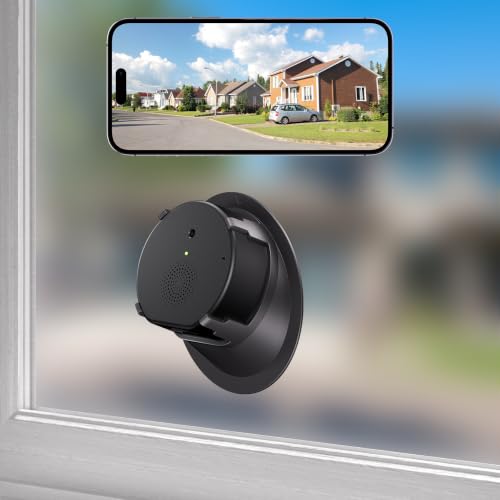 Fazoxo 2.5K Wireless Window Camera |
8.6/10 | Buy |
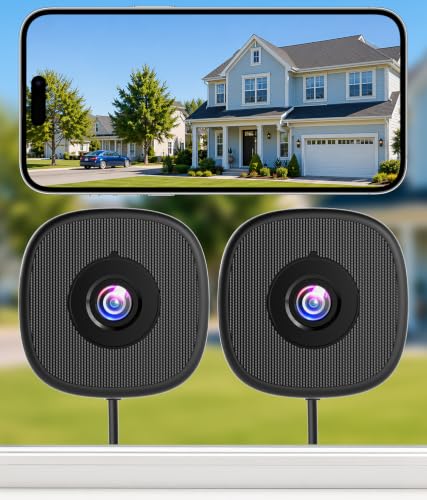 MISECU 2K Window Security Camera (2-Pack) |
8.3/10 | Buy | |
| Best Premium |
 Girafit 3MP 2K Window Camera |
8.1/10 | Buy |
 Girafit 3MP 2K Window Camera (2-Pack) |
8.1/10 | Buy | |
 WYZE Window Camera: Anti-Glare Indoor Security |
7.8/10 | Buy |
AXB 2K Window Security Camera
Designed to monitor outdoor spaces through interior glass, this compact AXB camera features anti-glare technology and full-color night vision. Dual-band Wi-Fi support and adhesive bracket mounting make it a practical option for exterior surveillance without drilling.
Pros
- Anti-glare design minimizes through-glass reflections
- Supports both 2.4GHz and 5GHz Wi-Fi
- Compact footprint installs easily without drilling
- Full-color night vision using dual-spectrum lighting
- Customizable AI motion detection zones
Cons
- MicroSD card not included for local storage
- Cloud storage requires an ongoing paid subscription
- Initial app pairing requires a manual reset procedure
Koohome 3K Window Security Camera
Housed in genuine American walnut, this compact camera records through window glass using anti-glare optics to monitor outdoor areas without exterior wiring. It offers renters and apartment dwellers an easy, drill-free surveillance setup with clear 3K resolution.
Pros
- Real walnut wood housing blends with home furnishings
- Anti-glare lens minimizes window reflections
- Magnetic adhesive mount requires no drilling
- Dual-band Wi-Fi supports both 2.4GHz and 5GHz
- Local 24/7 recording without mandatory subscription fees
Cons
- MicroSD card is not included
- Requires a nearby outlet for constant plug-in power
- Relatively narrow 105-degree field of view
Fazoxo 2.5K Wireless Window Camera
Designed for glass-mounted home surveillance, this wire-free camera delivers 2.5K video with a helpful six-second pre-roll buffer before motion triggers. An adjustable bracket and rechargeable battery allow flexible placement on windows without running power cords.
Pros
- Sharp 2.5K resolution with wide F1.6 aperture
- Six-second pre-roll captures context before motion occurs
- Completely wire-free battery design for flexible placement
- Supports local microSD storage without mandatory monthly fees
Cons
- MicroSD card must be purchased separately
- Color night vision requires ambient light to function
- Cloud video storage requires an optional paid subscription
MISECU 2K Window Security Camera (2-Pack)
Designed to adhere directly to glass, this indoor camera setup monitors outdoor areas without the need for exterior drilling or weatherproofing. Clear 2K resolution, glare-reduction design, and dual-band Wi-Fi make it an accessible surveillance option for renters and homeowners alike.
Pros
- Quick drill-free indoor installation on window glass
- Supports fast and flexible dual-band Wi-Fi networks
- Clear starlight color night vision through window glass
- Offers local continuous recording via microSD card
Cons
- MicroSD storage card is not included in the box
- Free cloud storage clips are capped at 8 seconds
- Advanced AI object recognition requires an optional paid subscription
Girafit 3MP 2K Window Camera
Designed for fast glass mounting, the Girafit 3MP Window Camera delivers 2K video clarity with dual-band Wi-Fi support. It is a solid choice for homeowners and renters seeking color night vision and continuous recording without running complicated wiring.
Pros
- Dual-band 2.4GHz and 5GHz Wi-Fi support
- Clear 3MP 2K video with color night vision
- Simple peel-and-stick installation process
- Flexible 24/7 recording via SD card or cloud
Cons
- Designed strictly for indoor window use
- Adhesive mount makes quick repositioning difficult
Girafit 3MP 2K Window Camera (2-Pack)
The Girafit 3MP 2K Window Camera 2-Pack delivers sharp indoor monitoring with dual-band Wi-Fi support and AI color night vision. Its peel-and-stick installation and 24/7 recording options provide an accessible security solution for viewing through interior glass.
Pros
- Sharp 3MP 2K video with color night vision
- Compatible with both 2.4GHz and 5GHz Wi-Fi
- Simple peel-and-stick setup with Bluetooth pairing
- Supports continuous 24/7 local or cloud recording
- Simultaneous live viewing for up to four feeds
Cons
- Designed strictly for indoor window use
- Peel-and-stick adhesive can complicate repositioning
WYZE Window Camera: Anti-Glare Indoor Security
The WYZE Window Camera is a compact indoor security camera designed to monitor the outdoors through window glass without glare, utilizing an f1.0 aperture lens and BSI sensor for color night vision. It offers subscription-free 24/7 continuous local recording via microSD, making it a practical option for apartment renters and homeowners seeking drill-free exterior surveillance.
Pros
- Flush window-mounting design eliminates interior glass reflection and glare issues
- Upgraded f1.0 lens and BSI sensor allow full-color night vision from ambient exterior lighting
- Continuous 24/7 local recording supported via microSD cards up to 512GB without monthly fees
- Quick Bluetooth pairing and included 10-foot power cable simplify interior positioning
- Works natively with Amazon Alexa, Google Assistant, and IFTTT automations
Cons
- Advanced AI recognition for people, pets, vehicles, and packages requires an optional cloud subscription
- Surveillance viewing angles are restricted to available indoor window placements
- MicroSD card for local video storage is sold separately
Technical Mechanics and Practical Guidelines for Through-Window Security Cameras
Deploying an indoor security camera to monitor exterior property through glass requires a thorough understanding of optical reflection, sensor mechanics, and motion detection algorithms. When homeowners attempt to point a conventional security camera out a window, they usually encounter severe image washout after sunset and completely unresponsive motion alerts. Solving these issues does not require complex industrial equipment, but it does demand camera hardware specifically engineered to handle the reflective and insulating properties of residential window panes. Selecting the right through-glass surveillance system involves examining how lens design, low-light sensors, mounting brackets, and local storage configurations interact with modern window glazing.
The Optical Barrier: Why Standard Infrared Cameras Fail Behind Glass
Conventional security cameras rely heavily on 850-nanometer or 940-nanometer infrared light-emitting diodes to illuminate dark environments. While infrared wavelengths travel easily through open air, residential glass acts as a semi-reflective mirror to this specific optical spectrum. When a camera’s integrated infrared LEDs activate inside a dark room facing a window, the infrared light bounces directly off the pane and blinds the image sensor. The resulting video feed shows an overexposed white glare in the center of the frame, rendering the outdoor environment pitch black and completely unviewable.
Modern residential architecture further compounds this issue through the use of double-pane and Low-Emissivity coated glass. Low-E coatings are microscopically thin metallic layers designed to reflect thermal infrared energy back into the living space to improve heating efficiency. Unfortunately, these thermal coatings also increase the reflective index of window glass, intensifying optical bounce-back from any internal light source. Even multi-pane gas-filled windows without specialized coatings introduce internal refraction layers that scatter incoming light and degrade video sharpness.
To record usable footage through a window at night, the camera must completely disable its internal infrared emitters. Dedicated window cameras eliminate built-in infrared reflections either by removing forward-facing IR lamps entirely or providing firmware toggles that keep illuminators permanently deactivated. The camera must then rely entirely on ambient outdoor light or separate exterior illuminators to illuminate the surveillance zone. Without internal infrared bounce-back, the optical sensor can focus cleanly through the glass pane and resolve exterior details without obstruction.
Motion Detection Mechanics: Replacing Passive Infrared with Computer Vision
Most battery-operated outdoor security cameras rely on Passive Infrared sensors to detect movement. These PIR sensors function by measuring changes in differential heat signatures across split detection zones within their field of view. However, window glass is fundamentally opaque to long-wave infrared thermal radiation emitted by human bodies, animals, and warm vehicle engines. As a result, an intruder can walk directly past a window-facing PIR camera without ever triggering a recording event or generating a push notification.
Effective through-glass security cameras circumvent this thermal limitation by utilizing optical pixel-luminance analysis and edge-based computer vision. Instead of searching for temperature fluctuations, the camera’s image processor continuously monitors changes in optical pixel groupings across consecutive video frames. Advanced models integrate dedicated neural processing units that analyze visual contours to distinguish between people, vehicles, pets, and package drops. Because this analysis relies purely on visible light entering the lens, the physical barrier of window glass does not impede detection accuracy.
Pixel-based motion detection requires fine calibration to prevent chronic notification fatigue. Because the system tracks visual pixel changes, environmental variables such as moving tree shadows, windshield reflections, and raindrops sliding down the glass pane can register as false movement. High-quality window cameras allow users to establish customizable activity zones, excluding high-glare surfaces or busy sidewalks from triggering alerts. Enabling person-detection filtering ensures the system only dispatches smartphone alerts when actual human silhouettes enter designated perimeter boundaries.
Low-Light Image Sensor Architecture and Large-Aperture Optics
Because through-window cameras cannot deploy internal infrared lights, their ability to capture clear nighttime video depends on optical sensor sensitivity. Backside-Illuminated CMOS image sensors dramatically improve low-light clarity by relocating internal wiring behind the photosensitive pixel layer. This physical architecture allows more incoming photons to strike each individual photodiode, producing a brighter image with significantly less digital noise. Starlight sensors leverage this improved quantum efficiency to reproduce recognizable color imagery under minimal ambient moonlight or distant streetlights.
A camera’s optical aperture plays an equally decisive role in through-glass performance. Lenses with ultra-wide physical apertures, such as f/1.0 or f/1.6, gather substantially more light than standard security lenses rated at f/2.0 or smaller. An f/1.0 lens allows four times as much light to reach the sensor compared to an f/2.0 lens, ensuring that dim scenes retain edge sharpness and contrast. These large-aperture optics allow window cameras to deliver full-color night vision even when facing unlit driveways or shadowy backyards.
Ambient exterior illumination remains a vital partner for any window-based surveillance setup. Even the most capable low-light sensor requires a baseline level of visible light to generate a clear exposure without motion blur. Homeowners can dramatically improve through-glass video quality by installing low-wattage exterior porch lights, landscape pathway lighting, or exterior solar fixtures. Strategic exterior lighting provides the necessary lux levels for the camera’s image sensor to resolve facial features and clothing details through the glass.
Power Architecture, Wake-Up Latency, and Continuous Video Buffering
Power delivery architecture directly dictates how a window camera operates and captures critical security events. Standard battery-powered cameras conserve energy by remaining in a deep-sleep state until their low-power PIR sensor detects heat movement. Because PIR detection does not function through window panes, a battery-powered window camera must keep its optical sensor and processor awake to analyze pixel movement. This continuous operational state can rapidly exhaust standard lithium-ion batteries within days unless the device is plugged directly into a continuous power supply.
Continuous AC or USB power allows window cameras to utilize advanced video pre-roll buffering. When a security camera relies solely on motion wake-up triggers, the system frequently misses the initial few seconds of an event, recording only the back of a person walking away. Continuously powered cameras maintain a rolling six-second video buffer in temporary memory. When a motion event is confirmed by the processor, the camera automatically attaches those preceding buffered seconds to the recorded clip, ensuring homeowners see exactly how an individual approached the property.
Homeowners deciding between indoor window setups and outdoor wireless hardware often evaluate battery security cameras with local storage for exterior mounting flexibility. While exterior battery cameras offer versatile placement on fences or trees, they remain vulnerable to battery degradation in sub-freezing temperatures and require regular recharging ladders. Window-mounted cameras leverage continuous indoor AC power via long USB cables, entirely eliminating battery maintenance while remaining protected from extreme weather and physical tampering. This stable power architecture ensures uninterrupted perimeter surveillance without seasonal battery anxiety.
Physical Mounting Mechanics and Interior Glare Suppression
Physical mounting alignment is critical when installing a security camera behind glass. Even when infrared emitters are disabled, interior room lighting can reflect off the inside face of the window pane and wash out the camera lens. Purpose-built window cameras utilize specialized peel-and-stick adhesive brackets, hook-and-loop fasteners, or silicone suction frames that hold the camera lens flush against the glass surface. Eliminating the physical air gap between the lens and the glass prevents stray interior light from entering the optical path.
Proper management of interior ambient lighting further enhances nighttime video clarity. If a desk lamp, television, or overhead light fixture illuminates the room behind the camera, stray light can bleed around the bracket edges and degrade image contrast. Installing a dark adhesive bezel around the camera bracket creates an effective light shield that blocks interior reflections. For optimal surveillance performance, homeowners should also angle indoor lighting away from surveillance windows or keep the immediate room darkened at night.
Surface hygiene on both sides of the window pane directly influences optical focus and autofocus stability. Dust particles, smudges, and mineral water spots on the exterior glass can cause auto-exposure algorithms to focus on the surface of the pane rather than the outdoor landscape. Thoroughly cleaning both interior and exterior glass surfaces with an alcohol-based glass cleaner prior to mounting ensures the lens maintains sharp focus on distant perimeters. Inspecting adhesive mounting strips periodically ensures the camera maintains its flush alignment against the pane over time.
Dual-Band Wireless Transmission and Network Bandwidth Management
Wireless network performance directly impacts live-view streaming latency and video recording reliability. Most indoor window cameras support both 2.4 GHz and 5 GHz dual-band Wi-Fi connectivity to adapt to diverse residential network environments. The 2.4 GHz frequency band provides superior structural penetration through interior drywall and insulated walls, making it ideal for cameras located farther from the central router. The 5 GHz frequency band offers significantly faster data throughput with less wireless congestion, which helps reduce video buffering when streaming high-resolution 2K or 3K feeds.
High-resolution video streams require substantial network bandwidth that can strain residential internet connections if not managed efficiently. A camera capturing 2K or 3K video using standard H.264 compression can consume several megabits per second of upstream bandwidth. Modern window cameras frequently adopt High Efficiency Video Coding, also known as H.265, which reduces required bitrates by roughly fifty percent while preserving image sharpness. Homeowners with metered residential broadband plans or asymmetric upload caps benefit substantially from H.265 compression, which prevents cameras from exceeding monthly data allowances.
Simplified device pairing protocols streamline the initial network configuration process. Many contemporary window security cameras incorporate Bluetooth radios that establish an immediate pairing handshake with mobile smartphone applications. This direct Bluetooth link eliminates the frustration of scanning reflective QR codes on camera bodies or dealing with repeated Wi-Fi connection timeouts. Once paired, the mobile app transfers local network credentials seamlessly, establishing a secure connection to the home’s wireless router in seconds.
Storage Topology: High-Endurance MicroSD Cards Versus Cloud Vaults
Storage architecture dictates how homeowners access, review, and archive surveillance recordings. Most window cameras include onboard microSD card slots supporting memory capacities up to 256GB or 512GB for continuous local recording. Because continuous 24/7 video recording subjects flash memory to constant write cycles, standard consumer flash memory can fail prematurely. Homeowners should always select high-endurance microSD cards rated for Class 10, UHS-I Speed Class 3, and Video Speed Class 30, which utilize specialized flash controllers designed for perpetual overwriting.
Evaluating local storage independence helps homeowners compare self-contained window units against comprehensive whole-home setups like continuous Power over Ethernet camera systems. While multi-camera PoE setups utilize dedicated network video recorders with massive spinning hard drives, indoor window cameras provide a compact, zero-subscription alternative for single-entryway monitoring. Onboard microSD storage ensures that footage continues recording even if home internet connectivity drops, preserving valuable evidence during network outages without recurring monthly fees. This local autonomy protects homeowner privacy by keeping sensitive video clips contained entirely within the physical premises.
Optional cloud subscription services provide an offsite safeguard against physical hardware damage or camera theft. Many window camera manufacturers offer cloud tiers that archive motion-activated video clips to encrypted remote servers for seven to thirty days. These subscription packages often unlock advanced cloud-based artificial intelligence features, such as vehicle classification, facial recognition, and package detection. Homeowners must balance the convenience and redundancy of cloud backups against the ongoing cumulative cost of recurring subscription fees.
Evidentiary Clarity, DORI Standards, and Surveillance Privacy Compliance
Assessing camera resolution through glass requires an understanding of the international standard IEC EN 62676-4, commonly known as DORI metrics. DORI defines optical performance in terms of Detection, Observation, Recognition, and Identification based on pixel density per foot. Achieving forensic identification requires at least 76 pixels per foot across the target’s face. While a 2K or 3K camera easily achieves identification density at short distances, the slight optical diffusion of double-pane window glass can reduce effective identification ranges, making camera placement near entry choke points essential.
Audio recording through glass introduces both physical limitations and significant legal considerations. Because sealed double-pane windows attenuate exterior acoustic vibrations, an indoor camera’s integrated microphone will capture very little audible conversation from outside. Furthermore, recording outdoor conversations can trigger legal liabilities under the Federal Wiretap Act (18 U.S.C. § 2511) and state-level eavesdropping statutes. While many states permit one-party consent audio recording, several jurisdictions require all-party consent when capturing private conversations. Homeowners should verify local audio recording statutes and consider disabling audio recording features entirely when pointing cameras across property boundaries.
Respecting residential privacy boundaries is essential when establishing a permanent through-window surveillance station. Under Fourth Amendment legal principles and state tort laws, individuals maintain a reasonable expectation of privacy within private backyards and interior living quarters. Homeowners must utilize in-app privacy masking tools to black out neighboring windows, decks, or shared property lines from the camera’s field of view. Verifying detection zones and confirming optical clarity during daytime and nighttime ensures an effective, legally compliant perimeter security monitoring system.
About the author
John Carlsen is a home security and smart home specialist with more than a decade of experience researching and testing security technology. His expertise covers DIY security systems, security cameras, smart devices, pricing, contracts, and connected-home technology. He combines hands-on product testing with detailed research to explain strengths, limitations, ownership costs, and real-world value in straightforward terms for homeowners and renters.