
How to Fix Security Camera Cable: A Practical Repair Guide for 2026
Restore reliable video surveillance by learning how to fix security camera cable damage, splice BNC coax lines, and seal connections in November 2026.
 By John R. Delaney
Updated November 17, 2026


Sudden video dropouts, flickering analog lines, and intermittent night vision failures often point directly to a compromised physical connection rather than a failed camera sensor. Outdoor wiring endures constant exposure to UV sunlight, seasonal temperature swings, shifting building trim, and even curious rodents that can chew through protective jackets. Learning how to fix security camera cable damage quickly restores your surveillance coverage without requiring a costly technician dispatch or an immediate hardware overhaul. Many homeowners facing signal issues with their wired setups or expanding PoE security camera systems can resolve these faults using straightforward physical splicing techniques or targeted cable segment replacements.
Whether your installation relies on traditional analog Siamese wiring combining BNC video with 12V DC power lines or modern twisted-pair network runs, diagnosing the exact failure point is the critical first step. A pinched wire behind a mounting bracket or oxidized center pin can mimic complete equipment failure, generating unnecessary frustration during routine monitoring. By understanding the mechanical structure of coaxial conductors, DC barrel jacks, and copper shielding, you can safely repair severed connections and re-establish a pristine video signal across your residential surveillance layout.
| Award | Product | SSG Score About SSG ScoreThe SSG Score is our own rating from 0 to 10, based on performance, design and build, ease of use, and value. It reflects independent research and is never influenced by manufacturers, retailers, or affiliate commissions. Learn more › | |
|---|---|---|---|
| Best Overall |
Flashmen 2-Pack 25ft All-in-One BNC Video
|
9.1/10 | Buy |
| Best Budget |
 Flashmen 25-Foot BNC Video & Power Cable |
8.8/10 | Buy |
 Cables Direct Online 10FT BNC Video and Power |
8.4/10 | Buy | |
 InstallerCCTV 60ft BNC Video & Power Cable |
8.4/10 | Buy | |
| Best Value |
 Flashmen 25ft BNC CCTV Cables, 2-Pack |
8.3/10 | Buy |
| Best Premium |
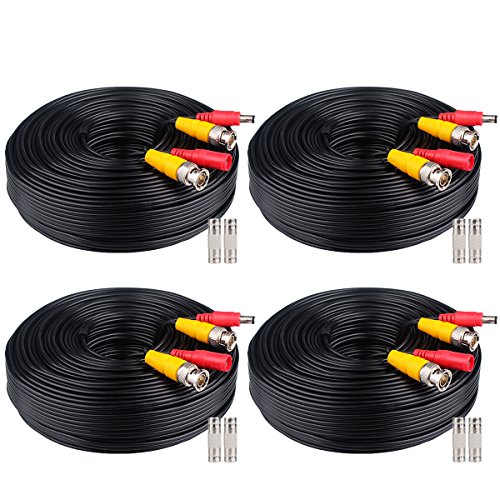 WILDHD 100ft CCTV BNC Security Camera Cable |
8.3/10 | Buy |
 iSmart 2-Pack 125ft BNC All-in-One Video and Power |
8.0/10 | Buy |
Flashmen 2-Pack 25ft All-in-One BNC Video
The Flashmen 2-Pack 25ft All-in-One CCTV Cables deliver pre-terminated BNC video and DC power connections designed for simple plug-and-play installation across HD-TVI, HD-CVI, HD-AHD, and analog surveillance setups. They are a practical, budget-friendly solution for homeowners extending hardwired camera runs to a central DVR without splicing wires.
Pros
- Pre-terminated BNC and DC power connectors enable quick, tool-free plug-and-play installation.
- Compatible with standard analog (700TVL to 1200TVL) and modern HD analog formats (HD-TVI, HD-CVI, HD-AHD).
- Two-pack bundle offers practical value for running or replacing cables on multiple cameras.
- Eliminates messy dual-cable runs by integrating video and power into one siamese cord.
Cons
- Fixed 25-foot length may be too short for large perimeter runs or require couplers for longer distances.
- Designed strictly for analog and coaxial BNC setups, making it incompatible with modern Ethernet PoE IP cameras.
- Does not include integrated audio RCA leads for cameras requiring separate analog microphone channels.
Flashmen 25-Foot BNC Video & Power Cable
Designed for straightforward CCTV setups, this pre-made Flashmen all-in-one cable carries both video and DC power over a 25-foot distance. Its pure copper 24 AWG coaxial build and bundled adapter kit make it a convenient option for compact security camera installations.
Pros
- Pure copper coaxial wiring maintains reliable signal transmission
- All-in-one design combines video and power delivery
- Includes versatile BNC and RCA connector adapters
- Weather-resistant construction allows outdoor use
Cons
- 25-foot length is short for larger property installations
- Thinner 24 AWG gauge limits longer cable extensions
- Single-pack format requires extra purchases for multi-camera setups
Cables Direct Online 10FT BNC Video and Power
This 10-foot all-in-one Siamese BNC and DC power cable provides a dependable, plug-and-play physical link between analog CCTV cameras and a local DVR recorder. It is an affordable, practical choice for DIY homeowners and installers needing a neat, short-run indoor connection without the hassle of custom crimping.
Pros
- Pre-terminated all-in-one design combines BNC video and power in a single clean run
- Factory-molded connectors eliminate the hassle of field stripping and crimping
- Shielded construction helps reduce video interference and signal degradation
- 10-foot length prevents excessive cable clutter in tight DVR equipment setups
Cons
- 10-foot span is too short for long-distance perimeter runs across large properties
- Specified by the manufacturer for indoor environments rather than direct burial or exposed outdoor routing
InstallerCCTV 60ft BNC Video & Power Cable
Designed for straightforward CCTV setups, this 60-foot Siamese cable integrates copper video and power lines to support analog and HD systems up to 5MP. Its slim profile routes smoothly through cord concealers, making it a practical wiring option for compatible DVR cameras.
Pros
- Pure copper wiring ensures solid signal and power transmission
- Broad format support handles resolutions up to 5MP
- Includes two extra female-to-female BNC adapters
- Slim profile fits easily into standard cord concealers
Cons
- Only compatible with cameras using 2.1mm DC power plugs
- Fixed 60-foot run requires couplers for longer installations
Flashmen 25ft BNC CCTV Cables, 2-Pack
Designed for straightforward surveillance setups, this Flashmen two-pack combines video transmission and DC power into a single pre-made line. The integrated BNC and power connectors deliver plug-and-play installation for analog HD systems without requiring manual wiring.
Pros
- Combines BNC video and power into one line
- Pre-terminated ends eliminate the need for crimping tools
- Broad compatibility with standard analog HD formats
- Convenient two-pack suits multi-camera installations
Cons
- Fixed 25-foot length limits long-distance camera placement
- Incompatible with digital IP and PoE systems
- Bulky pre-made connectors require larger wall pass-through holes
WILDHD 100ft CCTV BNC Security Camera Cable
The WILDHD 4x100ft BNC Siamese cable pack delivers pre-terminated video and DC power wiring designed for analog HD DVR surveillance systems up to 5MP resolution. It provides DIY homeowners and property managers an economical, plug-and-play wiring solution bundled with BNC extension couplers and mounting clips.
Pros
- Pre-fabricated Siamese design combines video and power into a single streamlined pull
- Broad compatibility across major HD-over-coax formats up to 5MP resolution
- Generous accessory bundle with 8 female BNC extension couplers and 100 nail clips
- Gold-plated center pins on BNC male connectors help preserve signal conductivity
Cons
- Not rated for 4K / 8MP video signals or Power over Ethernet (PoE) IP camera systems
- Pre-molded connectors require larger drill holes through exterior walls than bulk unterminated cable
- Long 100-foot power runs may experience minor DC voltage drop on power-hungry cameras with heavy infrared LED arrays
iSmart 2-Pack 125ft BNC All-in-One Video and Power
This pre-made 125-foot all-in-one cable 2-pack combines BNC video transmission and 12V DC power into a single run for CCTV surveillance setups. It is ideal for property owners wiring analog DVR security cameras without the hassle of cutting and crimping raw coax.
Pros
- Pre-terminated dual-lead design runs both video signal and DC power simultaneously in one physical pull
- Substantial 125-foot length per cord covers long runs to garages, backyards, or property perimeters
- Includes female BNC couplers and RCA adapters for versatile connection options right out of the box
- Standard 5.5mm x 2.1mm DC connectors fit most standard 12V analog CCTV camera systems
Cons
- Long 125-foot analog runs may experience minor signal attenuation or DC voltage drop depending on camera power draw
- Pre-molded connectors require drilling larger pass-through holes in walls compared to running bare, un-terminated bulk cable
- Designed strictly for analog BNC CCTV setups and incompatible with Power over Ethernet (PoE) IP camera systems
Comprehensive Guide to Diagnosing and Repairing Security Camera Cables
Resolving a damaged surveillance line requires isolating whether the failure exists in the video transmission path, the low-voltage power supply, or a shared grounding point. Because most residential installations utilize either analog Siamese cabling or twisted-pair network lines, identifying the exact cable anatomy dictates the repair strategy. Cutting away the compromised section and rebuilding the interface with proper terminations restores signal integrity without creating ongoing video artifacts. Taking a methodical approach ensures your security cameras remain dependable without introducing unnecessary electrical resistance or weather vulnerability.
Identifying Common Cable Faults and Video Failure Symptoms
Visual symptoms on your monitor often reveal the underlying physical damage before you ever touch a ladder or a wire stripper. A total black screen displaying a “No Video” warning usually indicates a complete sever in the video conductor or a total disconnection of the 12V DC power circuit. In contrast, rolling horizontal hum bars or high-frequency snow across an analog picture suggest a damaged shielding layer or a ground loop issue. Inspecting the physical cable run along exterior walls, gutters, or fence lines frequently uncovers pinched jackets, tight radius bends, or animal chew marks that breach the outer protective jacket.
Power-related cable faults often manifest uniquely when ambient daylight transitions into darkness. A camera may broadcast a crisp daytime picture, only to drop offline completely or begin an endless reboot cycle the moment its infrared LEDs illuminate. Infrared arrays demand significantly higher electrical current, causing an excessive voltage drop along thin, degraded, or improperly spliced power conductors. Recognizing this symptom saves substantial time, pointing the diagnostic path toward the low-voltage power pair rather than the video transmission core.
Anatomy of Security Camera Cabling: Siamese Coax vs Twisted Pair
Traditional analog and high-definition analog setups, such as AHD, HD-TVI, and HD-CVI systems, typically rely on conjoined Siamese cables. These assemblies physically bond a 75-ohm coaxial cable for composite or high-definition video transmission alongside a two-conductor stranded copper pair for low-voltage direct current. The coaxial portion consists of a solid or stranded center copper core, surrounded by a dielectric insulator, a woven metallic shield, and a PVC outer jacket. Maintaining this shielding intact is essential for deflecting electromagnetic interference produced by household wiring or nearby outdoor electrical fixtures.
Modern IP surveillance networks instead utilize twisted-pair Ethernet cables, such as Cat5e or Cat6, which carry both digital video packets and operating electricity simultaneously. Under the IEEE 802.3af and 802.3at Power over Ethernet standards, power and data travel across four balanced pairs of copper wire. When maintaining advanced setups like add-on security cameras for NVR setups, technicians must preserve the tight conductor twists up to the termination point. Physical damage to any single pair within an Ethernet jacket can induce severe packet loss, frame dropping, or a complete loss of camera power.
Essential Diagnostic Tools and Continuity Testing
Pinpointing the precise point of failure without unnecessarily tearing down dozens of feet of wiring requires a few basic diagnostic instruments. A standard digital multimeter set to measure direct current voltage and resistance provides immediate verification of electrical continuity and potential short circuits. By measuring voltage at the camera end of the cable run under load, you can quickly verify whether the line delivers the nominal 12V DC required for operation. A drop below roughly 10.8V DC indicates excessive conductor resistance, an incomplete splice, or a degraded copper path.
Continuity testing verifies that the internal conductors have not broken inside an intact outer jacket. Disconnecting both ends of the cable allows you to test for an open circuit between the center video pin and the outer metallic barrel. If the multimeter beeps when touching the center conductor to the outer shield while the opposite end is disconnected, a short circuit exists somewhere along the run. For complex installations involving long perimeter spans, a specialized CCTV tester or cable toner helps locate hidden line breaks behind drywall or inside attic crawlspaces.
Splicing and Re-Terminating BNC Coaxial Connections
Splicing coaxial cable by twisting the bare copper wires together with electrical tape is a common mistake that invariably ruins video quality. Coaxial cable functions as a precision transmission line where physical geometry and shielding continuity maintain a stable 75-ohm impedance. When a cable is severed, the proper repair method involves cutting away the crushed section and terminating each freshly cut end with a new BNC connector. Using three-tier coaxial wire strippers guarantees the outer jacket, braided metallic shield, and inner dielectric core are trimmed to the exact lengths required by the terminal.
Compression BNC connectors offer the highest mechanical stability and weather resistance for residential repairs compared to older crimp-on or twist-on designs. Once both ends are cleanly stripped, slide the connector body over the dielectric until the center pin seats firmly and locks into the connector face. Squeeze the connector with a dedicated linear compression tool to form a permanent 360-degree seal around the cable jacket. After attaching compression BNC male plugs to both severed ends, join them securely using a standard female-to-female BNC barrel adapter to re-establish continuous signal transmission.
Repairing Damaged Low-Voltage 12V DC Power Leads
The dual-conductor power lead running alongside Siamese video cable carries low-voltage direct current, making it relatively straightforward to splice when severed. Strip approximately half an inch of insulation from both the positive and negative conductors on each side of the damaged segment. Slide a piece of marine-grade, adhesive-lined heat shrink tubing over each individual wire before joining the conductors. Twisting the bare copper strands into a secure lineman splice and soldering the joint creates a low-resistance bond that resists mechanical pulling and oxidation.
If soldering in the field is impractical, weather-sealed crimp butt connectors with internal heat-activated sealant provide a reliable alternative. Always maintain strict polarity alignment during this process, connecting the red positive wire to positive and the black negative wire to negative. Reverse polarity can instantly damage the internal circuitry of analog cameras that lack reverse-bias diode protection. Once the copper splices are secured, position the heat shrink tubing over the joints and apply gentle heat until the internal adhesive flows outward to encapsulate the exposed metal completely.
Replacing a damaged terminal plug requires standard 2.1mm by 5.5mm DC barrel connectors, which represent the universal standard across residential analog equipment. Screw-terminal DC pigtail adapters offer a fast, tool-free method to replace crushed or bent barrel jacks without requiring specialized crimpers. Ensure the center pin remains positive while the outer sleeve serves as ground, which corresponds to the standard center-positive architecture of surveillance power supplies. Loose or corroded DC connectors cause intermittent reboot cycles, so securing the screw terminals firmly prevents future service disruptions.
Splicing and Repairing Power over Ethernet Network Lines
Repairing an Ethernet network cable powering an IP surveillance camera demands strict adherence to twisted-pair wiring geometry. Standard Cat5e or Cat6 cables contain eight color-coded solid or stranded copper conductors arranged in four tightly twisted pairs. If an outdoor network run is severed by landscaping equipment or building maintenance, trimming the damaged ends cleanly is necessary before installing new RJ45 modular plugs. Terminating the cables according to the standard T568B pinout pattern maintains compatibility across all commercial switches and network recorders.
Preserving the pair twists right up to the crimp point is crucial because untwisting conductors more than half an inch invites severe crosstalk and data loss. When repairing high-bandwidth surveillance lines, such as those servicing driveway PTZ security cameras, signal stability depends heavily on consistent pair geometry. Once two RJ45 male connectors are crimped onto the severed ends, join them using an IP67-rated waterproof inline coupler. These specialized couplers feature screw-down compression collars and rubber O-rings that prevent moisture from wicking into the delicate gold-plated RJ45 pins.
Weatherproofing Splices and Preventing Water Ingress
Moisture is the single greatest enemy of repaired outdoor security camera wiring, as capillary action can draw water several feet inside a damaged cable jacket. Standard vinyl electrical tape quickly degrades under direct ultraviolet sunlight, leaving seams exposed to driving rain, ice, and morning dew. The most effective protective strategy combines self-amalgamating silicone tape with heavy-wall polyolefin heat shrink tubing. Self-fusing silicone tape chemically bonds to itself when stretched, forming a seamless, rubberized barrier that completely repels moisture and environmental dust.
Physical cable routing also plays an essential protective role that prevents water from ever reaching a repaired connection. Always bend a downward drip loop into the cable immediately before it enters a junction box, connector housing, or exterior wall penetration. Drip loops force descending water to collect at the lowest curve of the wire and drop harmlessly to the ground rather than running directly into the electrical interface. Installing a surface-mounted weatherproof junction box to house spliced BNC adapters and DC connections shields delicate terminals from physical stress and heavy precipitation.
Deciding Between Splicing and Installing Pre-Made Replacement Runs
While field splices offer a fast temporary fix, replacing an entire compromised run with a pre-made Siamese cable is often the smarter long-term investment. Splicing requires dedicated tools, compression fittings, heat guns, and substantial ladder time, which can quickly exceed the effort of running a fresh line. Pre-made all-in-one cables feature factory-molded BNC connectors and molded DC barrel plugs engineered to minimize signal attenuation and physical strain. For residential runs spanning 25 to 100 feet, pre-fabricated Siamese lines eliminate the risk of cold solder joints or mismatched connector tolerances.
Cable length and conductor gauge also dictate whether a repair is viable or if a heavier replacement line is necessary. Long runs exceeding 100 feet suffer noticeable voltage loss if thin 24 AWG power conductors are spliced repeatedly. High-quality pre-made cables utilizing pure copper cores and robust shielding maintain crisp 1080p and higher resolution analog video without introducing high-frequency noise. If an existing wire has suffered multiple breaches along its span or displays brittle, UV-damaged insulation throughout, pulling a brand-new pre-made line restores complete structural reliability.
Post-Repair Verification and Video Signal Calibration
Testing the completed repair under realistic operational conditions ensures that your surveillance system performs reliably around the clock. Begin by powering the camera and inspecting the live video monitor for any signs of ghosting, line jitter, or color shifting. Gently manipulate the repaired cable section by hand to confirm there are no intermittent breaks or loose pin connections inside the newly installed BNC or RJ45 terminals. A steady, uninterrupted live stream confirms that both mechanical shielding and conductor continuity have been properly re-established.
The final verification step requires checking camera functionality under maximum electrical load during night vision operation. Cover the camera lens and ambient light sensor with an opaque cloth to trigger the internal IR-cut filter and activate the infrared LED ring. If the video feed remains bright and clear without rebooting, horizontal banding, or image rolling, the power leads are delivering adequate voltage. Securing the repaired cable neatly against the building surface with UV-rated mounting clips completes the restoration, ensuring continuous perimeter safety and peace of mind.
About the author
John R. Delaney is a veteran technology editor and product reviewer specializing in home security, smart home devices, and wireless networking. With extensive experience evaluating connected security systems, cameras, smart locks, sensors, and networking equipment, he brings a practical testing mindset to consumer technology. His work emphasizes usability, performance, connectivity, and long-term value for homeowners building reliable smart security systems.