
What Is the Best No Subscription Security Camera: Selection Guide for 2026
Compare what is the best no subscription security camera options for November 2026 with local storage, reliable power, and zero recurring monthly fees.
 By Rebecca Edwards
Updated November 5, 2026

Recurring cloud fees have turned modern residential surveillance into an expensive ongoing utility bill for many property owners. Homeowners frequently encounter subscription fatigue after discovering that essential features like person detection, activity zones, and video clip archives require perpetual monthly payments. Exploring What Is The Best No Subscription Security Camera allows buyers to maintain complete control over their recorded footage while avoiding mandatory recurring service fees. Modern standalone surveillance equipment relies on local microSD storage, centralized base stations, and on-device artificial intelligence to process security events directly at the network edge.
Eliminating cloud dependencies also enhances personal data privacy by keeping private video streams off remote corporate servers. Battery and solar hardware has evolved significantly, making it practical to deploy wire-free cameras with local storage across fences, outbuildings, and driveway gates without sacrificing perimeter awareness. Whether you need a simple indoor monitoring unit or a complete multi-point outdoor perimeter system, understanding hardware capabilities ensures dependable video capture during network outages. Selecting the proper architecture comes down to balancing installation flexibility, power delivery, and your preferred storage topology.
| Award | Product | SSG Score About SSG ScoreThe SSG Score is our own rating from 0 to 10, based on performance, design and build, ease of use, and value. It reflects independent research and is never influenced by manufacturers, retailers, or affiliate commissions. Learn more › | |
|---|---|---|---|
| Best Overall |
eufy Security 4K Indoor Cam E30 Pan and Tilt Pet
|
9.2/10 | Buy |
| Best Value |
 TKMARS Video Doorbell with 4.3-Inch Monitor |
9.2/10 | Buy |
| Best Premium |
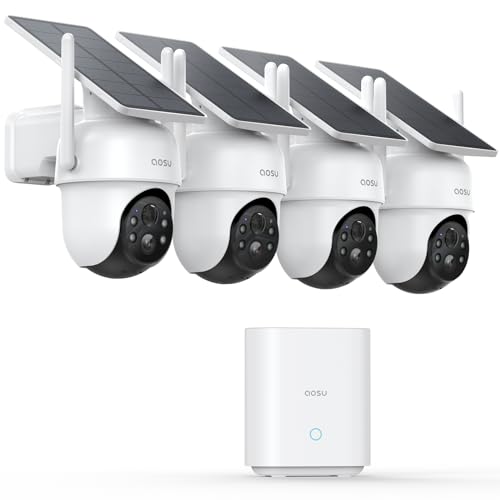 aosu D1 Classic 4-Cam Wireless Outdoor Security |
9.2/10 | Buy |
 AUKIN 4G LTE Solar Cellular Security Camera |
9.1/10 | Buy | |
| Best Budget |
 SEHMUA 4G LTE Cellular Solar Outdoor Security |
8.6/10 | Buy |
 youkey 2K 360° Indoor Security Camera |
8.3/10 | Buy | |
 psync MaaX V1 Wired Security Camera |
8.0/10 | Buy |
eufy Security 4K Indoor Cam E30 Pan and Tilt Pet
The eufy Security Indoor Cam E30 delivers detailed 4K video recording, motorized 360-degree pan-and-tilt tracking, and intelligent on-device detection without mandatory monthly fees. It is an ideal fit for families, pet owners, and privacy-minded buyers seeking high-resolution indoor monitoring across Apple HomeKit, Alexa, and Google Assistant setups.
Pros
- Sharp 4K video resolution offers exceptional indoor clarity for family and pet monitoring
- No mandatory subscription fees to access on-device AI detection and local video playback
- Motorized pan-and-tilt auto-tracking covers broad living areas with zero manual aiming
- Broad smart home compatibility spanning Apple HomeKit, Amazon Alexa, and Google Assistant
- Color night vision supported by an integrated spotlight for clear visibility in dim conditions
Cons
- Local storage requires purchasing a compatible microSD card separately
- Apple HomeKit integration is limited to 1080p resolution rather than native 4K
- Indoor-only enclosure lacks outdoor weatherproofing or moisture resistance
TKMARS Video Doorbell with 4.3-Inch Monitor
Designed for simple offline security, this wireless system pairs a 170-degree outdoor camera directly with an included 4.3-inch monitor without requiring Wi-Fi or recurring fees. It provides push-to-talk intercom and local recording, making it well suited for seniors and privacy-conscious households.
Pros
- Operates completely without Wi-Fi, apps, or recurring subscriptions
- Includes a dedicated 4.3-inch IPS indoor display screen
- Wide 170-degree viewing angle with integrated night vision
- Push-to-talk communication controls when audio is transmitted
- Supports local video storage up to 32 GB
Cons
- MicroSD card is not included in the package
- Indoor monitor requires continuous USB-C connection for regular use
- Outdoor battery lasts only up to one month
aosu D1 Classic 4-Cam Wireless Outdoor Security
The aosu D1 Classic 4-Cam Kit delivers complete perimeter visual defense using solar-powered 2K pan-and-tilt cameras paired with a dedicated aosuBase hub for subscription-free encrypted local storage. It is an ideal zero-monthly-fee security solution for suburban homeowners looking to monitor entryways, yards, and driveways without wiring hassles.
Pros
- Subscription-free residential security with 32GB of encrypted local loop recording housed safely inside the aosuBase hub.
- Continuous solar charging requires only three hours of sunlight daily, minimizing the need for manual battery recharging.
- 360-degree pan-tilt coverage with automatic motion tracking ensures subjects are actively followed across the camera view.
- Simultaneous four-camera split-screen live viewing and cross-camera event sequencing simplify outdoor perimeter monitoring.
Cons
- Requires sufficient daily sunlight exposure (at least three hours), which may limit optimal placement under deep soffits or shaded tree canopies.
- Lacks cellular backup and relies entirely on local wireless connectivity, meaning remote push alerts depend on home internet uptime.
- Permanent exterior installation requires drilling mounting holes, making it less adaptable for strict drill-free rental balconies.
AUKIN 4G LTE Solar Cellular Security Camera
The AUKIN 4G LTE Solar Cellular Security Camera delivers wire-free off-grid surveillance for remote properties, farms, and job sites without requiring Wi-Fi or recurring monthly data plans. Featuring 2K full-color night vision, 360-degree motorized pan-tilt tracking, and an integrated 7000mAh battery continuously refreshed by solar power, it offers dependable coverage in areas where traditional network cameras cannot function.
Pros
- Embedded multi-carrier VSIM provides lifetime free 4G LTE connectivity with zero recurring monthly data fees or subscription contracts.
- Independent cellular operation connects via AT&T, T-Mobile, and Verizon coverage, making it ideal for remote properties lacking Wi-Fi.
- Motorized 360-degree pan-tilt coverage with automated human tracking and crisp 2K full-color night vision.
- Solar panel generates substantial daily replenishment power to support the internal 7000mAh battery under adequate sunlight.
- Includes a pre-installed 32GB microSD card for out-of-the-box local event recording without cloud storage paywalls.
Cons
- Embedded VSIM card is dedicated exclusively to this camera and cannot be swapped or transferred to other cellular data plans.
- Solar recharging depends heavily on unobstructed direct sunlight and may experience reduced charging efficiency during prolonged overcast or winter weather.
- Lacks native compatibility with third-party NVR storage arrays, desktop RTSP streams, or Home Assistant network setups.
SEHMUA 4G LTE Cellular Solar Outdoor Security
The SEHMUA 4G LTE Solar Security Camera provides true off-grid perimeter protection with 2K resolution, pan-tilt rotation, and continuous 6W solar charging without requiring Wi-Fi. It is an ideal pick for property owners monitoring remote locations such as barns, rural acreage, construction sites, and vacation homes.
Pros
- Operates completely without local Wi-Fi or electrical grid power using 4G LTE cellular data
- Motorized pan-and-tilt rotation provides 360-degree viewing coverage via the Ubox mobile app
- Included 6W solar panel helps maintain continuous battery charge in sunny outdoor locations
- Pre-installed multi-carrier SIM card supports AT&T, T-Mobile, and Verizon cellular coverage
- Crisp 2K resolution with 4X digital zoom and optional full-color night vision illumination
Cons
- Does not support standard home Wi-Fi network connections
- Spotlight for full-color night vision must be manually toggled on inside the Ubox app
youkey 2K 360° Indoor Security Camera
Designed for nurseries and living areas, this compact pan-and-tilt camera delivers 2K video with automatic motion tracking and specialized AI alerts for baby crying and pets. It provides flexible local recording on a microSD card alongside straightforward smart home voice integration.
Pros
- Crisp 2K resolution with 360-degree coverage
- Dedicated AI detection for people, pets, and crying
- Supports local microSD card storage up to 256GB
- Integrates with Amazon Alexa and Google Assistant
- Quick setup using Bluetooth fast pairing
Cons
- MicroSD card is sold separately
- Operates exclusively on 2.4GHz Wi-Fi bands
psync MaaX V1 Wired Security Camera
The psync MaaX V1 provides continuous local recording with integrated 64GB storage and zero mandatory subscription fees. Equipped with an F1.0 aperture and dual-band Wi-Fi, it offers clear color night vision without relying on visible spotlights.
Pros
- Built-in 64GB storage with no subscription fees
- Large F1.0 aperture for spotlight-free color night vision
- Dual-band 2.4GHz and 5GHz Wi-Fi support
- IP65-rated weather-resistant camera housing
Cons
- Requires a continuous wired power source
- Power adapter operates only down to 32 degrees Fahrenheit
Understanding No-Subscription Security Architecture and Hardware
A zero-subscription surveillance system operates by shifting core computing and storage tasks directly onto local hardware rather than relying on remote servers. Instead of streaming continuous video feeds to commercial data centers, these cameras manage detection, encryption, and media archiving entirely within your home perimeter. This local architecture eliminates recurring monthly charges, protects personal privacy, and maintains recording reliability even during external broadband interruptions. Understanding how individual hardware components interact allows you to build a resilient security setup tailored to your specific property layout.
Local Storage Topologies and Memory Endurance
Local storage methods generally divide into edge-based memory cards, internal flash chips, and centralized home hubs. Standalone indoor and outdoor units, such as the eufy Security 4K Indoor Camera E30 and the youkey 2K Indoor Secuirty Camera, utilize removable microSD slots supporting cards up to 256GB. Some advanced designs eliminate external cards entirely by integrating built-in memory directly onto the primary circuit board. For instance, the psync MaaX V1 2K Outdoor/Indoor Wired Security camera features factory-installed 64GB storage, enabling continuous 24/7 video capture right out of the box without requiring card formatting or accessory purchases.
Continuous recording places heavy structural demands on flash memory due to relentless write and overwrite cycles. Standard consumer memory cards quickly fail under continuous video surveillance workloads because their flash memory cells degrade from thermal stress and continuous write operations. Property owners utilizing continuous recording should always select High Endurance cards rated for Video Speed Class 30 (V30) and UHS Speed Class 3 (U3) with wear-resistant flash memory. Configuring motion-triggered recording instead of continuous recording significantly extends memory card longevity on battery and solar devices.
Centralized hub storage offers an additional layer of security by decoupling physical media from vulnerable exterior camera mounts. Systems like the aosu D1 Classic 4-Cam Kit utilize an interior base station equipped with 32GB of encrypted storage that saves footage inside the home even if an outdoor camera is damaged or stolen. Property owners seeking expanded surveillance capacity across multiple structures often upgrade to centralized network video recorder setups with high-capacity SATA hard drives for continuous archiving. This segregated approach guarantees physical data preservation against outdoor tampering and harsh environmental conditions.
Edge-Based Artificial Intelligence Versus Cloud Video Analytics
Older motion detection systems relied strictly on pixel-vector changes, triggering endless false alarms whenever wind tossed tree branches, headlights swept past, or rain fell. Modern no-subscription systems avoid this nuisance by incorporating dedicated Neural Processing Units (NPUs) that run computer vision algorithms locally on the camera itself. The youkey 2K Indoor Secuirty Camera utilizes on-device NeuraMind intelligence to differentiate instantly between human shapes, household pets, and crying baby sounds without transmitting video clips to external servers. Similarly, the eufy Security 4K Indoor Camera E30 executes smart auto-tracking locally to follow subjects smoothly across a room.
Battery and solar cameras require specialized motion detection hardware to conserve internal power while on standby. Rather than keeping power-hungry optical sensors active constantly, outdoor units like the AUKIN 4G LTE Solar camera and the SEHMUA 4G LTE Cellular Solar Security Camera utilize passive infrared (PIR) sensors. These thermal sensors measure infrared radiation changes across split detection zones, waking the camera hardware only when a warm body moves across its field of view. This dual-stage detection system prevents battery depletion while ensuring immediate recording of genuine activity.
Advanced multi-camera kits expand on-device intelligence across your entire exterior perimeter. The aosu D1 Classic kit features cross-camera tracking, automatically correlating video events recorded across different cameras during the same time window into a single playback sequence. Users can view multiple live feeds simultaneously on a single screen without experiencing the severe lag typical of cloud-relayed streams. Setting customized activity zones within the camera application further eliminates nuisance alerts from public sidewalks and passing roadway traffic.
Wireless Networking, RF Protocols, and Off-Grid Connectivity
Wireless security cameras generally operate across the 2.4 GHz radio spectrum because lower frequencies penetrate dense building materials like brick, concrete, and stucco more effectively than higher frequencies. However, congested 2.4 GHz environments in urban areas can create packet loss, frozen live feeds, and delayed push alerts. The psync MaaX V1 camera addresses this friction by providing dual-band Wi-Fi support across both 2.4 GHz and 5 GHz networks. Utilizing the 5 GHz band minimizes radio interference and delivers greater data throughput, provided the camera remains within adequate range of the wireless access point.
Some security installations operate in environments where standard Wi-Fi networks do not exist or where homeowners prefer complete network isolation. The TKMARS Doorbell Camera Wireless No Subscription system demonstrates an alternative architecture by communicating directly with an included 4.3-inch IPS monitor over a dedicated point-to-point 2.4 GHz RF link. This standalone doorbell requires no home Wi-Fi network, router pairing, mobile app installation, or user account creation. Visitors appear instantly on the indoor screen when they press the button, and the monitor allows active wake-up viewing and push-to-talk communication without internet exposure.
Remote properties such as barns, ranches, construction compounds, and detached storage sheds frequently lack both broadband internet and local Wi-Fi coverage. Cellular surveillance units solve this dilemma by routing data directly over mobile telecommunication carrier networks. The AUKIN 4G LTE Solar security camera incorporates an embedded VSIM card with lifetime free cellular data, connecting across national carrier towers without requiring monthly mobile contracts. Other cellular units, like the SEHMUA 4G LTE camera, utilize bundled trial SIM cards that require third-party cellular data plans after an initial evaluation window, making it essential to verify ongoing data terms before deployment.
Optical Performance, Sensor Physics, and the DORI Standard
Resolution claims can often mislead buyers if optical sensor dimensions and lens quality are not taken into account. The eufy Security 4K Indoor Camera E30 provides native 4K capture, packing double the horizontal and vertical pixel density of standard high-definition sensors to resolve fine facial details. High resolution proves invaluable during digital zoom operations, allowing property owners to enlarge recorded footage without breaking the image into unreadable digital noise. Outdoor cameras like the aosu D1 Classic kit and the psync MaaX V1 deliver crisp 2K / 4MP resolution, striking an optimal balance between clear imaging and manageable video file sizes.
Evaluating camera effectiveness requires referencing the international IEC EN 62676-4 standard, which establishes DORI parameters for video surveillance. Under this standard, Detection requires 25 pixels per meter to establish that an object is present, while Observation requires 63 pixels per meter to assess characteristics like clothing color. Recognition demands 125 pixels per meter to determine with certainty whether a person has been seen before, and forensic Identification requires 250 pixels per meter to confirm identity beyond reasonable doubt. Selecting higher resolution sensors ensures that critical identification distances extend further across your yard or driveway.
Low-light imaging architecture also varies significantly between different camera models. Traditional night surveillance utilizes 850nm infrared LEDs that illuminate dark yards in monochrome, though these emitters produce a faint red glow visible to intruders. Newer optical designs, such as the psync MaaX V1, incorporate large F1.0 aperture lenses that capture substantial ambient light to produce vivid full-color night vision without requiring visible LED spotlights. Meanwhile, outdoor models like the aosu D1 Classic utilize integrated white LED spotlights to illuminate dark zones actively, providing color evidence while serving as a visible intruder deterrent.
Power Delivery Systems, Solar Sizing, and Thermal Limitations
Power architecture dictates where and how continuously a security camera can operate on your property. Plug-in wired cameras like the eufy E30 and the psync MaaX V1 draw continuous current from low-voltage USB or DC adapters, allowing uncompromised 24/7 continuous recording without battery conservation limits. Wire-free systems rely on rechargeable lithium-ion cells paired with high-efficiency photovoltaic solar panels for autonomous power generation. For example, the AUKIN 4G LTE camera pairs a 7000mAh internal battery with an efficient solar panel generating up to 3000mAh daily under direct sunlight, easily offsetting its typical daily consumption of 800 to 1200mAh.
Environmental conditions and regional climates heavily influence battery chemistry and charging performance. Lithium-ion batteries experience significant chemical resistance and capacity drops when temperatures plunge below 32 degrees Fahrenheit (0 degrees Celsius). Built-in battery management systems will intentionally throttle or disable solar charging in sub-freezing weather to prevent permanent dendrite formation and cell damage. Homeowners in northern climates must position solar panels where they receive unobstructed winter sunlight and anticipate occasional manual charging cycles during extended periods of freezing temperatures.
Mounting location and mechanical design also influence outdoor surveillance longevity. Choosing systems with motorized pan and tilt capabilities allows property owners to eliminate blind spots across wide areas with a single camera mount. For large property boundaries, reviewing guidelines on pan-tilt outdoor camera placement helps determine optimal mounting heights between eight and ten feet for proper facial recognition angles. Ingress protection ratings such as IP65 or IP66 ensure that delicate internal electronics remain sealed against windblown dust, driving rain, and winter snow accumulations.
Privacy Standards, Data Sovereignty, and US Audio Surveillance Laws
Operating a zero-subscription security camera system returns complete data sovereignty to the property owner. Cloud-connected security devices inherently introduce remote access vulnerabilities, external server breaches, and unannounced subscription price hikes. Standalone systems that write directly to local storage keep sensitive personal footage contained within your physical living space. Devices like the youkey 2K indoor camera also provide on-demand privacy modes that turn off the live video stream instantly when family members are home, ensuring complete peace of mind inside living areas.
Audio recording capabilities require careful legal consideration under United States federal and state wiretap statutes. The federal wiretap act (18 U.S.C. § 2511) prohibits intercepting oral communications without the consent of at least one party where individuals hold a reasonable expectation of privacy. Furthermore, several states enforce strict all-party (two-party) consent laws requiring every person in a conversation to agree to audio recording. Property owners deploying outdoor intercoms or audio-capable cameras should check local state laws and consider disabling audio recording functions when cameras monitor public access zones.
Camera placement must also respect neighbor privacy boundaries and Fourth Amendment curtilage principles. While homeowners possess the legal right to monitor their own driveways, porches, and front yards, pointing lenses directly into neighboring bedroom windows or fenced private backyards can trigger civil invasion of privacy disputes. Utilizing software privacy masking within the camera setup menu allows users to black out sensitive property boundaries digitally. Maintaining open communication with adjacent neighbors regarding camera angles fosters a safer neighborhood environment while preventing unnecessary property conflicts.
Routine System Maintenance and Post-Installation Verification
A dependable surveillance installation requires systematic verification immediately following physical mounting. Check the wireless Received Signal Strength Indicator (RSSI) through the camera utility menu, targeting a signal strength of -65 dBm or stronger to ensure stable live feeds. Simulate an internet outage by disconnecting your broadband router temporarily to confirm that local recording to the microSD card or base station continues uninterrupted. For battery and solar models, monitor battery percentage trends over a full 48-hour cycle to verify that solar input adequately replenishes power drawn by motion triggers.
Long-term reliability depends on simple routine hardware maintenance performed every few months. Wipe optical glass lenses and protective dome covers with a clean microfiber cloth to remove spiderwebs, airborne dust, and dried water spots that degrade night vision clarity. Inspect silicone weatherproofing plugs and cable drip loops around outdoor housing to prevent moisture intrusion into sensitive electrical ports. Property owners using high-write microSD storage should reformat memory cards twice annually through the companion application to refresh file allocation tables and prevent data corruption.
Selecting the right no-subscription security camera ultimately depends on matching hardware architecture to your property layout and power resources. Hardwired indoor units deliver continuous high-resolution recording for interior rooms, while solar-assisted wireless systems provide flexible outdoor perimeter protection without trenching cables. Point-to-point intercoms and cellular units solve unique monitoring challenges where home internet is absent. Investing in equipment with local storage, on-device artificial intelligence, and rugged weatherproofing ensures reliable property protection without the burden of ongoing monthly fees.
About the author
Rebecca Edwards is a veteran journalist and home safety expert with decades of editorial experience and more than a decade focused on home and personal security. She researches and tests security systems, smart gadgets, safety technology, and crime-related data to turn complicated topics into practical advice. Her consumer-focused approach helps families evaluate security products based on real needs rather than marketing claims alone.