
Who Makes the Best Security Camera Systems: Practical Guide for 2026
Learn who makes the best security camera systems in November 2026 with analysis on wired DVRs, wireless solar hubs, on-device AI detection, and local storage.
 By Rebecca Edwards
Updated November 4, 2026

Property owners frequently face a difficult choice between wire-free convenience and continuous recording reliability when establishing a residential surveillance perimeter. While motion-activated battery cameras offer rapid installation without drilling through exterior wall structures, wired configurations backed by dedicated video recorders provide uninterrupted round-the-clock archiving without network dropouts. Determining who makes the best security camera systems requires examining how different manufacturers approach physical power architecture, video compression protocols, and on-premise data storage. High-performance installations often integrate PoE security camera configurations to eliminate Wi-Fi latency while securing video feeds locally.
Leading brands distinguish themselves through optical engineering, false-alarm reduction via on-device artificial intelligence, and customer-first storage topologies that reject mandatory monthly subscription fees. Whether selecting hybrid wired setups from manufacturers like ANNKE or solar-assisted wireless systems from brands such as Vivideye and Gianteye, matching the system architecture to the physical layout of your property prevents severe coverage gaps. Evaluating sensor resolution, ingress protection ratings, and local drive endurance ensures that your surveillance investment remains effective through extreme weather and network outages.
| Award | Product | SSG Score About SSG ScoreThe SSG Score is our own rating from 0 to 10, based on performance, design and build, ease of use, and value. It reflects independent research and is never influenced by manufacturers, retailers, or affiliate commissions. Learn more › | |
|---|---|---|---|
| Best Overall |
Gianteye 2K Solar Wireless Security Cameras
|
9.2/10 | Buy |
| Best Value |
 Vivideye 4MP Solar Wireless Security Camera System |
8.6/10 | Buy |
| Best Budget |
 Vimtag 2.5K Indoor Outdoor Security Camera 2-Pack |
8.4/10 | Buy |
 VISION WELL 2K Wireless Security Camera |
8.3/10 | Buy | |
 Aiwixen 4-Camera Wired Security System (512GB) |
8.0/10 | Buy | |
| Best Premium |
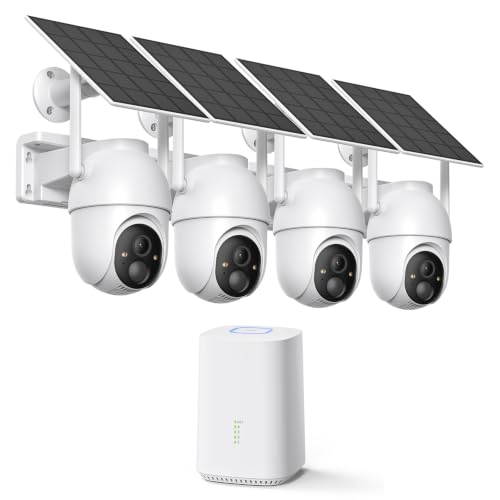 ELYSOO 2K Solar Security Camera 4-Pack |
7.8/10 | Buy |
 ANNKE 8-Channel 3K Lite Wired Outdoor Security |
7.8/10 | Buy |
Gianteye 2K Solar Wireless Security Cameras
The Gianteye 2K Solar Wireless Security Camera 4-Pack delivers comprehensive outdoor surveillance with motorized 360-degree pan-tilt coverage, dual-band Wi-Fi flexibility, and continuous solar charging. It is an ideal multi-camera system for homeowners seeking expansive perimeter monitoring without running cables or paying forced monthly subscription fees.
Pros
- Four-camera package provides multi-angle coverage across driveways, yards, and entryways with motorized 360-degree pan-tilt mobility.
- Dual-band 2.4GHz and 5GHz Wi-Fi connectivity provides reliable connection options depending on router placement and wall interference.
- Detachable solar panels provide continuous trickle-charging, eliminating the chore of dismounting cameras for manual battery recharging.
- Subscription-free local video storage via onboard MicroSD slots allows homeowners to retain private event footage without recurring fees.
- IP65 weather-resistant rating ensures dependable performance through harsh seasonal rain, snow, and heat.
Cons
- MicroSD storage cards are not included in the package and must be purchased separately for each camera.
- Like most battery and solar-powered surveillance units, it operates on motion-activated recording and does not support continuous 24/7 video capture.
- Smart home voice integration is limited to Amazon Alexa, lacking native support for Apple HomeKit or Google Home.
Vivideye 4MP Solar Wireless Security Camera System
The Vivideye 2-Camera Solar Security System delivers sharp 4MP resolution, 360-degree motorized pan-tilt tracking, and an encrypted 128GB local storage hub that eliminates monthly fees. It is an ideal wire-free solution for suburban homeowners and renters looking for comprehensive perimeter monitoring without recurring subscriptions.
Pros
- Zero ongoing subscription costs with 128GB of pre-installed, encrypted local storage housed safely inside the hub.
- Motorized 360-degree panning combined with innovative cross-camera tracking handoffs across active monitoring zones.
- True wire-free installation powered continuously by bundled 5W solar panels and 8000mAh battery packs.
- Dual-band 2.4GHz and 5GHz Wi-Fi compatibility with factory pre-paired setup right out of the box.
- Rugged IP66 weatherproofing rated to endure extreme seasonal temperatures from -4°F up to 122°F.
Cons
- Mechanical auto-tracking functionality is disabled by default and requires manual activation inside the Truisee app.
- AI human detection range is limited to a maximum distance of 29 feet, which may not suit expansive perimeter properties.
- Smart home voice integration is limited to Amazon Alexa, lacking native support for Google Home or Apple HomeKit ecosystems.
Vimtag 2.5K Indoor Outdoor Security Camera 2-Pack
The Vimtag 2.5K Indoor/Outdoor Security Camera 2-Pack offers 4MP video clarity, dual-band Wi-Fi flexibility, and color night vision backed by a built-in spotlight and siren. It provides a versatile, cost-effective monitoring solution for homeowners and renters seeking reliable indoor or perimeter coverage with local microSD storage support.
Pros
- Dual-band 2.4 GHz and 5 GHz Wi-Fi compatibility provides greater connection flexibility than standard 2.4 GHz-only cameras
- Solid 2.5K video resolution paired with spotlight illumination ensures clear daytime and nighttime video capture
- IP66-rated enclosure allows seamless transition between indoor nursery monitoring and exposed outdoor surveillance
- Local microSD slot enables subscription-free video storage without forcing an ongoing monthly cloud fee
- Convenient plug-and-play setup supports freestanding tabletop placement or permanent wall mounting with included screws
Cons
- MicroSD card is not included in the box and must be purchased separately for local recording
- Continuous AC power connection is required, limiting placement to areas near electrical outlets
- Advanced cloud video recording and extended alert history require an optional paid Vimtag Cloud subscription
VISION WELL 2K Wireless Security Camera
The VISION WELL 2K Wireless Security Camera delivers flexible, wire-free surveillance for indoor or outdoor spaces with clear 2K resolution, color night vision, and on-device AI motion filtering. It is a dependable, budget-conscious choice for homeowners and renters seeking reliable entryway deterrence without mandatory monthly fees.
Pros
- Completely wire-free battery installation with included bracket and screws, making it ideal for renters and suburban homeowners.
- Sharp 2K video clarity supported by full-color night vision and a 33-foot illumination range.
- PIR motion detection paired with smart AI filtering for people, vehicles, pets, and packages.
- Local recording support on microSD cards up to 128GB to avoid mandatory monthly subscriptions.
- IP65 weather-resistant rating suitable for exterior perimeter or sheltered entryway mounting.
Cons
- Only connects to 2.4 GHz Wi-Fi networks and does not support 5 GHz frequencies.
- Designed for motion-activated event clips rather than continuous 24/7 video recording.
- MicroSD storage card is not included in the box and must be purchased separately.
Aiwixen 4-Camera Wired Security System (512GB)
Equipped with four weatherproof cameras and a dedicated 512GB DVR, this wired security kit offers 24/7 continuous local recording with zero subscription fees. It delivers up to 100 feet of night vision and works as a standalone monitor setup or an app-connected remote system via router.
Pros
- Pre-installed 512GB hard drive with no monthly fees
- Rugged IP68 waterproof and weather-resistant camera housing
- Infrared night vision reaches up to 100 feet
- Customizable motion detection zones reduce false alerts
- Operates for local monitoring without an internet connection
Cons
- Requires running physical BNC cables to each camera
- Remote mobile access requires a wired router connection
- Modest 512GB drive capacity for four continuous video streams
ELYSOO 2K Solar Security Camera 4-Pack
This four-camera setup provides comprehensive outdoor coverage powered by solar charging and dual-band Wi-Fi connectivity. With included 64GB local storage and motorized pan-tilt capability, it suits property owners wanting multi-angle security without recurring monthly fees.
Pros
- Dual-band Wi-Fi connection for stable streaming
- Includes preloaded local storage without monthly fees
- Continuous solar operation with minimal daily sunlight
- Full-color night vision with automatic spotlight
Cons
- Requires adequate direct sunlight exposure to maintain charge
- Weatherproofing is rated at IP65 rather than IP67
ANNKE 8-Channel 3K Lite Wired Outdoor Security
The ANNKE 8-channel wired surveillance kit provides continuous 24/7 recording with a pre-installed 1TB hard drive, intelligent human and vehicle filtering, and smart dual-light night vision. It is an ideal, zero-monthly-fee security solution for homeowners seeking multi-camera perimeter coverage.
Pros
- Pre-installed 1TB hard drive delivers continuous 24/7 local recording without any mandatory cloud subscription fees.
- Smart Dual-Light design flexibly switches from 100-foot IR night vision to 66-foot full-color illumination when motion occurs.
- AI Motion Detection 2.0 filters for people and vehicles, allowing quick event searching during playback.
- Heavy-duty IP67 weather-resistance rating ensures dependable outdoor durability through harsh seasonal weather.
- Hybrid DVR architecture supports TVI, AHD, CVI, CVBS, and IP formats, facilitating future camera upgrades up to 3K or 5MP.
Cons
- Requires physical cable routing for all eight cameras back to the central DVR location.
- Included cameras capture in 1080p (2MP), which offers less digital zoom clarity than premium 4K systems.
- Permanent wired setup is generally unsuitable for apartment renters needing non-destructive installation.
Evaluating Security Camera Manufacturers and System Architectures
Determining who makes the most effective surveillance systems requires looking beyond brand recognition and evaluating physical hardware architecture. Different manufacturers excel in distinct deployment categories, ranging from continuous hardwired coaxial recorders to decentralized solar-assisted wireless ecosystems. A property owner seeking round-the-clock forensic capture needs a fundamentally different hardware platform than someone requiring quick, wire-free perimeter alerts over driveway gates. By analyzing optical components, storage topology, power delivery, and false-alarm suppression algorithms across established brands, buyers can identify the manufacturer that aligns with their specific operational needs.
Hardwired DVR and NVR Systems: Continuous Recording Infrastructure
Manufacturers that focus on hardwired architectures prioritize continuous video recording over battery preservation. Brands such as ANNKE build surveillance kits utilizing BNC coaxial cabling or network infrastructure paired with dedicated Digital Video Recorders (DVRs) or Network Video Recorders (NVRs). These systems bypass residential Wi-Fi entirely for data transmission, routing video feeds directly to centralized local hard disk drives. Systems incorporating continuous recording avoid the latency delays and missed event clips that frequently plague sleep-to-wake battery models.
Centralized recording hardware from companies like ANNKE or Aiwixen includes pre-installed hard drives ranging from 512GB to multi-terabyte drives. Continuous local archiving ensures that physical incidents occurring outside designated motion zones are still captured. When expanding coverage across large properties, integrating expandable add-on cameras for NVR setups allows homeowners to add specialized optical sensors without extra licensing costs. Furthermore, wired systems continue writing footage to disk even during broadband outages, maintaining complete physical property logs.
Wire-Free and Solar-Powered Hub Systems: Rapid Perimeter Deployment
Brands specializing in wireless solar ecosystems have re-engineered home surveillance by pairing low-power CMOS sensors with dedicated micro-solar panels. Manufacturers such as Vivideye and Gianteye design systems that eliminate the labor-intensive chore of running physical cables through exterior siding, attics, or finished drywall. These systems rely on integrated lithium-ion battery banks that continuously replenish their charge using compact solar panels requiring only two to three hours of direct daily sunlight. The elimination of power cords makes these units particularly practical for monitoring distant fences, detached sheds, and long driveways.
Modern solar camera manufacturers frequently incorporate centralized base stations or home hubs to manage local video processing and encrypted file archiving. The Vivideye architecture, for instance, pairs outdoor pan-tilt cameras with an expandable four-channel home hub housing integrated flash memory. This approach provides significant security advantages because recorded event clips remain safely stored indoors even if an exterior camera is vandalized or physically stolen. Property owners investing in wire-free hardware often find that battery security cameras with local storage strike the right balance between rapid deployment and subscription-free privacy.
Standalone Wi-Fi and Hybrid Indoor-Outdoor Solutions
Certain manufacturers focus on compact, versatile cameras designed for rapid setup and flexible placement across indoor and outdoor spaces. Brands like VIMTAG build multi-purpose units capable of serving as nursery monitors, pet watchers, or weatherproof exterior perimeter guards. These cameras connect directly to domestic wireless networks through automated QR-code scanning routines, eliminating complex router port-forwarding configurations. Compact units often feature magnetic bases, tabletop stands, and articulated mounting brackets that support renter-friendly installations without permanent structural damage.
The versatility of hybrid indoor-outdoor cameras extends to dual-band wireless networking and integrated deterrence hardware. Units from VIMTAG combine high-definition imaging with built-in white spotlights and acoustic siren alarms to actively discourage trespassers. Standalone cameras also incorporate two-way audio modules, enabling property owners to converse with delivery couriers or family members directly through a mobile interface. However, because standalone units lack a centralized hard drive hub, users must rely on local onboard microSD cards or encrypted cloud subscription services for video clip retention.
Sensor Resolution and Optical Processing: 1080p, 2K, and 4MP Clarity
Camera manufacturers deploy various optical sensor resolutions that directly impact the pixel density of captured video footage. Standard 1080p (2-megapixel) sensors provide sufficient clarity for general perimeter observation, but higher-resolution 2K (3-megapixel) and 4MP sensors deliver significantly greater forensic detail. Manufacturers such as ELYSOO and Vivideye utilize 4MP sensors that allow digital zooming into distant license plates or human faces without immediate pixelation. Increased resolution, however, requires more sophisticated video compression to prevent domestic network congestion.
To manage the high bitrates generated by 2K and 4MP video streams, reputable surveillance manufacturers utilize advanced compression codecs such as H.265 and H.265+. ANNKE, for example, incorporates H.265+ encoding across its wired DVR systems, reducing video file sizes substantially compared to legacy H.264 formats. Efficient compression extends the operational lifespan of local hard drives and prevents multi-camera wireless feeds from saturating residential broadband upload bandwidth. Buyers evaluating camera systems must recognize that high-resolution video streams are only as dependable as the compression algorithms managing their data throughput.
Night Vision Architectures: Infrared Illuminators versus Dual-Light Color Arrays
Effective property surveillance depends heavily on low-light imaging capabilities, an area where camera manufacturers employ two distinct hardware approaches. Traditional systems rely on 850nm infrared light-emitting diodes (LEDs) that cast non-visible illumination across the surveillance field, producing high-contrast black-and-white video. Manufacturers like Aiwixen engineer infrared arrays capable of projecting night vision up to 100 feet in complete darkness using mechanical IR-cut filters. Infrared illumination provides discreet surveillance without drawing visual attention to camera mounting positions.
In contrast, modern wireless and hybrid systems increasingly deploy smart dual-light technology that integrates white-light LED spotlights alongside traditional infrared emitters. Systems from ANNKE, Gianteye, and VISION WELL switch automatically from covert infrared monitoring to full-color night vision the instant an onboard sensor detects human movement. Full-color night capture provides critical evidentiary details, such as clothing hues and vehicle colors, which are lost in monochrome infrared feeds. The sudden activation of an intense spotlight also serves as a potent psychological deterrent against prowlers entering private property lines.
Motion Detection Mechanisms: Passive Infrared Sensors versus Edge AI Vision
The method a manufacturer uses to detect movement determines whether a surveillance system provides dependable security or constant notification fatigue. Battery-powered and solar systems rely primarily on Passive Infrared (PIR) hardware sensors that measure rapid changes in ambient thermal radiation across split detection zones. Because PIR sensors require a moving heat signature, such as a person, animal, or hot vehicle engine, they prevent camera processors from waking up during harmless wind gusts or foliage movement. Manufacturers like Gianteye and ELYSOO combine PIR hardware with onboard artificial intelligence algorithms to filter out non-human movement.
Wired systems, such as ANNKE platforms running AI Motion Detection 2.0, analyze incoming pixel arrays directly using dedicated neural processing hardware inside the recorder. This continuous computer vision processing accurately classifies human silhouettes and vehicle profiles while discarding moving shadows, falling rain, and nocturnal insects. By customizing activity zones and detection sensitivity parameters within the management application, users can isolate primary walkways from busy public roadways. Advanced edge-based AI processing eliminates false alerts at the camera level without routing private video frames to external third-party cloud servers.
Storage Topology and Subscription Freedom: Hubs, Hard Drives, and MicroSD Flash
Surveillance manufacturers adopt vastly divergent models regarding video storage architecture and recurring customer fees. Many mass-market consumer camera brands force users into recurring monthly subscription plans to access video history, person detection, and activity zones. Conversely, brands like ANNKE, Vivideye, and Aiwixen prioritize complete subscription freedom by integrating secure local storage hardware right out of the box. Wired DVR systems provide pre-installed hard disk drives that record continuously for weeks or months, automatically looping over the oldest data when disk capacity is reached.
Wireless systems handle subscription-free local storage using high-endurance microSD cards or indoor base stations. Manufacturers that incorporate local storage slots give property owners complete sovereignty over their evidentiary footage without exposure to cloud subscription price increases. However, users selecting standalone cameras that rely on onboard microSD cards must install high-endurance flash memory rated for continuous write cycles. Standard consumer flash memory cards rapidly degrade under frequent surveillance overwriting, leading to corrupted sectors and unrecoverable video files during critical security incidents.
Network Frequencies and Signal Penetration: 2.4 GHz versus 5 GHz Wi-Fi
Wireless surveillance manufacturers must balance radio signal transmission range against video data throughput when designing communication modules. The 2.4 GHz frequency band remains the surveillance industry standard because its longer electromagnetic wavelengths penetrate exterior building envelopes, dense brickwork, and stucco siding far more effectively than higher frequencies. However, crowded 2.4 GHz spectrums often suffer from heavy interference generated by neighborhood routers, Bluetooth accessories, and microwave appliances. Signal degradation frequently leads to dropped live streams, delayed push notifications, and interrupted recordings.
To resolve wireless congestion, innovative manufacturers such as Vivideye, Gianteye, and VIMTAG engineer dual-band Wi-Fi radios that support both 2.4 GHz and 5 GHz networks. The 5 GHz wireless band provides substantially higher data transmission rates and lower latency, enabling smoother high-resolution live streaming and rapid video playback. Systems equipped with self-adaptive dual-band connectivity automatically negotiate the cleanest available wireless channel with the home router. For optimal performance, wireless cameras should maintain a Received Signal Strength Indicator (RSSI) of -65 dBm or better at their permanent exterior mounting positions.
Environmental Durability: Ingress Protection and Thermal Boundaries
Outdoor surveillance hardware must withstand relentless exposure to driving rain, blowing dust, ultraviolet sunlight, and freezing ambient temperatures. System manufacturers document physical environmental resistance through standardized Ingress Protection (IP) ratings defined by international engineering standards. An IP65 rating, present on units from Gianteye and ELYSOO, indicates that the enclosure is completely dust-tight and resistant to low-pressure water jets from any direction. Higher ratings, such as IP66 and IP67 found on Vivideye and ANNKE hardware, provide protection against high-pressure water surges and temporary immersion.
Operating temperature limits represent another vital engineering factor that distinguishes premium outdoor equipment. Systems engineered for harsh climates operate reliably across extreme temperature bands, typically from -4 degrees Fahrenheit up to 122 degrees Fahrenheit. Wired camera systems from brands like Aiwixen boast IP68 waterproof ratings and rust-proof metal housings that endure heavy seasonal snowpacks and coastal salt air. Conversely, property owners deploying solar-assisted battery cameras in cold northern climates must note that internal lithium-ion batteries cannot safely accept a chemical recharge when ambient temperatures drop below 32 degrees Fahrenheit.
Legal Compliance and Privacy Considerations for Residential Surveillance
Deploying a comprehensive home camera system requires careful attention to United States federal, state, and local privacy statutes. Under common law principles and Fourth Amendment jurisprudence, individuals maintain a reasonable expectation of privacy within residential living spaces, bathrooms, and screened backyards. While homeowners possess the legal right to monitor their own property boundaries and curtilage, pointing cameras directly into neighbor windows or private recreational zones can trigger civil liability for intrusion upon seclusion. Responsible surveillance design involves adjusting camera viewing angles and applying software privacy masks over adjacent properties.
Audio surveillance introduces even stricter regulatory compliance challenges under federal wiretap laws (18 U.S.C. Section 2511) and individual state eavesdropping statutes. While federal law and many jurisdictions operate under one-party consent rules, several states mandate all-party consent before any private oral conversation may be legally recorded. Because sensitive microphones on modern cameras can capture conversations occurring on public sidewalks or neighboring yards, homeowners should review state laws and consider disabling audio recording functions. Maintaining visual monitoring while muting microphone capture protects property owners from unintended statutory violations while preserving necessary visual security evidence.
System Verification and Practical Deployment Takeaways
Establishing an effective residential security camera installation culminates in rigorous post-installation verification and performance testing. After securing mounting brackets at an optimal height of eight to nine feet to balance facial identification angles against physical tampering, installers must conduct walk tests across all monitored zones. Verifying detection ranges against the international DORI standard (Detection, Observation, Recognition, and Identification) ensures that cameras provide actionable evidence rather than ambiguous pixel shapes. Users should also simulate network disconnects to verify that local DVRs or base station hubs continue archiving footage without an active internet gateway.
Ultimately, determining who makes the ideal security camera system depends on weighing physical installation constraints against long-term operational expectations. Property owners requiring uninterrupted, forensic-grade 24/7 video capture across extensive perimeters are best served by wired DVR and NVR systems from manufacturers like ANNKE and Aiwixen. Conversely, those prioritizing rapid, non-invasive installation across rental properties or distant perimeter fences will benefit from solar-assisted, dual-band hub ecosystems from brands like Vivideye and Gianteye. Selecting the right manufacturer and hardware architecture ensures comprehensive property protection without unexpected subscription burdens or continuous maintenance headaches.
About the author
Rebecca Edwards is a veteran journalist and home safety expert with decades of editorial experience and more than a decade focused on home and personal security. She researches and tests security systems, smart gadgets, safety technology, and crime-related data to turn complicated topics into practical advice. Her consumer-focused approach helps families evaluate security products based on real needs rather than marketing claims alone.