
Which Light Bulb Security Camera Is Best: A Practical Guide for 2026
Learn which light bulb security camera is best for your property in November 2026 with our guide to PTZ tracking, Wi-Fi, and local storage.
 By Rebecca Edwards
Updated November 8, 2026

Exterior property monitoring often introduces difficult installation hurdles, such as drilling through masonry siding or repeatedly recharging lithium-ion batteries in cold weather. Converting an existing outdoor porch fixture into a continuous surveillance point solves those headaches by tapping directly into standard household AC power lines. Determining which light bulb security camera is best depends heavily on whether your fixture requires motorized pan-and-tilt tracking, dual-band Wi-Fi reception, or high-lumen illumination to deter unwanted nighttime visitors. Property owners evaluating flexible options often look into pan-tilt outdoor surveillance options to achieve complete perimeter awareness without running complex low-voltage wiring.
Standard E26 and E27 light sockets deliver uninterrupted electrical current, giving socket-based cameras the ability to record continuously and track moving subjects across wide entryways. Modern models combine 2K optical sensors, full-color night vision, and onboard microSD archiving to eliminate expensive monthly cloud storage contracts. Choosing the right device means balancing fixture enclosure depth, wireless signal strength through exterior building envelopes, and smart home platform compatibility. Evaluating these core hardware traits ensures your surveillance setup provides dependable property protection without unexpected downtime or connectivity failures.
| Award | Product | SSG Score About SSG ScoreThe SSG Score is our own rating from 0 to 10, based on performance, design and build, ease of use, and value. It reflects independent research and is never influenced by manufacturers, retailers, or affiliate commissions. Learn more › | |
|---|---|---|---|
| Best Overall |
WESECUU 2K Dual-Band Light Bulb Camera
|
9.1/10 | Buy |
| Best Premium |
 WESECUU 2K Light Bulb Security Camera |
9.1/10 | Buy |
| Best Value |
 Wyze Bulb Cam 2K HD Security Camera |
8.4/10 | Buy |
 Poleeye 2K Dual-Band Light Bulb Camera |
8.1/10 | Buy | |
| Best Budget |
 WESECUU 2K Dual-Band Light Bulb Camera |
8.0/10 | Buy |
 Chpuss 2K Dual-Band Light Bulb Camera |
8.0/10 | Buy |
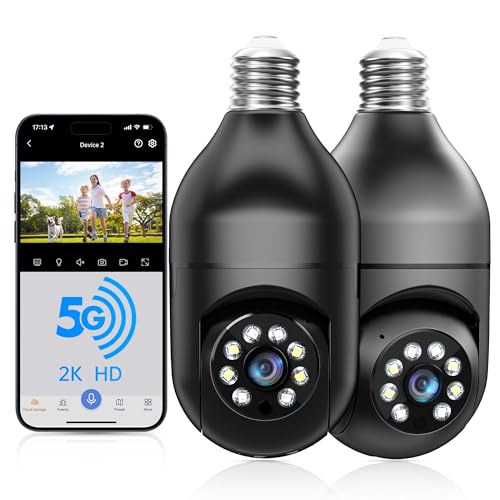
WESECUU 2K Dual-Band Light Bulb Camera
Screwing directly into standard E27 sockets, this outdoor camera delivers 2K video and full motion tracking without complex wiring. It is well suited for homeowners seeking flexible dual-band Wi-Fi connectivity and color night vision.
Pros
- Supports both 5GHz and 2.4GHz Wi-Fi networks
- Simple setup into standard E27 light sockets
- Wide 360-degree pan and tilt motion tracking
- Local microSD card support up to 128GB
Cons
- Cloud subscriptions must be purchased separately per camera
- Video clarity degrades during extreme weather conditions
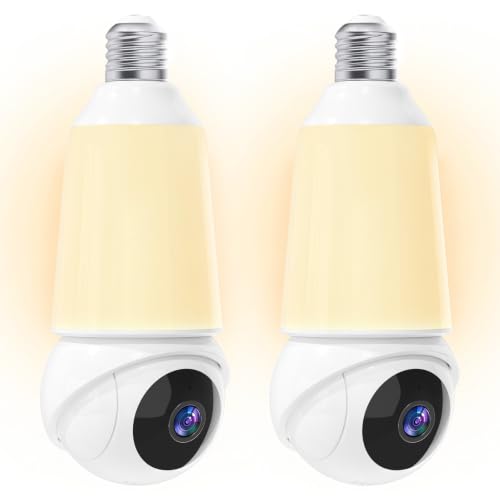
WESECUU 2K Light Bulb Security Camera
Screwing directly into a standard E27 socket, this dual-band camera pairs a 2K sensor with an integrated 1000-lumen light to illuminate and monitor entryways. It offers motorized 355-degree pan tracking, two-way audio, and color night vision for users seeking wire-free installation.
Pros
- Supports both 2.4GHz and 5GHz Wi-Fi networks
- Bright 1000-lumen integrated illumination
- Installs directly into standard E27 light sockets
- Local microSD storage supported up to 128GB
Cons
- Cloud video storage requires a paid subscription
- Requires continuous power to the light socket
- Relies on the third-party EseeCloud mobile app
Wyze Bulb Cam 2K HD Security Camera
Screwing directly into standard E26 light sockets, the Wyze Bulb Cam integrates an 800-lumen warm light with a 2K surveillance camera. It provides a convenient entryway monitoring solution featuring continuous local recording and a wide 160-degree field of view.
Pros
- Simple installation into standard E26 light sockets
- Crisp 2K resolution with color night vision
- Continuous local recording without mandatory subscriptions
- Wide 160-degree field of view minimizes blind spots
- Integrated 800-lumen dimmable LED fixture
Cons
- Pan and tilt adjustments must be made manually
- Cannot be used with existing dimmer switches
- Advanced AI object detection requires a paid subscription
Poleeye 2K Dual-Band Light Bulb Camera
Screwing directly into standard light sockets, this outdoor dome camera provides crisp 2K video with motorized auto-tracking. Its dual-band Wi-Fi support makes it an easy setup for monitoring porches or garages without running power cords.
Pros
- Fits directly into standard E26 or E27 light sockets
- Dual-band Wi-Fi supports 2.4GHz and 5GHz networks
- Wide 355-degree pan and tilt with auto-tracking
- Full-color night vision reaches up to 33 feet
- Free basic features without a mandatory subscription
Cons
- MicroSD card for local storage is sold separately
- Requires constant light socket power to stay active
WESECUU 2K Dual-Band Light Bulb Camera
Screwing directly into standard E27 light sockets, this outdoor PTZ camera delivers 2K surveillance with dual-band Wi-Fi for steady streaming. It provides an accessible security upgrade for homeowners wanting pan-and-tilt monitoring without running dedicated electrical lines.
Pros
- Simple installation into standard E27 sockets
- Dual-band Wi-Fi enhances connection stability
- Full-range pan and tilt minimizes blind spots
- Color night vision reaches up to 33 feet
- Supports local recording via microSD cards
Cons
- Video clarity degrades during extreme weather conditions
- Cloud storage requires an ongoing paid subscription
- Requires constant power supply from the light fixture
Chpuss 2K Dual-Band Light Bulb Camera
Screwing directly into standard light sockets, this outdoor camera delivers 2K video and full-color night vision without requiring hardwired electrical installation. Dual-band Wi-Fi and 360-degree motion tracking make it a practical option for monitoring porches and entryways.
Pros
- Works on both 2.4GHz and 5GHz Wi-Fi networks
- Screw-in design avoids complex electrical wiring
- Clear 2K resolution with color night vision
- Extensive coverage with motorized pan and tilt
- Built-in spotlight and audible siren alert
Cons
- MicroSD card is not included
- Cloud video storage requires a paid subscription
- Requires constant power to the light fixture
Evaluating Light Socket Surveillance Architecture and Hardware Performance
Deciding which light bulb security camera is best requires matching your physical fixture dimensions, network infrastructure, and security objectives against specific camera capabilities. While many socket cameras share a similar cylindrical exterior, their mechanical rotation, wireless reception, and lighting outputs vary considerably across brands. Understanding these underlying hardware architectures ensures you select a unit that delivers dependable visual evidence rather than dropped connections and false alerts. Evaluating how each model manages continuous power and data storage provides the clearest path toward securing your entryway effectively.
Fixture Sizing, Socket Standards, and Continuous AC Power Mechanics
Light bulb security cameras draw operational electricity directly from standard Edison light sockets, typically utilizing standard E26 bases in North America or E27 fixtures internationally. These devices require a continuous line voltage supply between 110V and 240V AC to keep their internal image processors and Wi-Fi radios functioning. Wall switches controlling the designated light fixture must remain permanently toggled on, which frequently necessitates installing switch guards to prevent accidental power cutoffs. Connecting these cameras to circuits governed by wall dimmer switches can damage internal power converters and cause severe operational failure.
Physical clearance inside decorative sconces represents a common installation hurdle that catches many property owners unprepared. Some cameras feature telescoping stems that extend outward by over an inch to clear narrow fixture rims, while larger motorized bodies require substantial width and depth. Sconces with enclosed glass globes or tight bottom openings can physically block a bulb camera from threading into the socket. Verifying that your outdoor light enclosure has at least several inches of lateral clearance prevents mechanical binding and overheating during continuous operation.
Motorized PTZ Tracking Versus Manual Wide-Angle Positioning
Mechanical pan-and-tilt capabilities distinguish motorized surveillance bulbs from fixed wide-angle alternatives. Motorized models incorporate miniature internal stepper motors that rotate the optical assembly horizontally up to 355 degrees and tilt vertically up to 90 degrees. This wide mechanical movement allows the camera to track moving visitors automatically and allows homeowners to pan around the yard using mobile companion software. Stepper motors introduce mechanical wear points over years of continuous tracking, and the lens cannot record areas behind its active position while turned elsewhere.
Fixed-position bulb cameras take an alternate approach by utilizing wide-angle optical lenses with fields of view reaching approximately 160 degrees. These units rely on manual adjustment during initial setup, allowing users to point the lens toward key entry zones before locking the angle in place. Eliminating internal motors removes mechanical failure risks and ensures the camera continuously monitors a wide fixed path without chasing distant distractions. Homeowners seeking active driveway tracking often favor motorized panning, while those watching a compact front porch may prefer the steady coverage of a wide fixed lens.
Dual-Band Wireless Connectivity and Structural Signal Attenuation
Wireless reliability dictating video feed stability often hinges on whether a camera supports dual-band Wi-Fi or operates solely on a single radio band. Cameras equipped with both 2.4 GHz and 5 GHz radios provide greater deployment flexibility across modern home mesh networks. The 2.4 GHz frequency band transmits signals over longer distances and penetrates dense exterior walls like brick, stucco, and wood siding more effectively. The 5 GHz band delivers higher data throughput and lower channel congestion when the light socket sits in close line-of-sight to the primary router.
Single-band cameras restricted to 2.4 GHz networks can struggle when neighbors saturate overlapping radio channels in dense urban neighborhoods. Dual-band models can switch to cleaner frequencies, reducing video lag and preventing dropped live streams during critical security events. Users should confirm their router allows separate network names or handles band steering properly to prevent pairing failures during initial setup. Measuring the received signal strength indicator at the intended socket ensures the camera maintains a stable uplink before you complete the installation.
Optical Clarity, 2K Resolution, and Illumination Capabilities
Optical resolution plays a decisive role in whether recorded video produces legally actionable forensic evidence or merely indistinct silhouettes. Most modern light socket security cameras feature 2K high-definition sensors, yielding approximately 3 megapixels of visual detail that surpasses older 1080p hardware. This elevated pixel density aligns with standardized security metrics, allowing for clearer facial recognition and object identification at distances up to 33 feet. Wide dynamic range technology further balances harsh direct sunlight and deep porch shadows, preventing facial blowout when visitors step under midday lighting.
Auxiliary lighting defines the dual nature of light socket cameras, which must illuminate entryways while capturing nocturnal video feeds. Certain high-output models integrate dimmable LED arrays delivering up to 1000 lumens, effectively replacing standard exterior light bulbs with functional floodlights. Powerful illumination allows the camera sensor to produce crisp full-color night vision, revealing critical clothing colors and vehicle details in dark conditions. Models with modest LED arrays rely more heavily on 850nm infrared illumination, which records clear monochrome footage without casting noticeable ambient glare across neighboring properties.
Local MicroSD Archiving Versus Cloud Subscription Dependencies
Storage architecture represents one of the largest ongoing operational considerations when selecting a light socket camera for residential monitoring. Many bulb cameras feature onboard flash memory card slots supporting microSD capacities between 128GB and 256GB for continuous local recording. Continuous overwriting cycles place significant thermal and write stress on flash memory, requiring specialized high-endurance cards rated for video surveillance workloads. Opting for dedicated local storage setups allows homeowners to review minute-by-minute historical footage without submitting to recurring monthly subscription fees.
Cloud storage services provide offsite video backup that remains safe even if an intruder physically unscrews or vandalizes the light bulb camera. Proprietary cloud plans frequently package event history alongside advanced cloud-based artificial intelligence features, such as distinguishing between pets, packages, and vehicles. These subscription services typically charge per-camera fees, which can accumulate quickly if you deploy multiple bulb cameras around your home exterior. Homeowners prioritizing data privacy and predictable costs usually favor high-capacity onboard microSD cards, while those wanting off-site redundancy lean toward cloud subscriptions.
Motion Detection Algorithms and Preventing Porch Notification Fatigue
Nuisance motion alerts represent a primary source of user frustration that can cause homeowners to ignore real security warnings. Light bulb security cameras rarely incorporate physical passive infrared thermal sensors due to space limitations and high socket operating temperatures. These cameras instead rely on optical pixel-change analysis and onboard artificial intelligence algorithms to evaluate movement across the image frame. Advanced computer vision models analyze incoming video frames to filter out shifting shadows, flying moths, and windblown shrubbery before triggering push notifications.
Calibrating the motion sensitivity slider inside the companion mobile app helps tune the system to the unique activity levels of your front yard. Setting custom detection zones allows you to mask out busy public sidewalks and passing street traffic while focusing surveillance strictly on your entryway. Enabling human body detection ensures that the camera only initiates automated siren alarms and spotlight triggers when an actual person approaches. Properly adjusted detection parameters prevent notification fatigue, ensuring you stay alert when genuine perimeter intrusions occur.
Environmental Protection, Fixture Enclosures, and Climate Factors
Exterior lighting fixtures expose surveillance hardware to fluctuating ambient temperatures, airborne dust, and driven rainwater. Light socket cameras lack heavy-duty sealed conduit connections, meaning they are designed primarily for sheltered outdoor fixtures rather than bare outdoor sockets. Installing these devices beneath porch eaves, covered porticos, or inside downward-facing sconces shields the electronic housing from direct moisture intrusion. Threading a bulb camera into an upward-facing, fully exposed lamppost risks rainwater pooling directly inside the electrical base, leading to short circuits.
Temperature extremes also influence the operational lifespan of the internal power supply and digital image sensor. Enclosing a camera inside a small, airtight glass globe during sweltering summer months traps heat generated by the LED driver and processor. High internal heat can degrade optical sensor performance, introduce digital video noise, and shorten the lifespan of onboard microSD memory cards. Choosing semi-enclosed fixtures with proper natural airflow protects the internal electronics during seasonal heat waves and freezing winter snaps.
Smart Home Ecosystem Integration and Mobile Platform Control
Seamless smart home integration enhances daily usability by connecting porch surveillance directly to your preferred voice assistant and display hardware. Many bulb cameras support Amazon Alexa, enabling users to stream live camera feeds directly to Echo Show devices or smart televisions via simple voice commands. Select models also integrate with Google Assistant, allowing homeowners to manage general device power and view activity feeds through smart displays. Checking ecosystem compatibility before purchasing ensures that your new camera interacts smoothly with your existing smart displays, automated routines, and light switches.
Companion mobile platforms like the EseeCloud or Wyze app govern the day-to-day operation, live streaming, and notification settings for your hardware. Reliable apps allow homeowners to share device access across multiple family members so everyone can monitor the property simultaneously from individual smartphones. These applications also facilitate remote two-way talk, letting you speak directly to delivery couriers or warn off suspicious individuals through the camera speaker. Intuitive mobile interfaces make reviewing archived video clips straightforward, saving valuable time when investigating property incidents.
Audio Surveillance Compliance and Residential Privacy Boundaries
Deploying outdoor security cameras equipped with sensitive two-way microphones introduces important legal obligations that every homeowner must respect. The federal wiretap statute under 18 U.S.C. Section 2511 and varying state laws regulate the recording of oral conversations without mutual consent. Several US states enforce strict all-party or two-party consent laws, requiring all individuals involved in a private conversation to agree to audio recording. Property owners living in two-party consent jurisdictions should consider disabling audio capture in the camera settings or posting clear signage indicating video and audio surveillance.
Camera angles must also respect the reasonable expectation of privacy held by neighbors in adjacent residential properties. Motorized pan-and-tilt cameras should never be positioned to look directly into neighboring bedroom windows, private backyards, or enclosed patio areas. Combining strategic camera angles with cameras featuring full-color night vision allows you to illuminate your immediate property while preventing intrusive spillover lighting. Setting physical or software privacy masks across fence lines prevents neighbor disputes while maintaining robust protection over your own front porch and driveway.
Selecting which light bulb security camera is best ultimately comes down to balancing your fixture clearance, network bands, and preferred storage architecture. Before permanently threading your camera into an exterior socket, test your home Wi-Fi signal at the fixture to ensure smooth high-definition streaming. Verify that your local microSD card formats properly within the app, calibrate the AI detection zones to avoid public sidewalks, and confirm your audio recording toggles comply with local regulations. Taking time to configure these hardware and software settings guarantees that your light socket camera provides seamless, maintenance-free security for years to come.
About the author
Rebecca Edwards is a veteran journalist and home safety expert with decades of editorial experience and more than a decade focused on home and personal security. She researches and tests security systems, smart gadgets, safety technology, and crime-related data to turn complicated topics into practical advice. Her consumer-focused approach helps families evaluate security products based on real needs rather than marketing claims alone.