
Are Home Security Cameras an Invasion of Privacy? Legal and Practical Guide for 2026
Learn whether are home security cameras an invasion of privacy under US law, audio wiretap rules, and neighbor property expectations in November 2026.
 By Alina Bradford
Updated November 5, 2026


Residential surveillance technology allows homeowners to protect entry points, monitor deliveries, and deter property crime with minimal effort. However, the rapid adoption of exterior lenses and connected smart cameras raises an urgent question: are home security cameras an invasion of privacy when their field of view crosses boundary lines? Striking a balance between proactive personal safety and respecting neighbor boundaries requires understanding how lens placement, viewing angles, and recording habits intersect with common privacy expectations. When surveillance devices monitor areas beyond a homeowner’s direct perimeter, ethical and legal tensions naturally surface.
Modern surveillance hardware introduces nuanced questions regarding audio interception, constant video streaming, and offsite cloud data transmission. Selecting wire-free security cameras with onboard storage and models equipped with mechanical privacy shutters gives residents greater autonomy over their recordings while mitigating unwanted digital exposure. Property owners who understand their system capabilities can safeguard their residences effectively without creating community friction or violating legal boundaries. Taking time to align optical settings with local property lines ensures reliable home protection without overstepping residential privacy norms.
| Award | Product | SSG Score About SSG ScoreThe SSG Score is our own rating from 0 to 10, based on performance, design and build, ease of use, and value. It reflects independent research and is never influenced by manufacturers, retailers, or affiliate commissions. Learn more › | |
|---|---|---|---|
| Best Overall |
Arlo Essential Indoor HD Camera (2nd Gen)
|
8.6/10 | Buy |
| Best Premium |
 DAIFAC 1080p Indoor Smoke Detector Shape Security |
8.6/10 | Buy |
| Best Value |
 Vimtag 2.5K Indoor Outdoor Security Camera 2-Pack |
8.4/10 | Buy |
| Best Budget |
 YDIFHQ 4K Mini Wi-Fi Security Camera |
8.3/10 | Buy |
 VISION WELL 2K Wireless Security Camera |
8.3/10 | Buy | |
 Armorcope Mini Wired Security Camera |
8.0/10 | Buy | |
 ZHOUCXZDA Mini Wireless Security Camera |
7.8/10 | Buy |
Arlo Essential Indoor HD Camera (2nd Gen)
Ideal for monitoring pets or nurseries, this compact camera pairs sharp HD live streaming and two-way talk with an automated physical privacy shield. It provides instant motion alerts and night vision right away, though video recording requires an Arlo Secure plan.
Pros
- Automated privacy shield protects personal home privacy
- Built-in two-way audio for clear conversation
- Wide 130-degree viewing angle with night vision
- Integrated remote siren for added home security
- Instant motion alerts sent to your phone
Cons
- Video storage requires a paid monthly subscription
- Smart detection features locked behind Arlo Secure plan
- Wired indoor-only design restricts placement options
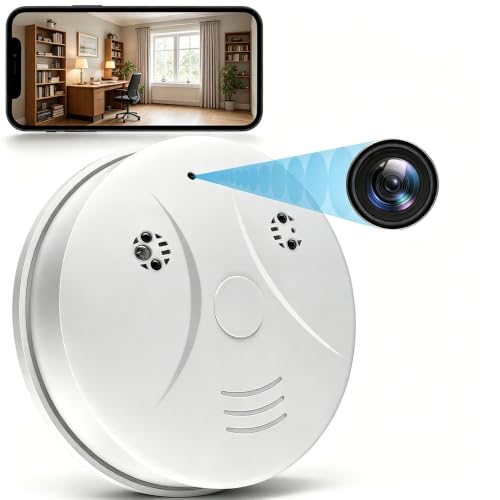
DAIFAC 1080p Indoor Smoke Detector Shape Security
The DAIFAC indoor security camera features a discreet smoke detector design offering 1080p streaming and an expansive 150-degree field of view. It suits homeowners and renters seeking covert room monitoring with flexible local microSD loop recording and straightforward 2.4GHz Wi-Fi access.
Pros
- Expansive 150-degree ultra-wide field of view covers entire rooms from an elevated ceiling mount
- Local 24/7 continuous loop recording onto microSD cards up to 128GB avoids mandatory monthly cloud subscriptions
- Dual-mode connectivity allows direct offline AP monitoring within 49.2 feet or remote access via 2.4GHz Wi-Fi
- Unobtrusive smoke detector form factor blends naturally into residential interiors and hallway ceilings
Cons
- Does not function as a smoke detector or fire alarm and cannot replace residential life-safety equipment
- Hardware specifications do not list integrated infrared night vision or two-way talk audio capabilities
- Operates exclusively on 2.4GHz Wi-Fi networks and does not support 5GHz wireless bands
Vimtag 2.5K Indoor Outdoor Security Camera 2-Pack
The Vimtag 2.5K Indoor/Outdoor Security Camera 2-Pack offers 4MP video clarity, dual-band Wi-Fi flexibility, and color night vision backed by a built-in spotlight and siren. It provides a versatile, cost-effective monitoring solution for homeowners and renters seeking reliable indoor or perimeter coverage with local microSD storage support.
Pros
- Dual-band 2.4 GHz and 5 GHz Wi-Fi compatibility provides greater connection flexibility than standard 2.4 GHz-only cameras
- Solid 2.5K video resolution paired with spotlight illumination ensures clear daytime and nighttime video capture
- IP66-rated enclosure allows seamless transition between indoor nursery monitoring and exposed outdoor surveillance
- Local microSD slot enables subscription-free video storage without forcing an ongoing monthly cloud fee
- Convenient plug-and-play setup supports freestanding tabletop placement or permanent wall mounting with included screws
Cons
- MicroSD card is not included in the box and must be purchased separately for local recording
- Continuous AC power connection is required, limiting placement to areas near electrical outlets
- Advanced cloud video recording and extended alert history require an optional paid Vimtag Cloud subscription
YDIFHQ 4K Mini Wi-Fi Security Camera
Measuring less than an inch long, this ultra-compact camera delivers 4K recording, automated night vision, and motion-triggered alerts. It suits discreet indoor monitoring and travel security, though continuous recording requires an external USB source.
Pros
- Extremely compact size enables hidden placement
- 4K resolution with automated infrared night vision
- Fast motion detection with phone snapshot alerts
- Supports continuous 24/7 operation using USB power
- Expandable local storage up to 128GB
Cons
- Internal battery lasts only up to 2.5 hours
- Direct Wi-Fi hotspot range capped at 49 feet
- Requires tethered USB connection for all-day use
VISION WELL 2K Wireless Security Camera
The VISION WELL 2K Wireless Security Camera delivers flexible, wire-free surveillance for indoor or outdoor spaces with clear 2K resolution, color night vision, and on-device AI motion filtering. It is a dependable, budget-conscious choice for homeowners and renters seeking reliable entryway deterrence without mandatory monthly fees.
Pros
- Completely wire-free battery installation with included bracket and screws, making it ideal for renters and suburban homeowners.
- Sharp 2K video clarity supported by full-color night vision and a 33-foot illumination range.
- PIR motion detection paired with smart AI filtering for people, vehicles, pets, and packages.
- Local recording support on microSD cards up to 128GB to avoid mandatory monthly subscriptions.
- IP65 weather-resistant rating suitable for exterior perimeter or sheltered entryway mounting.
Cons
- Only connects to 2.4 GHz Wi-Fi networks and does not support 5 GHz frequencies.
- Designed for motion-activated event clips rather than continuous 24/7 video recording.
- MicroSD storage card is not included in the box and must be purchased separately.
Armorcope Mini Wired Security Camera
Compact enough to tuck into small spaces, this wired camera provides versatile coverage with an IP66 weatherproof shell and dual-mode color night vision. It suits homeowners needing reliable day and night monitoring with flexible local storage.
Pros
- Compact footprint fits easily into tight spots
- IP66 weather resistance for outdoor durability
- Full-color and infrared night vision options
- Local microSD storage supported up to 128GB
- Built-in siren and flashing light deterrence
Cons
- Requires a wired power connection
- Advanced AI features require a paid subscription
- Listing details show conflicting 2K and 1080p resolutions
ZHOUCXZDA Mini Wireless Security Camera
This compact 1080p mini security camera provides motion alerts and short-range infrared night vision in an ultra-small one-inch profile. It suits apartment renters, pet owners, and budget-conscious buyers seeking simple indoor monitoring without monthly subscription fees.
Pros
- Ultra-compact 1 x 1 x 1-inch body allows discreet placement on desks, shelves, or mantels
- Supports local microSD card storage up to 256GB with zero recurring monthly subscription fees
- Offers both continuous recording and motion-activated recording modes
- Nano infrared LED provides black-and-white night vision up to 15 feet in dark rooms
- Compatible with iOS and Android devices over standard 2.4GHz Wi-Fi connections
Cons
- Specified as a video-only device, lacking two-way audio communication
- Lacks a documented IP weatherproofing rating, making it unsuitable for exposed outdoor installations
- Night vision distance is limited to 15 feet, making it best suited for smaller rooms rather than wide spaces
Navigating Privacy Boundaries, Surveillance Laws, and Responsible Camera Deployment
Home security cameras are generally not considered an invasion of privacy when owners install them on their own property to monitor public view, driveways, walkways, and entry choke points. Legal boundaries are crossed, however, when lenses point directly into spaces where neighbors or guests possess a reasonable expectation of privacy, such as bathrooms, bedrooms, and fenced private yards. Video recording alone rarely triggers criminal liability on residential exteriors, but enabling audio microphones can violate strict federal and state wiretap laws. Understanding where property rights end and privacy boundaries begin allows residents to deploy surveillance equipment responsibly while maintaining neighborhood goodwill.
The Reasonable Expectation of Privacy and Residential Curtilage
The legal doctrine governing residential privacy centers on the reasonable expectation of privacy, a standard derived from constitutional jurisprudence and civil tort law. Courts consistently rule that individuals cannot claim an expectation of privacy in areas that are plainly visible from public streets, sidewalks, or shared airspace. Front lawns, driveways, and open porches fall into this category, meaning exterior security cameras capturing these zones generally operate within established legal limits. A property owner has a recognized right to record their immediate surroundings to safeguard assets, family members, and visiting guests.
Surveillance boundaries shift dramatically when dealing with the legal concept of curtilage, which encompasses the intimate area immediately surrounding a residential home. Curtilage includes secluded backyards, screened patios, and private living quarters shielded from street-level view by tall fences or natural shrubbery. When an exterior camera is mounted at an angle that peers over privacy fences or directly into an adjoining home’s bedroom windows, courts may classify that recording as an actionable invasion of privacy. Homeowners must recognize that elevation and telephoto focal lengths alter how the law evaluates visual observation.
Judicial rulings often differentiate between passive background recording and targeted surveillance aimed at a specific individual. An outdoor camera positioned to capture a driveway that incidentally catches a sliver of a neighbor’s front walkway rarely violates civil statutes. Conversely, deliberately aiming a high-resolution camera at a neighbor’s master bedroom or private patio creates substantial exposure to claims of intrusion upon seclusion. Maintaining a clear defensible purpose for every lens angle protects homeowners from contentious neighborhood disputes and costly legal challenges.
Federal and State Audio Recording Consent Laws
Audio recording introduces significantly greater legal exposure than video surveillance due to stringent electronic eavesdropping and wiretap statutes. At the federal level, Title III of the Omnibus Crime Control and Safe Streets Act (18 U.S.C. § 2511) prohibits the intentional interception of oral communications without the consent of at least one party. This standard applies when individuals carry a justified expectation that their spoken words are not being overheard or intercepted by an electronic device. Many consumer cameras feature sensitive microphones that pick up whispered conversations well beyond the camera’s visual frame.
State laws create an even more intricate compliance landscape by dividing jurisdictions into one-party and all-party consent categories. In one-party consent states, an individual can record a conversation as long as one participant agrees, which often covers homeowners interacting with visitors on their porch. However, approximately a dozen states enforce all-party or two-party consent laws, requiring every individual in a conversation to agree before recording occurs. Operating an outdoor camera with an active microphone that captures neighbor conversations across property lines in an all-party state can constitute a criminal offense.
Property owners can eliminate electronic eavesdropping risks by adjusting device settings in their security software. Most modern IP cameras and video doorbells allow users to disable audio streaming and recording independently of the video feed. When an outdoor camera monitors an area near a sidewalk, shared driveway, or property fence line, disabling the internal microphone provides immediate legal protection. Disabling ambient audio eliminates wiretap concerns while preserving the vital visual evidence needed for home defense and package tracking.
Neighbor Privacy Disputes and Property Line Camera Angles
Perimeter surveillance frequently triggers neighbor friction when lenses appear pointed directly at adjoining properties. Homeowners installing wide-angle bullet cameras or pan-tilt driveway security cameras must consider how continuous panning motion appears from next door. Even when a camera is intended purely to watch a vehicle or detached garage, a motorized dome scanning back and forth can create genuine distress for neighbors. Transparent communication and careful mounting choices prevent mutual suspicion from escalating into code compliance complaints.
Hardware positioning plays a decisive role in keeping surveillance footage confined to relevant property boundaries. Mounting cameras at a moderate height of eight to ten feet and applying a downward tilt focuses the optical frame on ground-level activity. This downward orientation prevents the lens from capturing neighbor second-story windows or fenced swimming pool areas in the background. Aiming cameras downward also improves motion detection accuracy by reducing false triggers caused by distant road traffic or shifting horizon clouds.
Software masking tools provide an effective technical compromise for properties situated in close proximity. High-end camera firmware allows administrators to draw opaque black privacy masks over specific regions of the live video stream. These digital privacy zones black out selected sectors entirely, ensuring that footage from a neighbor’s yard is never recorded to flash storage or displayed on mobile apps. Demonstrating these digital boundaries to an uneasy neighbor often resolves disputes before they reach homeowners associations or municipal mediation.
Indoor Surveillance: Guest, Caregiver, and Tenant Boundaries
Interior home surveillance operates under far stricter privacy constraints than outdoor perimeter monitoring. Within private living spaces, expectations of personal privacy are paramount, making the placement of cameras inside guest bedrooms, changing rooms, and bathrooms strictly illegal across all US jurisdictions. Installing covert nanny cameras or compact lenses like the DAIFAC or YDIFHQ mini units in these sensitive spaces can lead to severe criminal prosecution under voyeurism statutes. Interior cameras must remain confined to common shared zones such as living rooms, entry hallways, and kitchens.
Monitoring domestic caregivers, babysitters, and in-home contractors presents unique ethical and operational challenges. While parents generally have a legal right to monitor common areas of their home to ensure child safety, covert recording can damage trust and introduce workplace privacy disputes. Many state labor departments and domestic employment guidelines recommend providing written notice to household staff regarding the presence of monitoring equipment. Transparency regarding indoor cameras promotes accountability while avoiding awkward workplace misunderstandings.
Landlords and rental hosts encounter rigorous statutory restrictions regarding indoor surveillance equipment. Property owners who lease homes or manage short-term rentals cannot place functional or hidden cameras inside tenant living quarters under any circumstances. Major booking platforms and state rental laws mandate that all exterior cameras must be disclosed in property listings before booking. Failing to disclose exterior lenses or concealing cameras inside rental properties constitutes a severe violation of guest privacy that frequently leads to permanent platform bans and substantial civil liability.
Hardware Privacy Features: Physical Shutters and Activity Zones
Camera manufacturers have increasingly engineered hardware solutions to address growing homeowner privacy concerns. Devices like the Arlo Essential Indoor Camera incorporate an automated mechanical privacy shield that physically covers the camera lens when the system is set to disarmed mode. This physical barrier cuts off the optical sensor entirely and disconnects internal microphones, providing visual confirmation that surveillance is inactive. Physical shutters eliminate the anxiety that remote hackers or cloud glitches could secretly activate indoor video feeds while occupants are home.
Advanced digital activity zones and edge-based computer vision also assist in limiting privacy intrusion. Models such as the VIMTAG 2.5K and VISION WELL wireless cameras allow users to define custom detection boundaries directly in their mobile applications. By restricting motion tracking to specific door mats, walkways, or interior gates, cameras ignore movements occurring in neighboring yards or communal corridors. Edge AI filtering differentiates between human bodies, passing vehicles, and household pets, preventing unnecessary recording cycles and reducing notification fatigue.
Status indicator lights serve as an essential visual cue for anyone moving through a monitored environment. Most consumer indoor cameras feature dedicated LEDs that illuminate or blink whenever a live view session opens or a motion-activated recording begins. Ensuring these status indicators remain active reassures houseguests and family members that cameras are operating transparently rather than spying in secret. Visible hardware feedback builds mutual trust among household members while preserving perimeter security.
Cloud Ecosystem Security Versus Local Storage Data Privacy
The architecture used to store video footage directly affects homeowner data privacy and external vulnerability. Cloud-connected security cameras transmit encrypted video streams over residential Wi-Fi to remote corporate servers for AI analysis and clip storage. While cloud platforms offer convenient multi-device viewing and offsite backup, they also create risks associated with credential stuffing, third-party data breaches, and server-side employee access. Storing footage on external servers requires users to trust vendor encryption standards and corporate retention policies.
Local storage architectures provide an appealing alternative for privacy-conscious property owners seeking complete data custody. Hardware supporting onboard microSD cards, such as Armorcope and ZHOUCXZDA units, stores video clips directly on high-endurance flash memory within the device. Standalone local setups can operate across private P2P or local AP modes, isolating video streams from the wider internet entirely. Bypassing commercial cloud subscriptions prevents recurring monthly storage fees while keeping sensitive domestic recordings safely within the home network.
Exterior camera illumination also intersects with neighborhood privacy expectations during nighttime hours. Deploying battery cameras featuring color night vision often involves integrated LED spotlights that activate upon detecting motion. While bright spotlights deliver vibrant full-color footage and deter prowlers, repeated nighttime activation can cast intrusive glare through neighbor bedroom windows. Balancing spotlight brightness, sensitivity timers, and passive infrared thresholds ensures nighttime safety without causing chronic neighborhood light nuisance.
Best Practices for Ethical and Legally Compliant Camera Deployment
Deploying a residential surveillance system ethically requires thoughtful planning before driving screws into exterior siding. Property owners should conduct a thorough visual audit through the mobile live view during the initial mounting process. This audit allows installers to verify that the camera lens focuses exclusively on relevant property features like entry gates, driveways, or garage doors. Adjusting the physical ball-mount bracket down keeps the horizon out of view and protects adjoining properties from incidental observation.
Posting conspicuous surveillance notices around the property perimeter provides immediate legal and practical advantages. A simple sign stating that video recording is active establishes clear notice for visitors, delivery workers, and utility personnel entering the grounds. In many jurisdictions, prominent signage diminishes any subjective expectation of privacy, effectively insulating property owners against civil intrusion claims. Visible warnings also act as an effective visual deterrent against opportunist trespassers before they approach physical entry points.
Regular system audits ensure that camera configurations remain aligned with privacy best practices over time. Homeowners should periodically check mobile application permissions, verify that firmware updates are installed, and update network passwords to prevent unauthorized access. In addition, rotating camera angles after severe wind storms or exterior maintenance ensures that lenses have not shifted toward adjacent property lines. Maintaining rigorous administrative oversight keeps surveillance networks secure, functional, and fully respectful of neighborhood boundaries.
Balancing Property Security With Community Privacy Standards
Security cameras represent one of the most effective deterrents against residential burglary and package theft available to modern homeowners. Their presence alone signals that a residence is actively protected and monitored against unauthorized intrusion. However, maximizing security does not require sacrificing the reasonable privacy expectations of neighbors, family members, or casual visitors. Responsible deployment combines strategic optical angles, selective audio muting, and modern hardware features to build a protective shield around the home.
Navigating privacy questions successfully comes down to intent, optical positioning, and respectful communication. Homeowners who take time to explain their camera placements and utilize privacy masking tools foster cooperative relationships with their neighbors. When communities understand that surveillance systems protect shared streets without invading private domestic spaces, neighborhood security improves for everyone. Proper camera management transforms residential surveillance from a potential source of friction into a valuable neighborhood safety asset.
About the author
Alina Bradford is a safety and security expert with more than two decades of experience researching consumer technology and personal safety. She has tested hundreds of security and safety products and brings first-responder training to her practical approach. Her expertise spans home security equipment, cameras, connected safety devices, apps, and emerging security technology, with a focus on making complex products easier for everyday consumers to understand.