
Are Solar Security Cameras Good: A Practical Guide for 2026
Deciding if are solar security cameras good involves looking at winter sunlight, battery life, and local video storage requirements for November 2026.
 By John R. Delaney
Updated November 5, 2026


Climbing a tall extension ladder every few weeks to unmount and recharge wire-free surveillance hardware frustrates many property owners. Running dedicated electrical conduit across exterior siding or trenching high-voltage cables through landscaping requires substantial time, specialized tools, and electrical expertise. Asking whether are solar security cameras good for modern perimeter protection centers on balancing installation convenience with everyday energy reliability. Pairing high-efficiency photovoltaic cells with rechargeable lithium-ion cells allows modern outdoor units to operate autonomously under reasonable sunlight exposure.
Recent improvements in low-power image processors, passive infrared sensors, and local video archiving make these setups increasingly practical for residential applications. Many property owners now combine off-grid solar panels with wire-free security cameras with local storage to eliminate monthly subscription fees while maintaining reliable surveillance. Selecting the right hardware still requires evaluating critical technical variables, including winter sunlight angles, cold-temperature battery chemistry, and Wi-Fi signal penetration through exterior building materials. Understanding these operational realities ensures homeowners deploy dependable outdoor coverage without unexpected downtime or constant maintenance headaches.
| Award | Product | SSG Score About SSG ScoreThe SSG Score is our own rating from 0 to 10, based on performance, design and build, ease of use, and value. It reflects independent research and is never influenced by manufacturers, retailers, or affiliate commissions. Learn more › | |
|---|---|---|---|
| Best Overall |
GALAYOU R6 2K Solar Security Camera
|
9.2/10 | Buy |
| Best Premium |
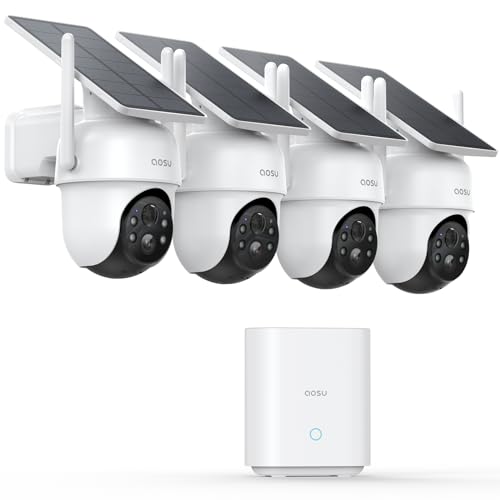 aosu D1 Classic 4-Cam Wireless Outdoor Security |
9.2/10 | Buy |
| Best Value |
 NullEasy SolarCam 4-Pack 2K Cameras |
9.1/10 | Buy |
 Vivideye 4MP Solar Wireless Security Camera System |
8.6/10 | Buy | |
 SEHMUA 2K Solar Security Cameras (2-Pack) |
8.3/10 | Buy | |
| Best Budget |
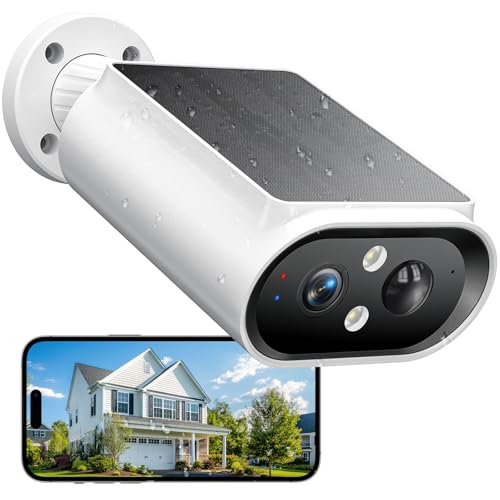 AlkiVision 2K Wireless Solar Security Camera |
8.1/10 | Buy |
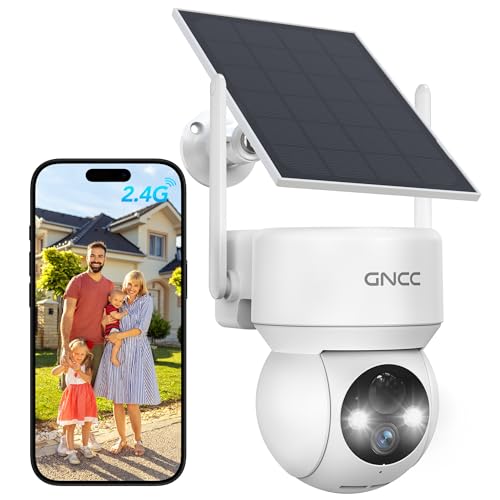 GNCC 1080P Solar Wireless Security Camera |
7.8/10 | Buy |
GALAYOU R6 2K Solar Security Camera
Combining continuous solar charging with sharp 2K resolution, the GALAYOU R6 provides wire-free surveillance for yards, garages, and driveways. Its motorized pan-and-tilt tracking and integrated siren deliver active property deterrence without hardwired electrical lines.
Pros
- Wire-free setup powered by continuous solar charging
- Sharp 2K resolution with color night vision
- Automated motion tracking across a wide coverage area
- Built-in siren and two-way audio for deterrence
- IP65 weather resistance handles outdoor conditions
Cons
- Limited to 2.4 GHz Wi-Fi networks only
- MicroSD card is not included in the box
- Continuous or extended cloud recording requires paid plan
aosu D1 Classic 4-Cam Wireless Outdoor Security
The aosu D1 Classic 4-Cam Kit delivers complete perimeter visual defense using solar-powered 2K pan-and-tilt cameras paired with a dedicated aosuBase hub for subscription-free encrypted local storage. It is an ideal zero-monthly-fee security solution for suburban homeowners looking to monitor entryways, yards, and driveways without wiring hassles.
Pros
- Subscription-free residential security with 32GB of encrypted local loop recording housed safely inside the aosuBase hub.
- Continuous solar charging requires only three hours of sunlight daily, minimizing the need for manual battery recharging.
- 360-degree pan-tilt coverage with automatic motion tracking ensures subjects are actively followed across the camera view.
- Simultaneous four-camera split-screen live viewing and cross-camera event sequencing simplify outdoor perimeter monitoring.
Cons
- Requires sufficient daily sunlight exposure (at least three hours), which may limit optimal placement under deep soffits or shaded tree canopies.
- Lacks cellular backup and relies entirely on local wireless connectivity, meaning remote push alerts depend on home internet uptime.
- Permanent exterior installation requires drilling mounting holes, making it less adaptable for strict drill-free rental balconies.
NullEasy SolarCam 4-Pack 2K Cameras
Providing multi-angle perimeter coverage for whole-property monitoring, this four-camera kit pairs solar power with crisp 2K video and color night vision. It suits homeowners who want flexible outdoor surveillance without running electrical wires.
Pros
- Solar power eliminates manual battery recharging
- Wide remote pan and tilt viewing angles
- Detailed 2K video with color night vision
- Built-in AI filters out false motion triggers
- Supports local microSD cards up to 128GB
Cons
- Does not offer automatic motion tracking
- No support for 24/7 continuous recording
- Incompatible with 5GHz Wi-Fi networks
Vivideye 4MP Solar Wireless Security Camera System
The Vivideye 2-Camera Solar Security System delivers sharp 4MP resolution, 360-degree motorized pan-tilt tracking, and an encrypted 128GB local storage hub that eliminates monthly fees. It is an ideal wire-free solution for suburban homeowners and renters looking for comprehensive perimeter monitoring without recurring subscriptions.
Pros
- Zero ongoing subscription costs with 128GB of pre-installed, encrypted local storage housed safely inside the hub.
- Motorized 360-degree panning combined with innovative cross-camera tracking handoffs across active monitoring zones.
- True wire-free installation powered continuously by bundled 5W solar panels and 8000mAh battery packs.
- Dual-band 2.4GHz and 5GHz Wi-Fi compatibility with factory pre-paired setup right out of the box.
- Rugged IP66 weatherproofing rated to endure extreme seasonal temperatures from -4°F up to 122°F.
Cons
- Mechanical auto-tracking functionality is disabled by default and requires manual activation inside the Truisee app.
- AI human detection range is limited to a maximum distance of 29 feet, which may not suit expansive perimeter properties.
- Smart home voice integration is limited to Amazon Alexa, lacking native support for Google Home or Apple HomeKit ecosystems.
SEHMUA 2K Solar Security Cameras (2-Pack)
Designed for wire-free exterior monitoring, this two-pack pairs continuous solar power with motorized pan and tilt for complete yard coverage. Built-in spotlights and 2K resolution ensure crisp color video day and night without requiring battery swaps.
Pros
- Solar panels provide continuous, wire-free power
- Wide pan and tilt range eliminates blind spots
- Color night vision supported by integrated spotlights
- Supports local recording without mandatory monthly fees
- IP65 rating withstands rain, snow, and sunlight
Cons
- Does not support 5GHz Wi-Fi networks
- MicroSD card is not included in the box
- Cloud storage requires a subscription after the trial
AlkiVision 2K Wireless Solar Security Camera
The AlkiVision Wireless Solar Security Camera combines 2K resolution, spotlight-assisted color night vision, and an IP67-rated exterior powered by a 5000mAh battery and solar panel. It suits budget-conscious homeowners and renters seeking wire-free perimeter monitoring with local microSD storage, though smart AI filtering requires a paid subscription.
Pros
- 2K video resolution paired with spotlight-assisted full-color night vision for enhanced low-light clarity
- Bundled solar panel and 5000mAh internal battery enable convenient wire-free exterior placement
- Certified IP67 weatherproofing provides dependable resistance against rain and dust
- Onboard microSD slot accommodates up to 128GB cards for subscription-free local event recording
Cons
- Smart AI classification (person, vehicle, pet, package) and custom activity zones require a paid Vicohome cloud subscription
- Restricted to 2.4GHz Wi-Fi networks with no support for 5GHz bands or wired Ethernet connections
- Operates strictly on motion-triggered clips up to 20 seconds, lacking continuous 24/7 video recording capability
GNCC 1080P Solar Wireless Security Camera
Designed for wire-free perimeter monitoring, this GNCC outdoor camera pairs a 3W solar panel and 5200mAh battery with motorized pan-and-tilt coverage. It delivers 1080p color night vision and PIR-triggered event recording without requiring hardwired power.
Pros
- Solar panel provides wire-free continuous power
- Wide motorized 355-degree pan and 90-degree tilt
- Built-in spotlight enables color night vision
- IP65 weather resistance for outdoor durability
- Supports local microSD card storage up to 128GB
Cons
- Does not support 24/7 continuous recording
- Lacks automatic motion tracking functionality
- Advanced AI detection requires a paid subscription
Evaluating Solar Security Cameras for Residential Surveillance
Solar security cameras provide a practical and capable surveillance solution for properties where running hardwired electrical lines is difficult or cost-prohibitive. These systems operate by harvesting ambient solar energy during daylight hours to recharge internal lithium-ion battery cells, which then power the camera continuously through nighttime and cloudy periods. Because they depend on stored battery power, they typically record motion-activated video events rather than streaming continuous 24/7 video footage. Determining whether are solar security cameras good for your property requires assessing your local sunlight exposure, network coverage, and specific perimeter security requirements.
How Solar Surveillance Hardware Balances Power and Performance
Modern solar surveillance equipment pairs high-efficiency photovoltaic panels with integrated lithium-ion battery packs to maintain continuous perimeter protection. The solar collector converts sunlight into low-voltage direct current, which flows through a power management circuit to replenish the rechargeable battery bank. Under typical outdoor conditions, most residential cameras require between two and three hours of daily direct sunlight to sustain ongoing operation. Energy-saving firmware keeps the camera in an ultra-low-power standby mode, waking up the optical sensor and wireless radio only when movement triggers a recording or when you access the live view.
Battery capacity plays a crucial role in maintaining system uptime during prolonged periods of heavy cloud cover, rain, or snow. Standalone cameras and multi-cam packages frequently utilize internal battery banks ranging from 5,000 milliampere-hours up to 8,000 milliampere-hours to buffer against winter weather deficits. For instance, systems like the Vivideye multi-camera setup combine a dedicated 5-watt solar panel with an 8,000 milliampere-hour battery to prevent unexpected operational shutdowns. Detachable panel designs further enhance reliability by allowing you to mount the camera body under a shaded porch while positioning the solar collector in direct sunlight using an extension cable.
Understanding Motion Detection: PIR Sensors Versus Pixel Analysis
Continuous video processing demands substantial electrical wattage that would quickly deplete a compact battery bank within a few hours. To conserve power, solar security cameras rely on hardware-based passive infrared sensors rather than continuous optical pixel analysis to detect activity. Passive infrared sensors detect rapid changes in thermal radiation across segmented optical zones, drawing minimal standby energy while monitoring your yard. When a person, animal, or warm vehicle crosses the detection threshold, the sensor instantly triggers the main processor to capture the event.
Basic thermal sensors can occasionally trigger false alarms when exposed to windblown foliage heated by direct sunlight or warm air currents. To minimize notification fatigue, manufacturers integrate on-device artificial intelligence that filters incoming movement events before sending alerts to your mobile phone. Camera systems such as the aosu and NullEasy models utilize edge-based computer vision algorithms to distinguish human body shapes from pets, passing shadows, and blowing debris. Adjusting detection sensitivity settings and establishing customized activity zones inside the companion mobile app helps prevent nuisance alerts and conserves vital battery power.
Optical Resolution, Field of View, and DORI Standards
Image resolution on solar security equipment has advanced significantly from older 1080p sensors to crisp 2K and 4-megapixel optical hardware. Higher pixel densities provide clearer recorded details when you digitally zoom into recorded clips to examine facial features or vehicle characteristics. Evaluating optical performance requires looking beyond simple megapixel marketing numbers and referencing the international IEC EN 62676-4 DORI standard. This surveillance framework defines four clear operational zones, including Detection, Observation, Recognition, and forensic Identification.
Under the DORI specification, general detection requires at least 25 pixels per meter, enabling you to tell whether an object is a human or an animal. Positive human recognition requires a minimum of 125 pixels per meter, while definitive legal identification demands at least 250 pixels per meter across the subject. Wide-angle fixed lenses offer broad area coverage, but they distribute available pixels over a wider area, reducing your maximum identification distance. Motorized pan-and-tilt options, such as the SEHMUA and GALAYOU cameras, allow you to rotate the lens up to 360 degrees horizontally to inspect specific zones without compromising pixel density.
Nighttime Performance: Infrared Illumination Versus Active Spotlights
Capturing clear footage after sunset is an essential requirement for any residential security system. Traditional night vision utilizes 850-nanometer infrared light-emitting diodes to illuminate the viewing area with invisible light, generating crisp black-and-white video footage. Infrared LEDs consume very little battery power and operate discreetly without casting visible light across your yard. Homeowners seeking richer nighttime evidentiary details often select battery security cameras featuring color night vision that incorporate bright LED spotlights and wide-aperture lenses.
Integrated spotlights activate automatically when the passive infrared sensor detects motion, illuminating the scene to capture critical details such as clothing colors and vehicle finishes. The sudden burst of bright light also functions as an active physical deterrent, letting trespassers know they have been spotted. Spotlights draw considerably more battery current than passive infrared illumination, making it wise to manage activation durations in high-traffic settings. Restricting spotlight activation to specific motion zones helps preserve stored battery reserves throughout long winter nights.
Network Connectivity and Wi-Fi Signal Transmission
Stable wireless network connectivity ensures your solar security cameras stream live footage smoothly and deliver timely motion notifications. Most solar outdoor cameras communicate over the 2.4-gigahertz Wi-Fi spectrum because lower-frequency radio signals penetrate exterior brick, wood, and stucco siding more effectively than 5-gigahertz frequencies. Select modern hardware, such as dual-band models from Vivideye, supports both 2.4-gigahertz and 5-gigahertz networks to provide flexible setup options. Checking wireless signal strength at your proposed exterior mounting spot using a mobile diagnostic app helps avoid connectivity headaches later.
Radio frequency attenuation occurs whenever wireless signals travel through dense structural materials such as insulated walls, double-pane glass, or metal garage doors. A weak wireless connection forces the internal Wi-Fi transmitter to repeatedly boost broadcast power, causing rapid battery drain and delayed push notifications. Aiming for a received signal strength indicator value of minus 65 decibel-milliwatts or stronger at the camera bracket ensures reliable data delivery. If your router signal is weak near your perimeter, installing a dedicated outdoor Wi-Fi extender or deploying a hub-connected system provides stable throughput.
Storage Options: Onboard MicroSD Cards Versus Cloud Subscriptions
How your camera stores recorded security footage affects both ongoing ownership expenses and overall privacy. Many homeowners prefer avoiding monthly subscription charges that lock essential video history and motion analysis behind recurring payment tiers. Several solar camera options support onboard microSD cards up to 128 gigabytes or include local home base stations that store encrypted clips directly inside your residence. Centralized base stations, such as the aosuBase unit, keep video files safe indoors even if an exterior camera is vandalized or taken.
Relying on local flash storage eliminates recurring monthly fees, but you must select the right memory card format to prevent write failures. Standard consumer microSD cards are not designed for repetitive surveillance writes, making high-endurance cards rated for Class 10, U3, and V30 performance essential. Optional cloud storage packages offer offsite redundancy, ensuring video evidence remains accessible if hardware is physically stolen or destroyed. Balancing your personal preference for subscription-free local operation against the convenience of offsite cloud backup helps you select the right storage approach.
Environmental Durability and Cold-Weather Battery Protection
Outdoor surveillance equipment must endure challenging weather conditions, from intense summer heatwaves to driving rain and heavy winter snow. Ingress protection ratings verify how effectively a camera enclosure prevents dust and water from reaching sensitive internal electronic components. An IP65 rating provides complete dust resistance and protects against low-pressure water sprays from rainfall or garden hoses, making it ideal for sheltered eaves. More exposed locations, such as open yard posts or unshaded exterior walls, benefit from heavy-duty IP66 or IP67 ratings like those featured on AlkiVision cameras.
Freezing winter temperatures introduce specific chemical limitations for all rechargeable lithium-ion battery cells. When ambient temperatures drop below 32 degrees Fahrenheit, or zero degrees Celsius, internal chemical reactions slow down significantly, reducing available electrical capacity. To prevent permanent battery cell damage, built-in battery management systems automatically stop accepting solar charging currents in sub-freezing temperatures. Homeowners in cold northern climates should fully charge camera batteries using an indoor USB connection before winter arrives and position solar panels to capture maximum midday winter sunlight.
Mounting Elevation, Viewing Angles, and Sun Exposure
Selecting the right physical mounting height directly affects motion detection reliability and facial capture clarity. Installing outdoor cameras at an elevation between eight and ten feet balances wide-angle property coverage with effective facial recognition angles. Mounting a camera too high creates an excessively steep downward perspective that captures only the tops of hats rather than clear facial features. Steep angles also reduce passive infrared efficiency, as thermal sensors respond best when visitors walk across the detection field rather than directly toward the camera.
Homeowners monitoring wide entry areas or sprawling driveways often install pan-tilt driveway security cameras to eliminate perimeter blind spots without needing multiple fixed cameras. Angling the lens slightly downward keeps the bright horizon from causing backlighting issues that can silhouette approaching visitors. Positioning the solar panel requires careful alignment; collectors in North America should face south and tilt to match your local geographic latitude for optimal solar harvesting. Trimming nearby tree branches ensures that shifting afternoon shade does not reduce daily photovoltaic energy production.
Continuous 24/7 Recording Limits and Practical Trade-offs
A common point of confusion among new buyers is whether solar security cameras can record uninterrupted video around the clock. True 24/7 continuous video recording requires a constant, high-output power source that small residential solar panels and battery cells cannot realistically provide. Constant video processing, active wireless streaming, and continuous encoding would exhaust an 8,000 milliampere-hour battery in under twelve hours. For this reason, solar security hardware is specifically engineered to operate in an event-triggered mode, waking up rapidly when motion is detected.
If your security plan strictly demands uninterrupted continuous surveillance recording, you should consider hardwired Power over Ethernet camera systems instead. Hardwired cameras receive continuous power and high-speed data over a single network cable, routing continuous video streams directly to a local network video recorder. However, for residential yards, driveways, detached barns, and perimeter gates, event-activated solar cameras provide exceptional protection without complex wiring. Recognizing this operational difference ensures you choose the hardware that matches your practical surveillance needs.
Legal Considerations, Audio Surveillance, and Privacy Boundaries
Deploying exterior cameras equipped with integrated microphones and two-way talk features introduces legal guidelines that homeowners must navigate. Under United States federal law, specifically Title 18 Section 2511 of the United States Code, recording oral conversations without proper consent can create legal liability. State eavesdropping laws vary significantly across the country, with some states following one-party consent rules while others enforce strict all-party consent requirements. Checking your state and local statutes helps you determine whether two-way audio recording should remain enabled or muted on your exterior cameras.
Neighbor Privacy and Digital Masking Guidelines
Visual surveillance requires equal care to respect the reasonable expectation of privacy held by neighbors and visitors. While recording your private front porch, driveway, and public street frontage is legally protected, aiming cameras directly into adjacent bedroom windows or private yards can lead to legal disputes. Most companion mobile applications allow you to draw customizable privacy masks that obscure sensitive neighboring zones directly in the video feed. Taking advantage of digital masking features demonstrates good neighborhood etiquette while keeping your property securely monitored.
Practical Takeaways for Reliable Solar Security Operation
Solar security cameras represent an excellent, cost-effective surveillance option for residential properties when installed with proper sunlight access and network coverage. They eliminate the hassle of routine battery swapping and avoid the substantial expense of hiring an electrician to run exterior conduit. Routine system maintenance involves wiping accumulated dust, pollen, and winter road grime off the solar collector and optical lens with a soft microfiber cloth every few months. Testing motion sensitivity settings and verifying Wi-Fi signal quality periodically ensures your solar surveillance cameras provide reliable, uninterrupted home security throughout every season.
About the author
John R. Delaney is a veteran technology editor and product reviewer specializing in home security, smart home devices, and wireless networking. With extensive experience evaluating connected security systems, cameras, smart locks, sensors, and networking equipment, he brings a practical testing mindset to consumer technology. His work emphasizes usability, performance, connectivity, and long-term value for homeowners building reliable smart security systems.