
Best Aeotec Door Sensor Battery of 2026 for Reliable Power
Power your home security smoothly with the best aeotec door sensor battery options for October 2026, offering long standby life and steady voltage.
 By John R. Delaney
Updated October 3, 2026
By John R. Delaney
Updated October 3, 2026

A dead contact sensor on a primary entryway leaves smart security automations completely blind without warning. Wireless entryway hardware demands stable voltage delivery, especially when transmitting status signals across Z-Wave networks to coordinated devices and a reliable smart lock door setup. Finding the best aeotec door sensor battery comes down to balancing discharge rates, thermal stability, and proper cell chemistry to avoid frequent replacements. While compact units like the Zwave Door Sensor Aeotec Recessed Door Sensor 7 rely on dedicated 1/2 AA lithium cells to maintain up to three years of power, other peripheral security detectors rely on robust cells like the Enegitech CR123A 3V Lithium Battery for dependable longevity.
Careful evaluation of manufacturer specifications and user feedback reveals that voltage consistency matters just as much as rated milliamp-hour capacity. Low-grade lithium cells often experience sharp voltage drops under cold temperatures or during sudden RF signal bursts, triggering false low-battery alerts on your hub interface. Selecting verified cells with built-in safety mechanisms ensures your perimeter sensors, occupancy monitors, and smart lighting triggers remain fully operational around the clock. Investing in the best aeotec door sensor battery solution keeps your smart automation hub responsive while preventing unexpected dropouts across your entire security grid.
| Award | Product | SSG Score About SSG ScoreThe SSG Score is our own rating from 0 to 10, based on performance, design and build, ease of use, and value. It reflects independent research and is never influenced by manufacturers, retailers, or affiliate commissions. Learn more › | |
|---|---|---|---|
| Best Overall |
Enegitech CR123A 3V Lithium Battery
|
9.2/10 | Buy |
| Best Value |
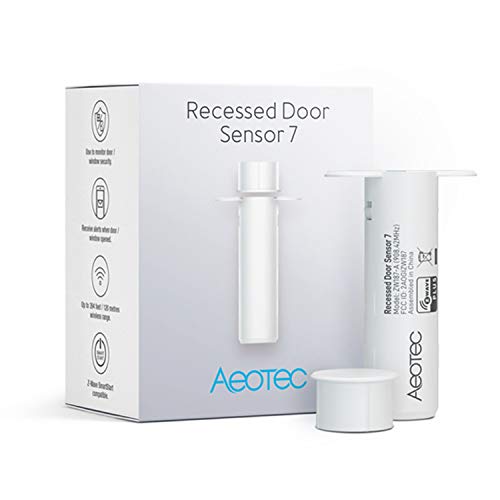 Zwave Door Sensor Aeotec Recessed Door Sensor 7
|
8.1/10 | Buy |
Frequently Asked Questions
What battery size does the Aeotec recessed door sensor use?
The Zwave Door Sensor Aeotec Recessed Door Sensor 7 uses a single 1/2 AA 3.6V lithium battery, commonly designated as ER14250. This specialized half-size cylinder fits directly inside the concealed cylindrical housing installed in your door frame. Other security sensors across related ecosystems often require CR123A cells like the Enegitech CR123A 3V Lithium Battery. Always confirm the specific model number before purchasing replacement cells.
Can rechargeable batteries be used in an Aeotec door sensor?
No, rechargeable lithium-ion cells should not be used in these low-power contact sensors. Rechargeable cells usually deliver higher peak voltages that can damage sensitive Z-Wave 700 series circuitry. They also suffer from rapid self-discharge rates, causing devices to lose power within weeks instead of years. Standard non-rechargeable lithium chemistry provides the steady voltage profile needed for reliable operation.
How long does the battery typically last in an Aeotec Z-Wave door sensor?
A quality battery generally lasts between one and three years depending on entry traffic and wake-up reporting intervals. Hardware running Z-Wave Plus V2 uses up to 66 percent less transmission power than earlier generations. Heavy-traffic exterior doors consume battery life faster than interior doors that rarely swing open. Adjusting the wake-up interval on your hub helps preserve battery reserves.
Why does a door sensor report low battery shortly after a new cell is installed?
Door sensors report battery levels during periodic wake-up intervals rather than immediately when a cell is inserted. Most smart hubs display cached battery figures until the sensor completes its next scheduled communication cycle. Tapping the action button wakes the sensor manually to force a fresh telemetry report. Integrating properly calibrated smart lock door contact sensors ensures synchronized status updates across your home platform.
Does the 2026 Best Aeotec Door Sensor Battery setup require a specific smart home hub to monitor battery percentage?
Yes, you need a compatible Z-Wave controller to read and display live battery telemetry. Systems like Samsung SmartThings, Hubitat Elevation, and HomeSeer HS3 fully support standard Z-Wave battery reporting classes. These hubs send smartphone notifications when power levels dip below critical thresholds. Controllers lacking proper Z-Wave profiles may fail to display battery percentages accurately.
About the author
John R. Delaney is a veteran technology editor and product reviewer specializing in home security, smart home devices, and wireless networking. With extensive experience evaluating connected security systems, cameras, smart locks, sensors, and networking equipment, he brings a practical testing mindset to consumer technology. His work emphasizes usability, performance, connectivity, and long-term value for homeowners building reliable smart security systems.