
Can I Point an Indoor Security Camera Outside? Practical Guide for 2026
Overcoming window glare is vital if you ask can i point an indoor security camera outside. Here is how to optimize video clarity for November 2026.
 By John Carlsen
Updated November 20, 2026

Mounting surveillance hardware along perimeter windows often seems like the fastest way to monitor a front porch or driveway without drilling into exterior walls. However, property owners quickly discover that positioning a standard lens behind glass leads to blinding infrared reflections, missed motion triggers, and washed-out daylight footage. If you find yourself asking can i point an indoor security camera outside, the short answer is yes, but only if you configure the settings correctly and understand the physical hardware limitations. Standard glass panes actively reflect interior room lighting, while modern Low-E coatings scatter optical signals and create significant daytime contrast issues.
Exterior environmental exposure presents another major obstacle when attempting to place indoor hardware beyond the threshold of your home. Standard indoor housings lack proper Ingress Protection ratings like IP65 or IP66, leaving sensitive circuits vulnerable to humidity, driving rain, and sub-zero temperature drops. Choosing weather-rated dual-purpose cameras or exploring dedicated battery security cameras with local storage can provide a far more resilient surveillance perimeter. Understanding how optical reflection, thermal motion sensing, and weatherproofing interact ensures your property stays monitored reliably without damaged hardware or unusable video evidence.
Top Products
| Award | Product | SSG Score About SSG ScoreThe SSG Score is our own rating from 0 to 10, based on performance, design and build, ease of use, and value. It reflects independent research and is never influenced by manufacturers, retailers, or affiliate commissions. Learn more › | |
|---|---|---|---|
| Best Overall |
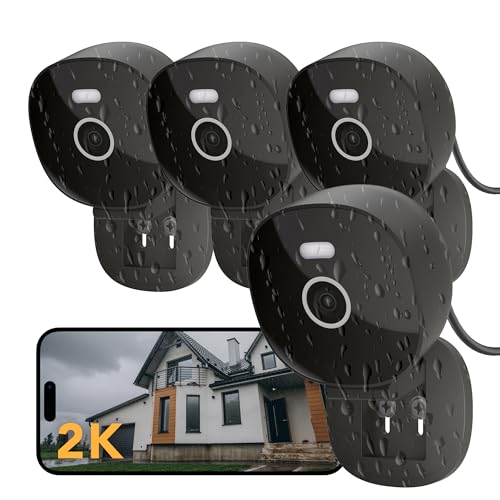
FAMVIVA 2K Wired Security Camera (4-Pack)
|
9.1/10 | Buy |
| Best Budget |
 Vimtag 4MP Dual-Band Security Camera |
8.6/10 | Buy |
| Best Premium |
 TP-Link Tapo C500 1080p Pan/Tilt Camera |
8.6/10 | Buy |
 TP-Link Tapo 1080P Solar Wire-Free Outdoor |
8.3/10 | Buy | |
| Best Value |
 AOQEE 2K Indoor Outdoor Security Camera 2-Pack |
8.3/10 | Buy |
 VISION WELL 2K Wireless Security Camera |
8.3/10 | Buy | |
 GUOANVISION 2K Dual-Band Security Camera |
8.0/10 | Buy |
FAMVIVA 2K Wired Security Camera (4-Pack)
This four-camera kit provides sharp 2K monitoring with color night vision and IP65 weather resistance for indoor or outdoor coverage. Integrated spotlights and sirens add active deterrence, though each unit requires a nearby power outlet.
Pros
- Crisp 2K video clarity with full-color night vision
- Integrated spotlight and siren deter potential intruders
- IP65 weatherproofing withstands rain and snow
- Seamless integration with Alexa and Google Home displays
Cons
- Requires a continuous wired outlet connection to operate
- MicroSD card must be purchased separately for local storage
Vimtag 4MP Dual-Band Security Camera
Delivering sharp 2.5K video over dual-band Wi-Fi 6, this compact wired camera provides reliable round-the-clock monitoring indoors or out. Its IP65 weatherproofing, color night vision, and local storage support make it a versatile pick for continuous home surveillance.
Pros
- Dual-band Wi-Fi 6 ensures fast, stable streaming
- Clear 2.5K resolution with integrated spotlight night vision
- Durable IP65 rating withstands rain and extreme temperatures
- Supports large local microSD cards up to 512GB
- Wired power eliminates the need to recharge batteries
Cons
- Requires access to an electrical outlet for power
- Cloud storage features require an ongoing subscription
- MicroSD card must be purchased separately for playback
TP-Link Tapo C500 1080p Pan/Tilt Camera
Delivering full 360-degree horizontal coverage with 1080p resolution, the TP-Link Tapo C500 tracks movement and detects people around your property. It serves well for homeowners wanting reliable automated outdoor monitoring with generous local storage options.
Pros
- Full 360-degree coverage minimizes outdoor blind spots
- Physical privacy mode physically conceals the lens
- Long-range night vision reaches up to 98 feet
- Supports high-capacity microSD cards up to 512GB
- Automated motion tracking follows moving subjects reliably
Cons
- Requires a wired power source outdoors
- Only connects to 2.4 GHz Wi-Fi bands
- Video resolution tops out at standard 1080p
TP-Link Tapo 1080P Solar Wire-Free Outdoor
The TP-Link Tapo 1080P security camera delivers wire-free flexibility powered by a solar panel and built-in battery, featuring full-color night vision up to 30 feet and subscription-free local storage up to 512GB. It is a practical, cost-effective solution for homeowners and renters seeking dependable perimeter surveillance without monthly fees.
Pros
- Continuous solar-assisted operation with an included 13-foot cable for flexible panel placement
- Subscription-free local video storage supporting microSD cards up to 512GB
- Free person and motion detection with customizable activity zones
- Full-color night vision up to 30 feet backed by dual integrated spotlights
- Rugged IP65-rated weather resistance against rain, dust, and snow
Cons
- Solar panel charging operates only at ambient temperatures above 32 degrees Fahrenheit
- Google Assistant live streaming is limited specifically to Chromecast and Google Nest display hardware
- Full 1080p resolution provides solid general visibility but lacks the higher pixel density of 2K or 4K surveillance systems
AOQEE 2K Indoor Outdoor Security Camera 2-Pack
The AOQEE 2K C1 two-pack provides versatile indoor and outdoor surveillance featuring sharp 2K resolution, white-light color night vision, IP65 weatherproofing, and 24/7 local recording to a microSD card. It is an ideal, budget-conscious setup for homeowners and renters seeking reliable multi-point coverage without mandatory monthly fees.
Pros
- Crisp 2K resolution paired with white-light full-color night vision
- Supports subscription-free 24/7 continuous local recording via microSD card (up to 128GB)
- IP65 weather-resistant housing suitable for indoor and outdoor placement
- Clear two-way audio communication with a built-in siren for active deterrence
- Seamless voice assistant compatibility with Amazon Alexa and Echo Show smart displays
Cons
- Requires a continuous wired power outlet, limiting placement where outlets are unavailable
- Operates exclusively on 2.4GHz Wi-Fi networks without support for 5GHz bands
- MicroSD card is not included and must be purchased separately for local storage
VISION WELL 2K Wireless Security Camera
The VISION WELL 2K Wireless Security Camera delivers flexible, wire-free surveillance for indoor or outdoor spaces with clear 2K resolution, color night vision, and on-device AI motion filtering. It is a dependable, budget-conscious choice for homeowners and renters seeking reliable entryway deterrence without mandatory monthly fees.
Pros
- Completely wire-free battery installation with included bracket and screws, making it ideal for renters and suburban homeowners.
- Sharp 2K video clarity supported by full-color night vision and a 33-foot illumination range.
- PIR motion detection paired with smart AI filtering for people, vehicles, pets, and packages.
- Local recording support on microSD cards up to 128GB to avoid mandatory monthly subscriptions.
- IP65 weather-resistant rating suitable for exterior perimeter or sheltered entryway mounting.
Cons
- Only connects to 2.4 GHz Wi-Fi networks and does not support 5 GHz frequencies.
- Designed for motion-activated event clips rather than continuous 24/7 video recording.
- MicroSD storage card is not included in the box and must be purchased separately.
GUOANVISION 2K Dual-Band Security Camera
Designed for indoor or outdoor placement, this plug-in GUOANVISION camera pairs sharp 2K resolution with dual-band Wi-Fi for stable continuous monitoring. It provides a straightforward, subscription-free surveillance choice for homeowners needing reliable color night vision and local storage.
Pros
- Dual-band Wi-Fi provides stable network connectivity
- Color night vision delivers clear after-dark footage
- Continuous 24/7 recording without required subscriptions
- Weatherproof IP66 enclosure withstands outdoor elements
Cons
- Requires access to an electrical outlet for continuous power
- Uses digital zoom instead of lossless optical zoom
Pointing Indoor Cameras Outside: Optical Physics, Common Pitfalls, and Practical Solutions
Pointing an indoor security camera out a window is a widespread practice for apartment renters and homeowners seeking quick perimeter surveillance without drilling into exterior walls. While setting a camera on an interior windowsill provides a convenient view of a porch or driveway, doing so introduces severe optical and mechanical compromises. Window panes reflect interior lighting, absorb critical thermal radiation needed for motion sensing, and wash out sensor exposure. Addressing whether you can successfully aim an indoor lens outside requires examining optical reflection mechanics, ambient illumination strategies, and environmental durability.
The Infrared Reflection Problem and Night Vision Glare
Standard indoor cameras rely on built-in infrared (IR) light emitting diodes (LEDs) to illuminate pitch-black rooms, typically broadcasting at the 850-nanometer wavelength. When an 850nm infrared beam strikes a glass window pane, the flat pane acts as a near-perfect mirror rather than an open aperture. The camera lens receives its own concentrated infrared beam bounced directly back into the optical CMOS sensor, generating a blinding white haze or circular glare. This intense flare whitewashes the entire video frame, making it impossible to observe anything happening on the dark exterior side of the glass.
Solving this night vision reflection requires disabling the internal infrared emitters entirely within the camera mobile application settings. Once the internal emitters are switched off, the camera relies strictly on ambient light entering from the outside environment to generate a usable image. Homeowners often install dedicated exterior floodlights or porch lights, while others deploy standalone 850nm infrared illuminators mounted physically outdoors. Many property owners also look toward battery security cameras with color night vision, which leverage wide-aperture lenses and white spotlights to produce clear evening footage without suffering from window bounce-back.
Why Passive Infrared Motion Detection Fails Through Glass
Passive infrared (PIR) motion sensors detect movement by measuring changes in ambient thermal radiation across split optical zones. When a warm object, such as a person or vehicle engine, moves across the sensor field of view, the thermal differential triggers the camera to wake and record. However, standard window glass is essentially opaque to the long-wave infrared radiation emitted by human body heat. Because thermal energy cannot pass through the glass envelope, a PIR sensor sitting on an interior windowsill will almost never detect an intruder walking outside.
To achieve reliable detection through a window, surveillance systems must utilize pixel-based motion analysis or edge-based artificial intelligence. Pixel detection software analyzes consecutive video frames for shifts in luminance, meaning changes in sunlight, passing tree shadows, or interior ceiling reflections can generate continuous false alerts. Modern on-device neural processing units (NPUs) mitigate this notification fatigue by analyzing visual shapes to confirm persons, vehicles, or animals rather than raw pixel changes. Even with computer vision enabled, thick double-pane glass can blur visual edge contrast, reducing detection reliability during heavy rain or foggy conditions.
Managing Daytime Glare, Double-Pane Glass, and Low-E Coatings
Daytime surveillance through windows introduces optical problems caused by varying ambient lighting between the interior room and the bright outdoors. Direct sunlight striking an exterior window surface creates severe reflection, mirroring interior furniture, lamps, or computer screens straight into the camera lens. Modern architectural windows feature Low-E (low emissivity) coatings composed of ultra-thin microscopic metal layers designed to reflect radiant heat. While excellent for thermal insulation, these Low-E coatings scatter visible light wavelengths, introducing noticeable green or purple color casts and lowering overall image sharpness.
Positioning the camera lens directly against the interior surface of the window glass significantly reduces these daylight reflections. Using a flexible silicone window collar or black non-reflective mounting bracket creates a light-tight seal between the lens barrel and the glass. Homeowners should also ensure that interior room lights behind the camera remain off, preventing internal ambient illumination from bouncing off the pane. Cameras equipped with Wide Dynamic Range (WDR) or High Dynamic Range (HDR) processing handle these scenes far better, balancing intense exterior sunlight with shaded porch alcoves.
Physical Weatherproofing and Environmental Ingress Limitations
Taking an indoor camera out of the house and mounting it directly outdoors without glass protection exposes delicate electronic circuits to severe environmental threats. Hardware designed strictly for indoor usage lacks Ingress Protection (IP) ratings, meaning the housing provides no certified seal against dust, driving rain, or airborne humidity. Moisture quickly penetrates unsealed cable ports, speaker grilles, and microphone diaphragms, leading to internal short circuits and permanent motherboard corrosion. Furthermore, non-UV-stabilized plastics degrade under persistent solar ultraviolet exposure, causing camera enclosures to turn brittle and crack over time.
Thermal extremes present another critical failure point for indoor camera hardware deployed in exterior environments. During peak summer months, direct solar radiation can heat dark camera housings well beyond manufacturer operating limits, inducing thermal shutdown or sensor degradation. In northern winter climates, sub-freezing temperatures cause internal condensation to freeze directly across the optical glass, rendering live video feeds completely unusable. Standard indoor power adapters and micro-USB or USB-C connection points also lack weatherproof silicone gaskets, creating dangerous electrical short-circuit risks when exposed to outdoor moisture.
Indoor/Outdoor Hybrid Cameras and Storage Architectures
Recognizing that homeowners need versatile placement options, several manufacturers now offer compact hybrid cameras carrying certified IP65 or IP66 weather resistance ratings. Compact models like the FAMVIVA 2K Wired Security Camera and the AOQEE 2K Cameras provide complete dust protection and water-jet resistance while maintaining a small form factor suitable for shelves or exterior walls. These hybrid devices allow users to place them against an interior window when desired or mount them directly under an exterior roof eave without risking moisture damage. Many of these units also incorporate integrated white spotlights, providing full-color night vision that operates effectively in any location.
Power delivery and local storage architecture play crucial roles in maintaining uninterrupted video surveillance. Continuous plug-in power enables constant 24/7 video recording (CVR), eliminating the sleep-to-wake recording latency that frequently plagues battery-powered devices. Units such as the VIMTAG 4MP camera support high-capacity microSD cards up to 512GB, allowing local footage archiving without forcing users into recurring cloud subscription fees. When selecting local storage for continuous recording, using high-endurance flash memory rated for Class 10 UHS Speed Class 3 (U3) and Video Speed Class 30 (V30) prevents write-cycle corruption.
Outdoor Pan-Tilt Coverage and Optical Identification Standards
When fixed windowsill angles fail to cover wide driveways or side walkways, dedicated motorized pan-tilt-zoom cameras offer superior physical flexibility. Devices like the TP-Link Tapo C500 provide 360-degree horizontal panning and wide vertical tilt ranges, allowing users to sweep entire exterior perimeters from a single mounting point. Mounting dedicated exterior hardware eliminates the optical compromises of window glass while expanding coverage across property boundaries. For broad exterior perimeters and vehicle approach paths, installing specialized pan tilt zoom cameras for driveway coverage ensures that blind spots along fence lines and gates are systematically monitored.
Optical resolution and sensor fidelity directly dictate whether recorded footage can serve as actionable evidence under the international IEC EN 62676-4 DORI standard. This surveillance framework defines four distinct criteria: Detection at 25 pixels per meter, Observation at 63 pixels per meter, Recognition at 125 pixels per meter, and Identification at 250 pixels per meter. Shooting through reflective or dirty window glass dramatically lowers effective pixel density and MTF sharpness, rarely achieving the forensic identification threshold. Direct outdoor mounting ensures the optical CMOS sensor receives unfiltered light, maximizing facial detail and license plate readability across critical driveway choke points.
Legal Compliance, Wiretap Statutes, and Privacy Boundaries
Positioning any camera to capture exterior areas requires strict adherence to residential privacy laws and electronic surveillance statutes. Under United States Fourth Amendment legal principles and state common law torts, individuals maintain no reasonable expectation of privacy in public streets, sidewalks, or open curtilage visible from public property. However, pointing a high-resolution camera directly into a neighboring home’s private interior windows, fenced backyard, or personal swimming area can trigger civil invasion of privacy lawsuits. Responsible property owners utilize software privacy masks within camera settings to black out adjoining properties and respect neighborhood boundaries.
Acoustic surveillance introduces even stricter statutory compliance hurdles under federal and state wiretapping legislation. The Federal Wiretap Act (18 U.S.C. Section 2511) and state-level eavesdropping statutes regulate the interception of oral communications where speakers expect privacy. In all-party (or two-party) consent states, recording an oral conversation without the explicit permission of all participants constitutes a serious criminal violation. Because sensitive microphone arrays on window-mounted cameras can pick up private outdoor discussions, disabling audio recording in the management application is often the safest legal approach.
Practical Placement Checklist for Windowsill Deployments
Achieving the best possible surveillance results when pointing an indoor camera through a window requires methodical physical and digital calibration. Start by thoroughly cleaning both the interior and exterior surfaces of the window glass using an ammonia-free optical cleaner to remove dust and smudges. Position the camera lens directly against the glass pane, utilizing an angled silicone shroud to block stray indoor light from reaching the optical barrel. Ensure that all reflective interior surfaces behind the lens are masked or shaded, and keep room lights in that specific area powered down during evening hours.
Next, access the camera mobile application settings to disable all built-in infrared LEDs and status indicator lights to stop internal bounce-back. Switch the camera motion detection mode from basic hardware PIR sensing to edge-based AI computer vision or pixel-based activity zones. Calibrate detection zones to focus specifically on entry walkways, excluding swaying tree branches, public roadways, or shiny car hoods that trigger false alarms. Finally, ensure an external light source, such as a porch sconce or motion floodlight, illuminates the outdoor observation zone so the CMOS sensor can capture clear color imagery.
While pointing an indoor security camera outside through glass involves notable optical challenges, applying correct lighting and placement tactics yields usable surveillance coverage. Eliminating internal infrared reflection, switching to computer vision detection, and positioning lenses flush against window panes helps bypass the most severe limitations. For long-term property protection without optical compromises, investing in weather-rated IP65 or IP66 hybrid cameras or dedicated exterior hardware remains the most reliable path. Balancing proper physical positioning with legal privacy compliance ensures your security setup delivers dependable peace of mind day and night.
About the author
John Carlsen is a home security and smart home specialist with more than a decade of experience researching and testing security technology. His expertise covers DIY security systems, security cameras, smart devices, pricing, contracts, and connected-home technology. He combines hands-on product testing with detailed research to explain strengths, limitations, ownership costs, and real-world value in straightforward terms for homeowners and renters.