
Can Security Camera Work Without Electricity: A Practical Guide for 2026
Explore whether can security camera work without electricity during power outages, and review battery, solar, and local storage backup options for November 2026.
 By John Carlsen
Updated November 19, 2026


Severe storms and unexpected utility grid failures often leave residential properties in total darkness, raising immediate concerns about perimeter surveillance continuity. Homeowners frequently wonder can security camera work without electricity when the main power lines go down. The straightforward reality is that while every surveillance device requires electrical energy to process video and illuminate night sensors, modern systems do not always depend on household utility outlets. Today, property owners deploy versatile hardware architectures ranging from rechargeable battery packs to dedicated solar panels that keep surveillance active when traditional wall plugs fail.
Selecting the right backup strategy involves understanding the critical difference between electrical power delivery and local network connectivity. A camera with an independent power reserve can still capture critical video evidence to an onboard memory card even when the home router shuts down completely. By integrating robust battery security cameras with local storage, residents maintain continuous monitoring and deter potential intruders during localized blackouts. Evaluating these decentralized power solutions ensures your property remains protected regardless of utility disruptions.
| Award | Product | SSG Score About SSG ScoreThe SSG Score is our own rating from 0 to 10, based on performance, design and build, ease of use, and value. It reflects independent research and is never influenced by manufacturers, retailers, or affiliate commissions. Learn more › | |
|---|---|---|---|
| Best Overall |
CINMOORE 2.5K Pan Tilt Indoor Camera 2-Pack
|
8.8/10 | Buy |
| Best Budget |
 Vimtag 4MP Dual-Band Security Camera |
8.6/10 | Buy |
| Best Value |
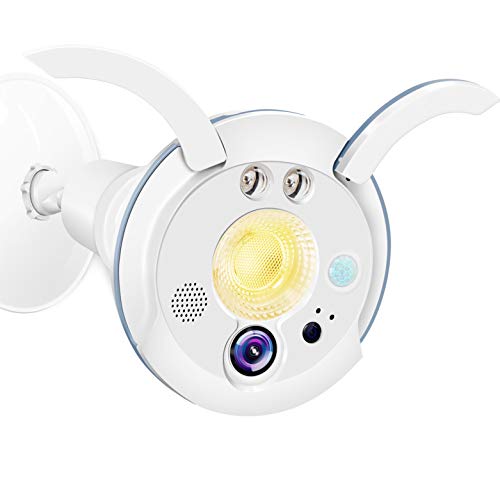 Sengled Snap G2 1080p Floodlight Camera |
8.4/10 | Buy |
 VSMAHOME 2K Indoor/Outdoor Security Camera |
8.3/10 | Buy | |
 ZEEPORTE 2K Wireless Outdoor Security Camera |
8.3/10 | Buy | |
| Best Premium |
 ZOMMRFVG 4MP USB Indoor Security Camera |
8.3/10 | Buy |
 Ducgqc 1080P 64GB Mini Security Camera |
8.0/10 | Buy |
CINMOORE 2.5K Pan Tilt Indoor Camera 2-Pack
Designed for monitoring pets, infants, and living spaces, this CINMOORE indoor camera pair delivers detailed 2.5K video with motorized pan and tilt coverage. Built-in local AI handles motion, crying, and pet alerts directly on the device without recurring monthly fees.
Pros
- Local AI detection requires no monthly subscription
- Sharp 2.5K video with infrared night vision
- Full-duplex audio allows simultaneous two-way talk
- Supports continuous 24/7 encrypted local storage
Cons
- MicroSD memory card is not included
- Limited to 2.4GHz WiFi networks only
Vimtag 4MP Dual-Band Security Camera
Delivering sharp 2.5K video over dual-band Wi-Fi 6, this compact wired camera provides reliable round-the-clock monitoring indoors or out. Its IP65 weatherproofing, color night vision, and local storage support make it a versatile pick for continuous home surveillance.
Pros
- Dual-band Wi-Fi 6 ensures fast, stable streaming
- Clear 2.5K resolution with integrated spotlight night vision
- Durable IP65 rating withstands rain and extreme temperatures
- Supports large local microSD cards up to 512GB
- Wired power eliminates the need to recharge batteries
Cons
- Requires access to an electrical outlet for power
- Cloud storage features require an ongoing subscription
- MicroSD card must be purchased separately for playback
Sengled Snap G2 1080p Floodlight Camera
Designed to screw directly into existing light sockets, the Sengled Snap G2 merges outdoor floodlight illumination with 1080p video monitoring. It suits homeowners who want perimeter security and two-way audio without running dedicated electrical wiring.
Pros
- Simple light socket installation requires no power cords
- 140-degree field of view with color night vision
- Durable IP65 rating withstands severe weather conditions
- Built-in two-way audio allows direct remote communication
Cons
- Human detection and custom motion zones require paid subscription
- Initial setup requires a temporary wired Ethernet router connection
- Operates exclusively on 2.4GHz Wi-Fi bands
VSMAHOME 2K Indoor/Outdoor Security Camera
This compact wired camera delivers crisp 2K video and full-color night vision for monitoring nurseries, pets, or building perimeters. An IP66 weatherproof build and two-way talk make it an adaptable security option for indoor and outdoor spaces.
Pros
- Clear 2K video stream with color night vision
- Durable IP66 weatherproof housing for outdoor conditions
- Enables continuous 24/7 recording to local storage
- Responsive two-way audio for talking to visitors
- Includes a two-year manufacturer warranty
Cons
- MicroSD card is not included in the box
- Short 6.56-foot power cable limits mounting flexibility
- Window glare degrades video when aimed through glass indoors
ZEEPORTE 2K Wireless Outdoor Security Camera
Designed for wire-free exterior monitoring, this battery-powered unit captures sharp 2K video alongside spotlight-assisted color night vision. It suits homeowners seeking easy mounting and motion-activated clip recording without running electrical cables.
Pros
- Wire-free setup with rechargeable battery power
- Crisp 2K video with full-color night vision
- Built-in spotlight and siren alarm for security deterrence
- Supports both local microSD and rolling cloud storage
- Durable IP65 weather-resistant construction
Cons
- Does not support continuous 24/7 video recording
- Only connects to 2.4GHz Wi-Fi networks
- Advanced AI detection requires subscription after trial
ZOMMRFVG 4MP USB Indoor Security Camera
Designed for nurseries and pet monitoring, this indoor camera delivers sharp 2K video with full pan-tilt tracking and cry detection. Its flexible USB power setup and dual-band Wi-Fi make it simple to place almost anywhere in the home.
Pros
- Dual-band Wi-Fi supports 2.4GHz and 5GHz networks
- Motorized pan and tilt with automatic motion tracking
- Convenient USB power allows flexible placement options
- Built-in cry detection and two-way audio communication
- Sharp 4MP 2K video resolution day and night
Cons
- Requires continuous USB power without an internal battery
- Temperature and humidity monitoring varies by hardware version
- Designed strictly for indoor use without weatherproofing
Ducgqc 1080P 64GB Mini Security Camera
Designed for discreet offline surveillance, this pocket-sized camera records 1080p video directly to its built-in 64GB memory without requiring an internet connection. It serves as a practical solution for homeowners and caregivers who prefer standalone recording over wireless app access.
Pros
- Built-in 64GB storage requires no extra card
- Discreet, pocket-sized dimensions for flexible placement
- Completely offline operation protects network privacy
- Sharp 1080p resolution provides detailed video
Cons
- Lacks Wi-Fi connectivity for live remote viewing
- Requires manual retrieval to access saved footage
How Security Cameras Operate Without Household Electricity
Every electronic surveillance camera requires a continuous electrical charge to operate its optical CMOS sensor, image signal processor, and wireless transmitter. When homeowners ask whether a security camera can function without electricity, they are usually asking whether cameras can run when the standard utility power grid fails. The short answer is yes, provided the camera relies on an independent DC power architecture such as rechargeable lithium-ion cells, solar energy collectors, or an uninterruptible power supply. However, surviving an electrical outage involves distinct trade-offs between continuous 24/7 video recording, real-time remote smartphone notifications, and local data retention.
The Difference Between Utility Grid Power and Low-Voltage Direct Current
Residential wall outlets deliver alternating current (AC) at 120 volts, but internal camera microchips run exclusively on direct current (DC) at voltages typically ranging from 5 to 12 volts. Standard plug-in security cameras utilize an external transformer or AC/DC adapter to convert household line voltage into low-voltage DC power. When a blackout strikes, the loss of utility AC power immediately starves these standard adapters, shutting down hardwired cameras instantly. In contrast, battery-operated units bypass the utility line entirely by feeding steady DC power directly to the internal printed circuit board.
This fundamental distinction explains why different camera models exhibit radically different resilience during severe electrical disruptions. Hardwired outdoor floodlights and standard indoor monitors cease operating the second the circuit breaker trips or utility wires fail. Conversely, devices engineered with native direct-current battery connections remain completely unaffected by external grid downtime. Understanding this electrical baseline allows homeowners to plan layered security deployments that combine continuous wired monitoring with resilient battery failover points.
Battery-Powered Architecture and Lithium-Ion Discharge Behavior
Standalone wireless security cameras rely on integrated or removable rechargeable lithium-ion battery packs to deliver uninterrupted direct current. These units enter an ultra-low-power standby mode where only an energy-efficient sensor remains energized to monitor the environment. Once thermal movement triggers the sensor, the camera wakes up its image processing engine and wireless transmitter within fractions of a second to record the event. Advanced wire-free options, such as battery cameras with color night vision, utilize integrated LED spotlights and high-sensitivity sensors while managing tight battery discharge budgets.
The operational lifespan of a battery-powered camera during an outage depends on trigger frequency, wake-up duration, and environmental conditions. If a camera wakes up twenty to thirty times a day to capture fifteen-second clips, modern lithium-ion cells can sustain operation for several months without external grid power. However, continuous 24/7 video streaming is rarely feasible on standalone battery packs because high-resolution video processing rapidly drains stored milliwatt-hours within a single day. For extended off-grid endurance, battery systems must be tuned strictly for motion-activated event capture.
Solar-Assisted Surveillance and Off-Grid Energy Harvesting
Pairing an outdoor battery camera with a compact solar photovoltaic panel creates an autonomous security station that operates indefinitely without utility electricity. These small solar accessories convert ambient sunlight into direct current, continuously replenishing the camera internal battery reserve during daylight hours. A properly positioned panel producing three to five watts of peak power can easily offset the daily milliamp-hour consumption of an active motion-triggered camera. This solar setup provides complete immunity to long-term grid collapse, making it ideal for remote fence lines, detached garages, and rural perimeters.
Effective solar harvesting requires strategic mounting angles and clear exposure to the southern sky in the Northern Hemisphere. Dirt, pollen, and tree shade can significantly degrade photovoltaic conversion efficiency, leaving batteries vulnerable to depletion during consecutive overcast days. Installers must also inspect the weatherproofing seals around the micro-USB or USB-C charging ports to prevent rainwater ingress from corroding the electrical contacts. When planned correctly, solar-assisted surveillance delivers continuous perimeter security completely detached from municipal electrical infrastructure.
Power over Ethernet Systems Backed by Uninterruptible Power Supplies
Commercial-grade residential surveillance frequently utilizes Power over Ethernet (PoE) compliant with IEEE 802.3af or 802.3at standards. Under this architecture, a single Cat5e or Cat6 twisted-pair cable transmits both high-bandwidth digital video and 48-volt direct-current power directly from a centralized network switch. Because the cameras draw electrical energy through the network cable itself, they do not require local AC outlets at each mounting location. This centralized wiring layout makes PoE installations exceptionally resilient against regional electrical outages when backed by appropriate power conditioning hardware.
Connecting the central network switch and Network Video Recorder (NVR) to a dedicated battery backup ensures uninterrupted surveillance throughout utility failures. Integrating an uninterruptible power supply for PoE security systems provides immediate seamless power transfer, preventing cameras from dropping video frames when grid voltage drops to zero. Depending on the volt-ampere rating of the battery backup and total system wattage, an NVR running multiple cameras can sustain continuous 24/7 recording for several hours. This setup delivers high-definition coverage without sacrificing continuous recording capabilities during temporary power blackouts.
USB Low-Voltage Operation and Portable Power Banks
Many compact indoor security cameras are engineered to operate via standard 5-volt USB power inputs rather than proprietary high-voltage transformers. These devices draw minimal current, often requiring only one to two amps through a basic USB-A or USB-C cable connection. Because they adhere to universal USB power delivery protocols, homeowners can disconnect them from standard wall chargers and plug them directly into portable lithium power banks. This flexibility allows an ordinary indoor camera to transform into a mobile surveillance unit during an electrical emergency.
A standard ten-thousand milliamp-hour portable power bank can sustain an indoor camera for twenty-four to forty-eight hours of continuous operation depending on infrared LED usage. Users should verify whether their chosen power bank supports pass-through charging, which allows the battery pack to charge from wall power while simultaneously powering the camera. When the household electricity drops, a pass-through power bank acts as an economical uninterruptible power supply for essential interior surveillance. This approach provides an accessible fallback for renters and homeowners who cannot install complex hardwired battery systems.
The Critical Split: Power Continuity Versus Internet Loss
Maintaining electrical power to a camera solves only half of the surveillance challenge during a widespread residential utility disruption. When municipal power fails, household broadband modems, optical network terminals, and Wi-Fi routers shut down immediately unless they also connect to dedicated backup power. Even if a battery-powered camera remains fully energized, it loses the wireless radio handshake required to communicate with external servers. Consequently, users will not receive real-time motion push notifications, and live-view streaming via mobile smartphone apps becomes temporarily unavailable.
Homeowners often confuse a camera being offline with a camera being entirely non-functional during an outage. While cloud-dependent features collapse without local Wi-Fi and wide-area network routing, the camera internal lens, sensor, and image processor continue operating normally on battery power. To bridge this communication gap, high-security installations employ cellular LTE fallback modems and battery-backed routers that maintain an active internet uplink during localized blackouts. Without an active network link, however, the security camera must rely entirely on local physical storage media to preserve critical event footage.
Local Storage Fallback: Recording Footage Without Wi-Fi or Cloud Access
Local storage architecture represents the single most crucial safeguard for capturing video evidence when power and internet connectivity fail simultaneously. Cameras equipped with onboard high-endurance microSD card slots write encrypted video clips directly to local flash memory chips without passing data across external networks. Compact standalone cameras, such as dedicated nanny cams with built-in storage modules, record continuous 1080p footage entirely offline without requiring a wireless router or pairing application. This self-contained architecture ensures that trespassers and suspicious activity remain permanently documented on physical media.
To ensure reliable operation during extended outages, homeowners should deploy Class 10, UHS Speed Class 3 (U3), and Video Speed Class 30 (V30) high-endurance memory cards. Standard consumer flash memory cards frequently suffer write fatigue and file allocation table corruption when subjected to repeated overwrite cycles in surveillance hardware. Furthermore, users should configure their cameras to use cyclic overwrite recording so the device automatically overwrites the oldest footage when storage reaches capacity. Testing offline recording functionality before an emergency guarantees that the camera will continue archiving footage when external networks vanish.
Motion Detection Mechanics Under Energy Conservation Constraints
Operating a security camera on independent DC power requires aggressive power management algorithms to prevent premature battery exhaustion. Unlike continuously powered cameras that analyze pixel changes across the entire video feed using software computer vision, battery cameras rely primarily on passive infrared (PIR) sensors. PIR sensors monitor ambient thermal radiation across split optical zones and consume only microamps of electrical current while waiting for movement. When a warm object, such as a person or vehicle, crosses these differential thermal zones, the PIR sensor triggers a hardware interrupt that wakes the primary camera processor.
While PIR detection dramatically conserves stored battery power, it introduces specific optical and physical limitations that homeowners must accommodate. Passive infrared sensors detect lateral motion across their field of view far more reliably than motion heading directly toward the camera lens. Additionally, PIR sensors cannot detect thermal differentials through double-pane glass, meaning battery-powered cameras cannot monitor outdoor yards when placed behind closed interior windows. Understanding these detection principles ensures optimal camera positioning along entry pathways to capture vital events without draining backup reserves through false environmental triggers.
Environmental Temperature Impacts on Off-Grid Power Systems
Outdoor surveillance cameras relying on battery power face severe operational hurdles when ambient temperatures drop below freezing. Standard lithium-ion battery chemistry experiences increased internal resistance and reduced electrochemical reaction speeds in sub-zero winter environments. When temperatures fall below thirty-two degrees Fahrenheit (zero degrees Celsius), available battery capacity can decrease by twenty to fifty percent, drastically shortening operating intervals. Furthermore, intelligent battery management systems (BMS) intentionally throttle or disable charging current at sub-freezing temperatures to prevent irreversible lithium plating and internal short circuits.
In southern climates, extreme summer heat presents an opposing challenge by accelerating chemical degradation and triggering thermal shutdown safety protocols. Camera housings exposed to direct solar radiation can reach internal temperatures exceeding one hundred and forty degrees Fahrenheit, stressing voltage regulator circuits. To maximize battery lifespan in harsh climates, property owners should mount cameras beneath protective architectural eaves or shaded soffits that reduce direct thermal absorption. Selecting cameras with robust IP65 or IP66 weatherproofing ratings ensures that internal seals resist driving rain and dust storms while operating under fluctuating temperature extremes.
Bandwidth, Codecs, and Storage Efficiency During Extended Blackouts
Video compression efficiency directly governs how many hours of footage a standalone camera can store on local media during an extended power outage. Modern surveillance cameras utilize High Efficiency Video Coding (H.265 / HEVC) or Advanced Video Coding (H.264 / AVC) algorithms to compress raw digital video streams. H.265 compression reduces bitrate requirements by roughly forty to fifty percent compared to legacy H.264 codecs without sacrificing optical clarity or edge sharpness. This enhanced efficiency allows a typical 2K or 4MP camera to store significantly more incident clips onto a 128GB or 256GB microSD card during off-grid periods.
Lower bitrates also reduce the write workload placed on the internal flash storage controller, lowering operational power consumption and minimizing internal heat generation. For properties running local NVR hard drives via backup battery stations, H.265 compression substantially extends total drive recording retention before overwrite routines activate. Maintaining sharp video clarity is essential for satisfying forensic DORI standards, specifically ensuring that captured footage achieves the 250 pixels-per-meter density required for legal facial identification. Selecting efficient compression codecs ensures maximum evidentiary value without overwhelming local storage capacity during emergencies.
Practical Verification and Battery Maintenance Workflows
Ensuring reliable security camera performance throughout unexpected power outages requires regular preventative maintenance and empirical verification. Homeowners should periodically simulate a utility failure by cutting circuit power to their primary camera adapters and monitoring local recording behavior. Verifying that the camera successfully switches to internal battery power or continues writing video clips to its local microSD card confirms system integrity before an actual emergency occurs. Additionally, inspecting mobile application battery health indicators every few weeks prevents surprises caused by gradual battery capacity loss.
Physical maintenance should include wiping dust and water spots from the optical lens cover using a microfiber cloth to prevent night vision infrared glare. Solar panels should be cleared of leaves, snow, and airborne grime to preserve maximum photovoltaic conversion efficiency throughout changing seasons. If an outdoor camera uses removable battery packs, keeping a fully charged spare pack on hand allows for instant zero-downtime swaps when power lines fail. Routine testing and disciplined battery upkeep guarantee that your residential surveillance infrastructure maintains unbroken vigilance whenever utility electrical service disappears.
About the author
John Carlsen is a home security and smart home specialist with more than a decade of experience researching and testing security technology. His expertise covers DIY security systems, security cameras, smart devices, pricing, contracts, and connected-home technology. He combines hands-on product testing with detailed research to explain strengths, limitations, ownership costs, and real-world value in straightforward terms for homeowners and renters.