
Do Security Cameras Pick up Sound? Audio Features and Privacy Guide for 2026
Do Security Cameras Pick Up Sound? Learn how modern security camera microphones function, audio range limits, and key privacy laws updated for November 2026.
 By Tyler Lacoma
Updated October 28, 2026


Wind blowing across a porch, delivery drivers stepping up to an entryway, or distant property line noises often prompt homeowners to rethink their perimeter monitoring setup. When setting up residential surveillance, many homeowners wonder, do security cameras pick up sound alongside standard high-definition video capture. Most modern residential surveillance units, including battery-assisted and hardwired outdoor models, come equipped with built-in miniature microphones designed to record environmental sound or facilitate two-way conversations. However, audio performance varies significantly depending on physical housing design, acoustic dampening, and digital signal processing. Understanding how these acoustic sensors perform helps property owners make practical deployment decisions for entryways, driveways, and interior living zones.
Evaluating audio capabilities requires balancing hardware clarity against power consumption and network bandwidth. Many homeowners deploy battery security cameras with local storage to avoid cloud service fees while retaining event-triggered audiovisual evidence. While optical sensors capture visual motion data, integrated microphones provide complementary context by registering acoustic events like breaking glass, barking dogs, or conversational exchanges near the doorway. Still, environmental turbulence such as heavy gusts or passing traffic can muddy recordings, making background noise filtering a critical consideration. Exploring microphone mechanics, wireless transmission demands, and statutory compliance ensures that your audio-enabled surveillance setup remains both technically effective and legally compliant.
| Award | Product | SSG Score About SSG ScoreThe SSG Score is our own rating from 0 to 10, based on performance, design and build, ease of use, and value. It reflects independent research and is never influenced by manufacturers, retailers, or affiliate commissions. Learn more › | |
|---|---|---|---|
| Best Overall |
Gianteye 2K Solar Security Camera (2-Pack)
|
9.2/10 | Buy |
| Best Premium |
 Gianteye 2K Solar Wireless Security Cameras |
9.2/10 | Buy |
| Best Budget |
 DEKCO 2K Wired Outdoor Security Camera |
8.8/10 | Buy |
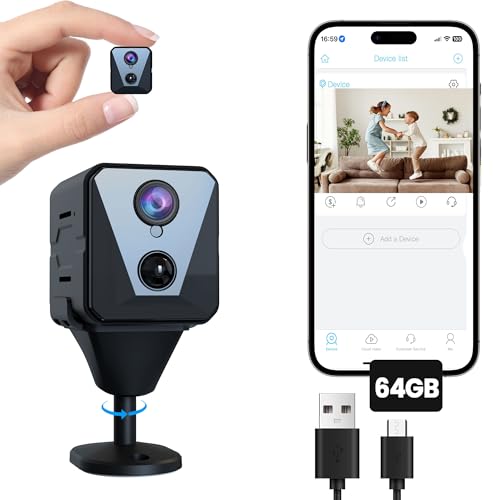 Funstorm Wireless Security Camera with 64GB SD |
8.6/10 | Buy | |
 aosu 2K Solar Outdoor Security 6-Camera Kit |
7.8/10 | Buy |
Gianteye 2K Solar Security Camera (2-Pack)
This wire-free dual-camera kit delivers 2K pan-tilt coverage paired with dual-band Wi-Fi and solar charging. It suits homeowners seeking flexible outdoor monitoring with color night vision and local storage options without mandatory monthly fees.
Pros
- Supports both 2.4GHz and 5GHz Wi-Fi networks
- 360-degree pan-tilt rotation minimizes blind spots
- Integrated spotlight provides full-color night video
- Local recording available without recurring subscription fees
Cons
- MicroSD storage card is not included
- Requires regular sunlight exposure to maintain continuous charge
Gianteye 2K Solar Wireless Security Cameras
The Gianteye 2K Solar Wireless Security Camera 4-Pack delivers comprehensive outdoor surveillance with motorized 360-degree pan-tilt coverage, dual-band Wi-Fi flexibility, and continuous solar charging. It is an ideal multi-camera system for homeowners seeking expansive perimeter monitoring without running cables or paying forced monthly subscription fees.
Pros
- Four-camera package provides multi-angle coverage across driveways, yards, and entryways with motorized 360-degree pan-tilt mobility.
- Dual-band 2.4GHz and 5GHz Wi-Fi connectivity provides reliable connection options depending on router placement and wall interference.
- Detachable solar panels provide continuous trickle-charging, eliminating the chore of dismounting cameras for manual battery recharging.
- Subscription-free local video storage via onboard MicroSD slots allows homeowners to retain private event footage without recurring fees.
- IP65 weather-resistant rating ensures dependable performance through harsh seasonal rain, snow, and heat.
Cons
- MicroSD storage cards are not included in the package and must be purchased separately for each camera.
- Like most battery and solar-powered surveillance units, it operates on motion-activated recording and does not support continuous 24/7 video capture.
- Smart home voice integration is limited to Amazon Alexa, lacking native support for Apple HomeKit or Google Home.
DEKCO 2K Wired Outdoor Security Camera
Homeowners seeking non-stop perimeter monitoring will appreciate this hardwired DEKCO camera, which pairs continuous power with a 180-degree motorized pan. Its sharp 2K resolution, built-in spotlights, and color night vision provide clear evidence without the hassle of recharging batteries.
Pros
- Continuous wired power enables true 24/7 surveillance
- Wide 270-degree total coverage via app pan controls
- Crisp 2K resolution with color night vision
- Integrated spotlight and siren deter intruders effectively
Cons
- Requires a paid subscription for video playback
- Lacks an onboard microSD card storage slot
- Compatible only with 2.4GHz Wi-Fi networks
Funstorm Wireless Security Camera with 64GB SD
The Funstorm wireless battery camera provides compact indoor monitoring with 2K video clarity, night vision, and an included 64GB SD card for subscription-free storage. It is an accessible, wire-free surveillance choice for renters, homeowners, and pet owners looking for flexible placement without recurring monthly fees.
Pros
- Pre-installed 64GB microSD card provides immediate, subscription-free local clip storage out of the box.
- Ultra-compact dimensions (1.4 x 1.4 x 1.8 inches) make it exceptionally easy to place discreetly without mounting hardware.
- Wire-free battery power allows flexible repositioning between rooms without dealing with electrical outlets or cords.
- Wide 120-degree field of view captures broad living room, entryway, or nursery coverage from a single vantage point.
Cons
- Frequent motion triggers reduce battery longevity to around 7 days, necessitating regular recharging in busy households.
- Operates exclusively on 2.4GHz Wi-Fi networks and does not support 5GHz bands or cellular connections.
- Product specifications list 2K HD resolution despite 4K marketing in the title, which may confuse resolution expectations.
aosu 2K Solar Outdoor Security 6-Camera Kit
Designed for expansive property coverage without ongoing subscription fees, this six-camera system pairs 2K video and color night vision with split solar panels for flexible charging placement. Its central aosuBase manages local storage up to 1TB while multi-camera tracking consolidates motion events across different angles into a single timeline.
Pros
- Flexible split solar panels optimize sunlight exposure
- Local storage without mandatory recurring subscription fees
- Cross camera tracking simplifies multi-angle event review
- Color night vision with integrated active deterrence
- Simultaneous live viewing for up to four cameras
Cons
- MicroSD card for local storage sold separately
- Solar charging efficiency depends heavily on weather conditions
- Detection accuracy varies with lighting and mounting distance
Technical Capabilities, Acoustic Limits, and Legal Realities of Audio Surveillance
The vast majority of consumer and commercial security cameras pick up sound through onboard microphones. Modern IP cameras, smart video doorbells, and wireless perimeter cameras routinely integrate audio capture to complement high-resolution visual evidence. While older analog CCTV setups often required separate audio input lines, digital network cameras now process sound directly on the internal circuit board. Deciding how and when to utilize this capability requires understanding acoustic hardware mechanics, signal transmission limits, and strict statutory boundaries governing residential audio surveillance. Balancing these technical features with practical legal compliance ensures property owners capture necessary evidence without infringing on local privacy standards.
How Modern Security Camera Microphones Capture Audio
Miniature electret condenser microphones and micro-electro-mechanical systems (MEMS) sensors serve as the primary acoustic hardware inside residential security cameras. These tiny components mount directly onto the camera motherboard behind small pinhole apertures sealed with acoustic membranes. The protective membrane shields internal electronics from moisture and dust ingress while allowing pressure waves from ambient sound to reach the diaphragm. When sound waves strike the sensor diaphragm, the hardware translates mechanical vibrations into electrical voltage changes. The camera onboard processor then samples and digitizes this analog signal for transmission or local storage.
Digital signal processors play an essential role in refining incoming audio streams before video encoding occurs. Without active processing, small pinhole microphones pick up significant background rumble from HVAC compressors, road traffic, and wind turbulence. Integrated filtering algorithms apply high-pass and low-pass acoustic thresholds to suppress frequencies outside the human vocal spectrum. Some advanced models incorporate dynamic gain control, automatically boosting faint sounds while attenuating sudden loud noises to prevent digital clipping. These signal adjustments ensure that spoken words near an entryway remain intelligible rather than becoming distorted noise.
Hardware placement on the physical camera chassis also directly influences audio fidelity. Bullet and turret cameras designed for exterior mounting often angle their microphone ports downward to reduce rain impact and direct wind exposure. Dome cameras frequently enclose audio elements within specialized dampening rings to prevent internal motor noise from panning mechanisms from bleeding into recordings. Some weather-resistant enclosures also feature micro-mesh barriers that diffuse passing air currents to limit wind noise. Understanding these hardware design choices explains why compact outdoor cameras capture nearby conversations clearly while struggling with distant ambient murmurs.
One-Way Recording vs. Full-Duplex Two-Way Talk Mechanics
Surveillance audio architecture generally splits between one-way passive recording and interactive two-way communication systems. One-way audio setups utilize an onboard microphone strictly to capture ambient sounds and encode them alongside the video stream. This method provides vital evidentiary context, documenting verbal threats, engine noises, or forced entry sounds without requiring user intervention. Passive audio monitoring requires minimal processing overhead and operates continuously or triggers strictly when the camera detects visual motion. Because passive listening places negligible strain on system processors, it remains standard across standalone local storage systems and battery-powered units.
Interactive systems expand surveillance utility by adding miniature speakers to create two-way talk channels. Half-duplex communication functions like a traditional walkie-talkie, permitting only one party to transmit audio at any given second. When a homeowner presses the talk button inside a mobile app, the camera microphone temporarily mutes to prevent acoustic feedback loops. This muting mechanism eliminates speaker squeal, but it prevents the user from hearing what the other person is saying until the button is released. While half-duplex technology keeps hardware designs simple, it frequently causes conversational interruptions and unnatural communication pauses during fast-paced doorstep interactions.
Full-duplex communication delivers simultaneous two-way audio transmission, allowing both parties to speak and listen concurrently. This protocol relies on acoustic echo cancellation software running on the camera neural processor or application backend. The software identifies audio output generated by the camera internal speaker and subtracts that waveform from the microphone input in real time. Systems supporting full-duplex communication allow property owners to converse naturally with delivery couriers or visitors without manual push-to-talk toggling. When building a multi-point perimeter layout with a multi-camera PoE security system, verifying full-duplex support ensures clear voice interaction at critical entry gates.
Real-World Acoustic Pickup Range and Environmental Obstacles
Most residential security camera microphones reliably capture conversational speech within a radius of 10 to 15 feet under calm conditions. At this proximity, standard vocal volume easily overcomes baseline environmental noise floors in typical residential yards. Beyond 15 feet, the inverse square law causes sound wave intensity to dissipate rapidly, reducing speech clarity and distinct vocal identification. Faint background noises such as vehicle engines or barking dogs may register up to 30 or 40 feet away, but intelligible dialogue becomes difficult to distinguish at that distance. In open suburban environments, atmospheric dispersion and ambient neighborhood activity further degrade subtle vocal harmonics.
Environmental conditions present severe obstacles to outdoor audio surveillance clarity. High winds blowing across exterior microphone membranes generate intense low-frequency turbulence that can overpower other sound frequencies. Hard exterior surfaces like stucco walls, concrete driveways, and brick facades create acoustic reflections that generate noticeable echo and reverberation. Ambient urban noise from nearby highways or commercial air conditioning condensers also elevates local decibel thresholds, masking subtle footfalls or quiet whispers. Installing cameras under covered porches or adding foam acoustic windscreens helps preserve vocal intelligibility in high-noise outdoor environments.
Physical mounting height and directional positioning significantly impact how effectively an acoustic sensor registers ground-level sound. Cameras mounted higher than 10 feet experience substantial acoustic attenuation because sound waves must travel a greater diagonal distance to reach the microphone. Directing the camera away from prevailing wind patterns and positioning it beneath protective soffits helps mitigate acoustic interference. If you monitor broad arrival zones using pan-tilt driveway security cameras, keeping the physical housing sheltered shields the microphone port from open-air wind shear. Angling the lens and housing toward primary conversation zones also ensures sound waves travel directly toward the sensor aperture rather than glancing off the housing.
Audio Compression Codecs, Bitrates, and Storage Demands
Synchronizing audio tracks with video streams requires efficient digital compression codecs that conserve local storage and network bandwidth. Surveillance hardware commonly relies on audio codecs such as Advanced Audio Coding, G.711 pulse-code modulation, or G.726 adaptive differential pulse-code modulation. Advanced Audio Coding delivers superior acoustic fidelity at relatively low bitrates, making it standard among modern Wi-Fi and smart home cameras. Meanwhile, G.711 remains prevalent in industrial and legacy network video recorder setups due to its minimal computational processing overhead. Choosing the right compression scheme ensures that audio tracks match video frames precisely without introducing synchronization drift over long recordings.
Audio data streams contribute a modest but consistent footprint to overall network bandwidth calculations. Typical surveillance audio streams consume between 16 kbps and 64 kbps of continuous bandwidth depending on sample rates and chosen compression. Compared to 2K or 4K video feeds that demand several megabits per second, audio data represents a fraction of the total transmission load. However, across multi-camera installations with continuous video recording, audio streams steadily accumulate over weeks of local archival. On low-bandwidth upstream wireless connections, even small auxiliary audio streams can contribute to transmission bottlenecks during simultaneous remote viewing sessions.
Managing storage capacity involves balancing video retention against audio fidelity on local high-endurance microSD cards or network video recorders. High-endurance storage cards formatted for continuous surveillance overwrite older clips automatically once capacity thresholds are reached. Because audio streams remain permanently interleaved with video containers like MP4 or MKV files, disabling audio recording directly reduces container file sizes. Property owners operating with constrained local storage can disable audio tracks to maximize days of archived visual history without replacing hardware. Conversely, retaining compressed audio tracks provides indispensable auditory evidence that video frames alone might fail to document.
Federal and State Audio Recording Consent Laws in the United States
Installing audio-capable cameras introduces significant legal responsibilities under United States wiretapping and electronic surveillance statutes. Federal law under Title III of the Omnibus Crime Control and Safe Streets Act, codified at 18 U.S.C. Section 2511, establishes a baseline one-party consent rule for capturing oral communications. Under federal statutes, recording an oral conversation is generally permissible if at least one participant consents to the recording. However, capturing communications where no party has granted consent violates federal wiretap provisions unless an explicit statutory exemption applies. Homeowners who record conversations between third parties on their property without participating in the discussion risk running afoul of these federal standards.
State laws often impose considerably stricter audio surveillance mandates than federal baselines. Approximately a dozen states enforce all-party or two-party consent statutes, including California, Florida, Massachusetts, Pennsylvania, and Illinois. In these jurisdictions, recording an oral communication without obtaining consent from every participating party can lead to civil liabilities or criminal penalties. A security camera microphone that captures a private conversation between neighbors standing on an adjacent sidewalk could potentially trigger eavesdropping claims in all-party consent states. Because statutory penalties for unauthorized electronic recording can be severe, property owners must understand their state specific consent framework.
Understanding these statutory boundaries requires property owners to consult qualified local legal counsel rather than assuming camera settings comply universally. Most state wiretap laws hinge on whether an individual possesses an objectively reasonable expectation of privacy in that specific physical setting. While individuals walking openly along a public street generally lack privacy expectations, conversations conducted in semi-secluded yards or porches may be protected. Homeowners should verify state and municipal surveillance codes before deploying outdoor cameras with active continuous audio recording. Disabling audio recording or posting conspicuous surveillance warnings helps demonstrate good-faith compliance with local privacy expectations.
Managing Neighbor Privacy Boundaries and Curtilage Expectations
Legal protections surrounding residential privacy center heavily on the concept of curtilage, which encompasses the private land immediately surrounding a home. Courts consistently recognize that homeowners hold a strong expectation of privacy within their curtilage, including back patios, private courtyards, and bedroom window perimeters. When an outdoor security camera microphone captures private conversations occurring entirely inside a neighbor fenced yard, severe privacy disputes can arise. Even if video coverage stays within boundary lines, sensitive audio microphones can cross property borders unnoticed. Property owners should assess acoustic coverage just as carefully as optical camera angles to prevent intrusive neighbor disputes.
Physical barriers like fences, shrubs, and hedges block optical camera lenses but rarely attenuate acoustic sound waves effectively. High-gain microphones can pick up audible dialogue from across property boundaries, creating friction between adjoining property owners. Homeowners should intentionally angle cameras toward their own access paths, driveways, and main entryways to prevent peripheral acoustic bleed. Installing clear, visible signage indicating that audio and video surveillance devices operate on the property helps establish notice and mitigate reasonable privacy expectations. Conspicuous warning decals on perimeter gates satisfy legal notice standards in many jurisdictions and reduce neighbor misunderstandings.
Interior surveillance deployments present even higher privacy expectations and legal exposure than exterior perimeter cameras. Placing audio-enabled cameras inside shared rental properties, guest rooms, or home bathrooms creates severe statutory violations under state privacy torts. In multi-family dwellings or rental units, landlords and tenants must adhere strictly to residential privacy expectations, ensuring audio surveillance remains confined to authorized entryways. For personal interior use, homeowners often configure automated scheduling or geofencing to disable audio sensors while residents remain inside the dwelling. These automated privacy modes physically disconnect or electronically mute microphones whenever family members return home.
Practical Configuration: Enabling, Disabling, and Calibrating Audio Features
Most modern security camera companion applications allow users to control audio functions through software toggles. Within the system device settings, administrators can independently disable audio recording while retaining full-resolution video capture. This selective configuration provides an effective solution for property owners residing in all-party consent states who wish to avoid unintentional eavesdropping liabilities. Turning off audio capture eliminates the risk of recording private neighbor conversations while preserving optical motion tracking and video alerts. Many smart camera ecosystems also allow scheduling, keeping audio active during nighttime hours when privacy concerns decrease and intrusion risks rise.
Fine-tuning acoustic event detection enables cameras to serve as smart perimeter sensors without recording continuous private conversations. Many network cameras support specialized sound detection triggers calibrated specifically for high-frequency glass breakage, baby crying, or smoke alarm sirens. In these configurations, the camera processor monitors acoustic thresholds locally without archiving every background vocal exchange. When decibel levels spike beyond configured thresholds, the system pushes an immediate mobile alert and initiates a short, targeted event clip. This threshold-based approach conserves network bandwidth and local storage while providing vital acoustic security alerts.
Calibrating speaker volume and microphone sensitivity ensures clear two-way communication without generating unwanted environmental feedback. Users should test two-way talk volume levels from the mobile application to confirm that visitors can hear audio instructions clearly against street noise. If the camera output triggers harsh screeching or echo during live view, reducing speaker volume or repositioning adjacent reflective walls resolves the issue. Conducting these verification checks ensures that your surveillance audio configuration provides dependable property deterrence while respecting community boundaries. Regular acoustic testing guarantees that your two-way audio functions reliably during actual property visits or perimeter security events.
About the author
Tyler Lacoma is a smart home and home security technology expert with more than a decade of hands-on experience testing connected devices. His expertise includes security cameras, smart locks, home security systems, privacy features, smart-home compatibility, and emerging AI technology. He focuses on translating technical features into practical guidance that helps homeowners understand which security solutions truly fit their homes and everyday needs.