
How Do Security Cameras Work in Home Security System: Practical Guide for 2026
Explore how do security cameras work in home security system in November 2026 to learn how video capture, motion sensors, local NVR storage, and Wi-Fi networks function together.
 By John R. Delaney
Updated October 28, 2026


Modern residential surveillance relies on coordinated hardware and software rather than standalone recording lenses. Homeowners often wonder how do security cameras work in home security system when integrating outdoor optical sensors with central home hubs, wireless routers, and smartphone applications. A contemporary setup combines digital image capture, automated event detection, network transmission, and archiving to safeguard entry points. Understanding these mechanics helps users configure reliable coverage while avoiding false alarm fatigue and subscription traps. For properties without exterior electrical outlets, deploying battery security cameras with local storage offers a flexible way to capture footage without relying on distant wall receptacles.
At the optical level, sensors transform photons into digital data streams that travel across dual-band Wi-Fi or physical network cabling. Once the camera detects motion through thermal infrared sensors or computer vision algorithms, it routes compressed video directly to an onboard memory card, a centralized hard drive, or a cloud server. Property owners who require uninterrupted continuous recording often turn to Power over Ethernet security systems to eliminate wireless latency and avoid battery recharging cycles. Knowing how these communication pathways function ensures that every recorded event remains accessible during critical security incidents.
| Award | Product | SSG Score About SSG ScoreThe SSG Score is our own rating from 0 to 10, based on performance, design and build, ease of use, and value. It reflects independent research and is never influenced by manufacturers, retailers, or affiliate commissions. Learn more › | |
|---|---|---|---|
| Best Overall |
Gianteye 2K Solar Wireless Security Cameras
|
9.2/10 | Buy |
| Best Premium |
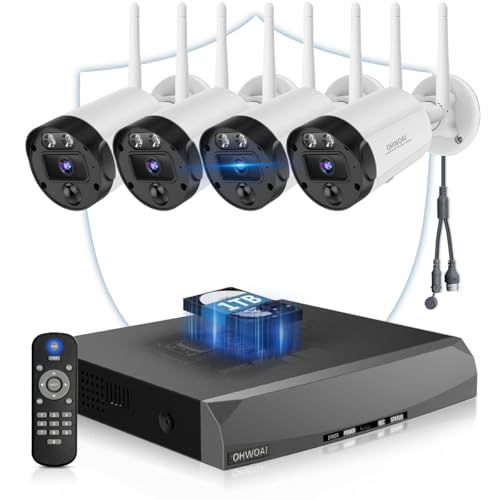 OHWOAI 4K 4-Camera Wireless System (1TB) |
9.2/10 | Buy |
| Best Budget |
 Vivideye 4MP Solar Wireless Security Camera System |
8.6/10 | Buy |
 How Everything Works in Your Home |
8.4/10 | Buy | |
| Best Value |
 Camcamp 4-Camera Wireless PTZ NVR System |
8.3/10 | Buy |
 GNCC 2K Indoor Pan-Tilt Security Camera |
8.0/10 | Buy | |
 Hiseeu 5MP Wireless Security Camera System |
8.0/10 | Buy |
Gianteye 2K Solar Wireless Security Cameras
The Gianteye 2K Solar Wireless Security Camera 4-Pack delivers comprehensive outdoor surveillance with motorized 360-degree pan-tilt coverage, dual-band Wi-Fi flexibility, and continuous solar charging. It is an ideal multi-camera system for homeowners seeking expansive perimeter monitoring without running cables or paying forced monthly subscription fees.
Pros
- Four-camera package provides multi-angle coverage across driveways, yards, and entryways with motorized 360-degree pan-tilt mobility.
- Dual-band 2.4GHz and 5GHz Wi-Fi connectivity provides reliable connection options depending on router placement and wall interference.
- Detachable solar panels provide continuous trickle-charging, eliminating the chore of dismounting cameras for manual battery recharging.
- Subscription-free local video storage via onboard MicroSD slots allows homeowners to retain private event footage without recurring fees.
- IP65 weather-resistant rating ensures dependable performance through harsh seasonal rain, snow, and heat.
Cons
- MicroSD storage cards are not included in the package and must be purchased separately for each camera.
- Like most battery and solar-powered surveillance units, it operates on motion-activated recording and does not support continuous 24/7 video capture.
- Smart home voice integration is limited to Amazon Alexa, lacking native support for Apple HomeKit or Google Home.
OHWOAI 4K 4-Camera Wireless System (1TB)
Designed for broad perimeter surveillance, this OHWOAI kit combines four 8MP cameras with a dedicated 1TB local recorder. Its 130-degree wide-angle view and motion-activated color night vision deliver detailed property monitoring without ongoing subscription fees.
Pros
- Crisp 8MP 4K video resolution
- Expansive 130-degree viewing angle reduces blind spots
- Color night vision extends up to 100 feet
- Integrated two-way audio for direct communication
- Subscription-free remote viewing across multiple devices
Cons
- Full-color night mode requires motion activation
- Heavier kit package weighing 8.6 pounds
Vivideye 4MP Solar Wireless Security Camera System
The Vivideye 2-Camera Solar Security System delivers sharp 4MP resolution, 360-degree motorized pan-tilt tracking, and an encrypted 128GB local storage hub that eliminates monthly fees. It is an ideal wire-free solution for suburban homeowners and renters looking for comprehensive perimeter monitoring without recurring subscriptions.
Pros
- Zero ongoing subscription costs with 128GB of pre-installed, encrypted local storage housed safely inside the hub.
- Motorized 360-degree panning combined with innovative cross-camera tracking handoffs across active monitoring zones.
- True wire-free installation powered continuously by bundled 5W solar panels and 8000mAh battery packs.
- Dual-band 2.4GHz and 5GHz Wi-Fi compatibility with factory pre-paired setup right out of the box.
- Rugged IP66 weatherproofing rated to endure extreme seasonal temperatures from -4°F up to 122°F.
Cons
- Mechanical auto-tracking functionality is disabled by default and requires manual activation inside the Truisee app.
- AI human detection range is limited to a maximum distance of 29 feet, which may not suit expansive perimeter properties.
- Smart home voice integration is limited to Amazon Alexa, lacking native support for Google Home or Apple HomeKit ecosystems.
How Everything Works in Your Home
This hardcover guide by Cybersoft Publishing explains residential electrical, solar, and smart device systems in accessible, plain English. It serves as a helpful reference for homeowners and DIYers planning the wiring, power, and infrastructure for smart security cameras and home automation.
Pros
- Breaks down complex residential electrical, solar, and smart device concepts into plain, accessible language
- Valuable reference for homeowners preparing to install hardwired outdoor cameras, video doorbells, or solar accessories
- Sturdy hardcover binding designed to withstand regular reference in home workshops and planning spaces
- Helps demystify home infrastructure before purchasing or hardwiring smart security equipment
Cons
- Instructional reference book only, containing no physical camera hardware, optical sensors, or recording capabilities
- Provides general educational guidance rather than step-by-step installation manuals for specific camera brands
- Does not substitute for municipal building codes or the services of a licensed electrician for complex line-voltage work
Camcamp 4-Camera Wireless PTZ NVR System
This plug-in Camcamp bundle pairs four dual-lens PTZ cameras with a dedicated 10-channel NVR for complete local property monitoring. It provides continuous 24/7 recording and automated motion tracking without requiring recurring cloud subscriptions.
Pros
- Dual-lens design eliminates blind spots using auto tracking
- Continuous 24/7 recording without subscription fees
- Three distinct night vision modes with spotlights
- Storage capacity expands up to 6TB on NVR
- Durable IP66 weatherproofing against extreme temperatures
Cons
- Each outdoor camera requires nearby plug-in power access
- Base 500GB hard drive fills quickly with four feeds
- Local storage design lacks native cloud backup integration
GNCC 2K Indoor Pan-Tilt Security Camera
The GNCC 2K Indoor Security Camera delivers motorized 340-degree pan and 80-degree tilt coverage with flexible dual-band Wi-Fi and 10-meter night vision. It is a practical indoor choice for apartment renters, pet owners, and parents seeking continuous local recording without mandatory subscription fees.
Pros
- Dual-band 2.4GHz and 5GHz Wi-Fi connectivity reduces network congestion and improves indoor streaming reliability.
- Motorized 340-degree pan and 80-degree tilt provide extensive room coverage with automated motion tracking.
- Supports continuous 24/7 local recording on microSD cards up to 128GB without requiring a monthly subscription.
- Quick pairing via Bluetooth streamlines the initial connection process through the Osaio mobile app.
Cons
- Accessing recorded video playback requires either purchasing a separate microSD card or paying for a cloud storage subscription.
- Designed strictly for indoor environments, lacking weatherproofing or water-ingress resistance for exterior use.
- Requires a continuous wired power source and does not feature an internal backup battery.
Hiseeu 5MP Wireless Security Camera System
This Hiseeu wireless surveillance package combines four 5MP outdoor bullet cameras with an all-in-one 10-inch monitor NVR, delivering continuous 24/7 recording to a pre-installed 1TB hard drive without recurring subscription fees. It is well-suited for homeowners and property managers wanting an easy-to-deploy perimeter defense system with zero monthly cloud overhead.
Pros
- Complete all-in-one system includes a dedicated 10-inch NVR monitor and pre-installed 1TB hard drive
- Zero ongoing monthly subscription fees with up to 45 days of continuous 24/7 recording
- Dual-band 2.4 GHz and 5 GHz wireless transmission provides flexible remote or standalone local operation
- Durable IP66 weatherproof construction operates reliably in extreme temperatures from -13°F to 122°F
- Expandable system supports up to 10 camera channels for comprehensive property security scaling
Cons
- Requires physical power outlets near each camera location since cameras are corded rather than battery-powered
- Features one-way audio listening only, lacking two-way intercom talkback functionality
- Does not list native smart home voice assistant integrations like Amazon Alexa or Google Home
System Architecture and Video Flow Mechanics
A modern residential security camera functions as an integrated optical sensor, digital processor, and network transmitter packed into a single enclosure. Instead of functioning as an isolated recorder, each unit captures physical light through an optical lens, converts those photons into digital video data, analyzes the scene for motion, and transmits encrypted packets across a home network. The destination for that video data depends entirely on system architecture, flowing either into local network video recorders, onboard flash memory, or remote cloud servers. At the same time, onboard logic boards process real-time events to push instant alerts to mobile devices or trigger automated responses across integrated smart home platforms.
Optical Capture and Image Sensor Fundamentals
The video capture process starts when ambient light passes through the camera glass and optical lens assembly. Glass elements focus incoming light directly onto a complementary metal-oxide-semiconductor sensor, commonly known as a CMOS image sensor. This sensor contains millions of photosensitive pixels that measure light intensity and color values across red, green, and blue spectrums. As lighting conditions shift from bright midday sun to deep evening shadows, the camera dynamically adjusts digital shutter speeds and sensor gain to balance exposure.
Lens focal length and curvature dictate the field of view, which typically ranges from 100 degrees to a wide 130 degrees on residential outdoor models. A broader field of view captures wide yard perimeters and multi-car driveways with fewer total hardware units. Specialized systems overcome perimeter blind spots by pairing fixed wide-angle lenses with motorized pan-and-tilt tracking modules that rotate across broad viewing angles. For properties with expansive sightlines, deploying pan-tilt-zoom cameras for driveway monitoring allows the lens to follow moving vehicles while keeping entryway gates fully within view.
Low-Light Illumination and Night Vision Modes
When natural ambient light drops below a specific lux threshold, standard optical sensors can no longer gather enough photons to form an intelligible color picture. Mechanical infrared-cut filters automatically slide away from the image sensor, allowing invisible infrared illumination to reach the pixel array. Built-in 850-nanometer infrared light-emitting diodes cast a beam that illuminates the darkness while remaining virtually invisible to the human eye, showing only a faint red glow at the source. This illumination produces sharp, high-contrast monochrome footage that cuts through pitch-black conditions across yards and driveways without alerting passersby to active recording.
Many contemporary security cameras supplement standard infrared LEDs with motion-activated white-light spotlights to produce full-color night vision. When the onboard sensor detects nearby activity, high-output LED arrays instantly flood the target area with visible illumination. This illumination allows the CMOS sensor to maintain daytime color processing, revealing crucial evidentiary details such as clothing colors, vehicle paint, and hair shades up to 65 or 100 feet away. Property owners can customize whether spotlights turn on automatically upon detection, remain off for discreet observation, or flash rapidly to warn intruders.
Motion Detection Technologies and Artificial Intelligence
Early residential security cameras relied primarily on software pixel-change detection, which analyzed consecutive video frames for shifts in lighting or color values. While simple to implement, pixel-based algorithms caused severe notification fatigue by triggering alerts from windblown tree branches, passing clouds, flying insects, or headlights. Modern wire-free and solar-powered systems resolve this issue by incorporating hardware-based passive infrared sensors alongside optical analysis. Passive infrared sensors monitor rapid changes in ambient thermal radiation within their detection field, waking the camera hardware only when a warm body crosses the detection path.
Advanced surveillance cameras now integrate onboard neural processing units running edge-based artificial intelligence algorithms. Instead of sending raw video to external servers for interpretation, the internal processor analyzes silhouette shapes and movement vectors directly on the camera. This onboard processing allows the system to distinguish accurately between humans, domestic pets, motor vehicles, and dropped delivery packages within fractions of a second. By filtering out non-threatening movement locally, edge artificial intelligence dramatically cuts down nuisance push notifications and conserves system bandwidth.
Power Delivery: Continuous Hardwired Power Versus Solar and Battery Systems
The underlying power delivery architecture directly dictates whether a camera can support continuous 24/7 video recording or must remain in low-power sleep between events. Corded systems connect directly to dedicated 12-volt direct-current power supplies or utilize low-voltage alternating-current lines. Because constant wall power eliminates energy conservation constraints, corded cameras keep their image sensors, processing chips, and network radios continuously active without entering sleep states. This continuous operation enables true non-stop recording to local hard drives, ensuring that fleeting security incidents occurring outside defined motion zones are never lost.
Conversely, wire-free security cameras rely on internal rechargeable lithium-ion battery packs, often supplemented by compact solar panels delivering continuous trickle charging. A compact high-efficiency 5-watt solar panel positioned in direct sunlight can replenish energy consumed by typical daily event recordings. These wire-free designs eliminate the need to run messy cables through exterior walls or hire certified low-voltage electricians for installation. However, solar charging efficiency drops significantly during prolonged overcast weather, winter snow cover, or sub-freezing temperatures where internal battery management systems halt charging to protect cell chemistry.
Video Compression, Network Transmission, and Dual-Band Wi-Fi
Once an image sensor captures video frames, the camera hardware must compress and transmit the digital data stream across the property network. High-efficiency video coding standards, particularly H.265+, compress visual information by analyzing spatial redundancy and predicting pixel movement across adjacent frames. This advanced compression reduces overall network bandwidth consumption and storage footprints by up to 50 percent compared to older H.264 codecs without degrading visual clarity. Lower bitrates are vital for multi-camera residential installations, preventing video streams from saturating home internet connections or triggering ISP data cap penalties.
Wireless security cameras transmit digital video packets using standard radio frequencies across 2.4 GHz and 5 GHz Wi-Fi bands. The 2.4 GHz frequency band operates at longer wavelengths, providing exceptional structural penetration through exterior brick, wood siding, and drywall over long distances. Meanwhile, the 5 GHz band provides significantly higher transmission throughput with reduced wireless interference, resulting in ultra-smooth high-definition video feeds. Dual-band wireless cameras automatically select the optimal frequency band or allow manual router pairing to balance range against data speed.
Storage Architectures: Local Network Recorders Versus Cloud Vaults
Video archiving forms the central backbone of residential surveillance, determining how easily property owners can retrieve historical footage after a security event. Local storage architectures route footage directly to high-capacity hard drives housed inside standalone Network Video Recorders or centralized home hubs. When expanding an existing home surveillance hub, integrating compatible add-on cameras for NVR systems allows users to scale property monitoring seamlessly across yards, garages, and secondary outbuildings. Local hubs keep video recordings stored securely on premises, protecting sensitive family privacy from unauthorized external data breaches.
Alternative storage models utilize onboard high-endurance microSD cards installed directly into sealed slots on each camera body. Onboard memory cards offer an economical, standalone recording solution that functions completely independently of external network hardware or central consoles. However, continuous overwriting cycles demand specialized high-endurance flash memory engineered to withstand constant write operations without file corruption. In contrast, cloud storage services automatically upload encrypted video clips to remote server facilities via the home internet connection, offering off-site redundancy at the cost of recurring subscription fees.
Two-Way Audio Communication and Smart Home Integration
Residential security cameras do not merely observe events; they enable real-time two-way voice interaction between homeowners and outdoor visitors. Integrated noise-reduction microphones capture crisp environmental audio, while weather-sealed miniature speakers project speech clearly across porch steps or driveways. Built-in acoustic echo cancellation algorithms eliminate annoying feedback loops, allowing natural simultaneous conversations similar to a telephone call. Property owners can use mobile applications to instruct delivery couriers where to leave parcels or warn unauthorized individuals that their actions are being recorded.
Surveillance cameras integrate tightly with broader smart home ecosystems through application programming interfaces and voice-assistant communication protocols. Compatible cameras pair with voice platforms such as Amazon Alexa, enabling users to display live feeds instantly on smart displays using simple voice commands. Cross-device communication allows camera motion triggers to activate exterior smart lighting, lock automated deadbolts, or initiate whole-home alarm sequences. Unified management platforms allow multiple family members to view split-screen live feeds, review playback timelines, and receive priority push notifications on mobile phones and tablets.
Offline Resilience, Environmental Weatherproofing, and US Legal Guidelines
A common concern among property owners involves system vulnerability during internet outages or power line failures. Cameras connected to local network video recorders or equipped with onboard microSD cards continue recording video uninterrupted even if broadband service drops entirely. While remote push notifications and mobile live streaming require active internet connectivity, local video loops write directly to physical storage media without interruption. Once broadband service restores, mobile access resumes automatically, allowing homeowners to review all timestamped event footage archived during the outage.
Exterior surveillance hardware must withstand severe environmental exposure, requiring robust engineering certified by international Ingress Protection standards. Cameras carrying an IP65 or IP66 weatherproof rating feature silicone gaskets, sealed cable entryways, and UV-stabilized housing that resist torrential rain, blowing dust, and snow. Robust internal thermal engineering ensures reliable operation across broad temperature ranges spanning from sub-zero winter freezes to sweltering summer heat. Regular physical maintenance simply involves wiping the optical lens cover with a microfiber cloth every few months to remove spiderwebs, dust accumulation, and water spots that could otherwise degrade image clarity.
Deploying security cameras requires careful attention to United States legal standards regarding reasonable expectations of privacy and audio recording compliance. Under federal wiretap regulations (18 U.S.C. Section 2511) and state-level eavesdropping statutes, recording private audio conversations without proper consent can create legal liability. Several states enforce two-party or all-party consent laws, requiring all individuals in a conversation to consent before audio recording can legally occur. Homeowners should position outdoor cameras to monitor property curtilage such as driveways, sidewalks, and porches while avoiding direct views into neighbor windows, fenced backyards, or private interior spaces.
Practical Optimization and Maintenance Considerations
Achieving peak performance from a home security camera setup requires deliberate planning during mounting, network configuration, and ongoing maintenance. Installing cameras at an optimal height between eight and ten feet off the ground balances broad visual perspective with clear facial recognition angles, preventing subjects from appearing obscured beneath hat brims. Angling lenses slightly downward minimizes direct lens flare from morning sunrises or oncoming car headlights while focusing detection zones squarely on physical entry paths. Verifying strong Wi-Fi signal levels or establishing hardwired connections ensures low latency and eliminates dropped video frames during critical moments.
Regular operational audits keep security equipment performing at peak capability over years of continuous exposure. Homeowners should periodically inspect physical camera mounts, clean debris from solar collectors, and confirm that camera lenses remain free from spiderwebs or moisture fogging. Testing motion trigger zones every season verifies that foliage growth has not introduced new false alarm sources or obstructed primary detection paths. When maintained with proper optical alignment and clean network pathways, residential security cameras provide dependable property awareness and irreplaceable video evidence during unexpected security incidents.
About the author
John R. Delaney is a veteran technology editor and product reviewer specializing in home security, smart home devices, and wireless networking. With extensive experience evaluating connected security systems, cameras, smart locks, sensors, and networking equipment, he brings a practical testing mindset to consumer technology. His work emphasizes usability, performance, connectivity, and long-term value for homeowners building reliable smart security systems.