
How to Hide Indoor Security Camera: Practical Guide for 2026
Learn how to hide indoor security camera techniques to protect your home discreetly in November 2026 while preserving clear sightlines and legal privacy compliance.
 By John Carlsen
Updated November 20, 2026


Many homeowners struggle to blend home surveillance equipment into their living spaces without creating visual clutter or signaling the presence of monitoring devices to guests. While bulky hardware can disrupt interior design, positioning a lens effectively requires balancing discreet placement with an unobstructed field of view. Learning how to hide indoor security camera solutions allows residents to maintain vigilance over entryways, common rooms, and valuables while preserving the aesthetics of their living areas. For wireless options, comparing setups against battery security cameras with local storage can also help determine how power architecture impacts placement flexibility.
Effective concealment involves much more than shoving a device behind a decorative pillow or inside a dark cabinet. Practical deployment demands careful management of thermal heat dissipation, Wi-Fi radio attenuation, and optical line of sight for motion sensors. Understanding the technical differences between passive infrared sensors and video-based motion analysis also ensures your discreet system continues capturing vital events without excessive false triggers. Balancing these physical factors with legal privacy considerations ensures a safe, reliable, and discreet residential security setup.
| Award | Product | SSG Score About SSG ScoreThe SSG Score is our own rating from 0 to 10, based on performance, design and build, ease of use, and value. It reflects independent research and is never influenced by manufacturers, retailers, or affiliate commissions. Learn more › | |
|---|---|---|---|
| Best Overall |
Vimtag 2.5K Indoor Outdoor Security Camera 2-Pack
|
8.4/10 | Buy |
| Best Premium |
 J-SINIGIDIN 1080P Mini WiFi Security Camera |
8.4/10 | Buy |
| Best Budget |
 Techage 2K Indoor Security Camera |
8.1/10 | Buy |
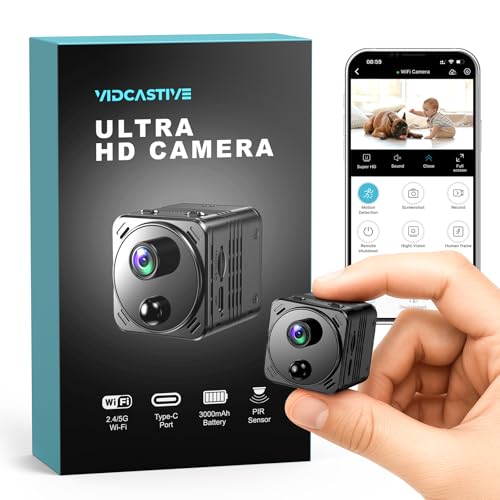 VIDCASTIVE 4K Mini Indoor Security Camera |
8.1/10 | Buy | |
 CharmPacks Disguise Vase for Ring Indoor Cam |
8.0/10 | Buy | |
| Best Value |
 ZHOUCXZDA Mini Wireless Security Camera |
8.0/10 | Buy |
 ZHOUCXZDA Mini Wireless Security Camera |
7.8/10 | Buy |
Vimtag 2.5K Indoor Outdoor Security Camera 2-Pack
The Vimtag 2.5K Indoor/Outdoor Security Camera 2-Pack offers 4MP video clarity, dual-band Wi-Fi flexibility, and color night vision backed by a built-in spotlight and siren. It provides a versatile, cost-effective monitoring solution for homeowners and renters seeking reliable indoor or perimeter coverage with local microSD storage support.
Pros
- Dual-band 2.4 GHz and 5 GHz Wi-Fi compatibility provides greater connection flexibility than standard 2.4 GHz-only cameras
- Solid 2.5K video resolution paired with spotlight illumination ensures clear daytime and nighttime video capture
- IP66-rated enclosure allows seamless transition between indoor nursery monitoring and exposed outdoor surveillance
- Local microSD slot enables subscription-free video storage without forcing an ongoing monthly cloud fee
- Convenient plug-and-play setup supports freestanding tabletop placement or permanent wall mounting with included screws
Cons
- MicroSD card is not included in the box and must be purchased separately for local recording
- Continuous AC power connection is required, limiting placement to areas near electrical outlets
- Advanced cloud video recording and extended alert history require an optional paid Vimtag Cloud subscription
J-SINIGIDIN 1080P Mini WiFi Security Camera
Measuring under an inch wide, this compact 1080p camera provides discreet monitoring with night vision and instant motion alerts. Because it lacks an internal battery, it works best plugged into a nearby USB outlet or dedicated power bank.
Pros
- Ultra-compact footprint allows discreet placement anywhere
- Crisp 1080p resolution provides clear video details
- Night vision captures footage in dark rooms
- Instant smartphone alerts upon detecting movement
- Straightforward Wi-Fi setup via mobile application
Cons
- No built-in battery requires constant external power
- Video-only recording without audio capture support
- Requires a portable power bank for wire-free placement
Techage 2K Indoor Security Camera
With sharp 2K resolution and dual-band Wi-Fi support, this plug-in monitor delivers responsive AI tracking and 24/7 recording for nurseries, pets, or living areas. It integrates seamlessly with Alexa and offers flexible local microSD storage for dependable home oversight.
Pros
- Sharp 2K video clarity
- Supports 2.4GHz and faster 5GHz Wi-Fi
- Built-in auto-tracking without mandatory subscription fees
- Continuous local storage up to 256GB
- Convenient voice integration with Alexa
Cons
- Requires a continuous wired power source
- MicroSD card sold separately
- Advanced cloud AI features require paid subscription
VIDCASTIVE 4K Mini Indoor Security Camera
Packing 4K streaming and dual-band Wi-Fi into a 1.6-inch cube, this compact camera is well suited for discreet home or office monitoring. A 3000mAh battery delivers flexible low-power standby alongside intelligent AI human detection and invisible night vision.
Pros
- Supports both 2.4GHz and 5GHz Wi-Fi bands
- Ultra-compact footprint fits easily into tight spaces
- Wide 150-degree field of view minimizes blind spots
- No visible red glow during infrared night recording
- Free three-day rolling cloud storage without a subscription
Cons
- MicroSD card is not included with the camera
- Continuous recording time maxes out at 15 hours
- Designed strictly for indoor use without weatherproofing
CharmPacks Disguise Vase for Ring Indoor Cam
Designed for Ring Indoor Camera owners seeking subtle surveillance, this compact vase hides security hardware in plain sight. It integrates into modern decor with a built-in cable pass-through and a small tray for greenery or knickknacks.
Pros
- Clever concealment for Ring Indoor Camera 2nd Gen
- Built-in opening for discreet power cable routing
- Dual-use design supports small plants or storage
- Compact footprint fits easily into home decor
Cons
- Plant is not included
- Designed specifically for Ring Indoor Camera 2nd Gen
- Third-party accessory without official Ring endorsement
ZHOUCXZDA Mini Wireless Security Camera
Measuring just over an inch across, this ultra-compact security camera provides PIR motion alerts and night vision for discreet home monitoring. Its built-in battery allows flexible wire-free placement, though recording is strictly limited to video without sound.
Pros
- Extremely compact and lightweight cube design
- Smart PIR motion sensor triggers mobile alerts
- Night vision captures images in complete darkness
- Rechargeable battery enables flexible cordless placement
Cons
- Video-only recording without any audio capture
- Relies on local SD storage for remote playback
ZHOUCXZDA Mini Wireless Security Camera
This compact 1080p mini security camera provides motion alerts and short-range infrared night vision in an ultra-small one-inch profile. It suits apartment renters, pet owners, and budget-conscious buyers seeking simple indoor monitoring without monthly subscription fees.
Pros
- Ultra-compact 1 x 1 x 1-inch body allows discreet placement on desks, shelves, or mantels
- Supports local microSD card storage up to 256GB with zero recurring monthly subscription fees
- Offers both continuous recording and motion-activated recording modes
- Nano infrared LED provides black-and-white night vision up to 15 feet in dark rooms
- Compatible with iOS and Android devices over standard 2.4GHz Wi-Fi connections
Cons
- Specified as a video-only device, lacking two-way audio communication
- Lacks a documented IP weatherproofing rating, making it unsuitable for exposed outdoor installations
- Night vision distance is limited to 15 feet, making it best suited for smaller rooms rather than wide spaces
Strategic Indoor Camera Concealment: Technical Principles, Placement Methods, and Operational Reliability
Hiding an indoor camera requires balancing physical invisibility with essential optical and electronic needs. A security camera must capture clear light, maintain network communication, dissipate internal heat, and reliably detect motion, yet concealment attempts often impede these functions. Successfully executing how to hide indoor security camera techniques requires understanding how enclosures impact optical clarity, thermal regulation, wireless signal stability, and sensor triggers before settling on a permanent location.
Preserving Optical Line of Sight and Lens Geometry
The primary challenge in concealing any optical surveillance device is preserving an unobstructed field of view. Security camera lenses, especially wide-angle models ranging between 110 and 150 degrees, rely on curved optical elements that capture light from the outer edges of the frame. Placing a lens too deep inside an enclosure creates severe vignetting, where dark circular shadows crop out significant portions of the room. Aligning the outer rim of the lens directly flush with the aperture opening prevents internal wall reflections and preserves the full monitoring area.
Wide-angle lens distortion makes partial obstructions disruptive. An object positioned just an inch away from the lens side can block an entire hallway or entryway due to peripheral perspective angles. Testing the camera feed in real time while making minor millimeter adjustments helps establish an optimal viewing angle. Ensuring the lens surface remains completely perpendicular to the cutout prevents optical distortion and glare across the recorded video frame.
Concealment Housings and Natural Everyday Decoys
Everyday household objects provide the most natural concealment opportunities because they blend into existing room decor without drawing suspicion. Bookshelves packed with varied book spines, entertainment centers with decorative items, and artificial potted greenery are prime candidates for discreet placement. Purpose-built camouflage accessories, such as hollowed disguise vases or custom decorative frames, provide integrated mounting brackets and specialized lens cutouts that maintain structural stability. Placing a camera among genuine household items prevents curious glances from focusing on an isolated, standalone object.
When integrating a camera into everyday items, consider the normal sightlines of visitors within the room. Devices placed at direct eye level are far more likely to be noticed than units positioned slightly above head height or below standard waistlines. Elevated positions, such as the top shelf of a bookcase or above kitchen cabinets, naturally direct the lens downward across high-traffic choke points. This overhead angle also minimizes accidental tampering and keeps the camera outside the typical field of casual gaze.
Thermal Management and Preventing Hardware Overheating
Digital image sensors, image signal processors, and wireless network chips generate continuous thermal energy during active operation. When a camera is enclosed inside a tight decorative compartment, hollowed toy, or tissue container, internal ambient temperatures can rise rapidly. Trapped heat accelerates processor throttling, which causes dropped video frames, intermittent rebooting, and permanent degradation of sensitive electronic components. Providing adequate passive ventilation through discrete vent holes at the top and bottom of the enclosure allows natural convection currents to carry warm air away from the chassis.
Battery-powered cameras face even greater thermal risks because lithium-ion chemical cells are sensitive to ambient operating temperatures. Enclosing a battery unit within an unventilated space under high processing loads can shorten the battery life cycle and reduce overall runtime. AC-powered units equipped with compact transformers also produce localized heat that requires conductive or convective cooling. Never wrap camera housings in fibrous insulation, cloth, or paper materials that might trap ambient thermal energy or create a potential fire hazard.
Power Delivery and Concealing Wiring Runs
Supplying continuous electrical power is one of the most visible giveaways of an indoor security camera installation. While continuous AC plug-in cameras provide uninterrupted 24/7 video recording, their trailing cables instantly reveal the location of the hidden unit. Using ultra-flat USB cables that run tightly along baseboard crevices, door frames, or behind furniture trim helps mask the electrical connection. Paintable adhesive cord concealers can also blend standard wires into existing drywall, turning an obvious power cord into an unnoticeable architectural line.
Wire-free, battery-powered cameras eliminate the need for permanent wall cabling, offering vastly superior flexibility when selecting unconventional hiding spots. However, miniature batteries often yield shorter operational intervals that require periodic recharging, necessitating convenient access to the device. Some property owners utilize compact external power banks tucked alongside the camera to extend runtime between charges without routing wires across open walls. In broader surveillance setups, property owners seeking reliable uninterrupted coverage often evaluate dedicated multi-camera wired surveillance systems that route Power over Ethernet cables inside wall cavities to completely eliminate external cord clutter.
Managing Infrared Night Vision and Glare Washout
Night vision functionality introduces substantial challenges when positioning cameras inside tight decorative enclosures or behind glass partitions. Standard consumer security cameras utilize 850-nanometer infrared LEDs, which emit a visible red glow in total darkness that instantly exposes the hidden camera location. When an infrared emitter is fired from inside an enclosure opening, the invisible IR beam reflects directly off the surrounding cutout edges back into the glass lens. This bounce-back phenomenon causes severe infrared flare, completely washing out the video image into an overexposed white fog.
To maintain stealth in complete darkness, specialized covert cameras employ 940-nanometer infrared LEDs that do not produce a perceptible red glow. Alternatively, disabling the onboard infrared emitters entirely through the mobile application settings allows the camera to record without flare reflections. When onboard IR is switched off, the camera must rely on ambient indoor night illumination, such as low-wattage accent lamps or smart schedule lighting. Homeowners who monitor indoor areas without visible infrared spotlights often compare their configurations to battery security cameras with color night vision to determine how ambient illumination affects low-light image clarity.
Motion Detection Performance and Sensor Mechanics
Concealment methods directly impact the effectiveness of onboard motion sensors, depending on the underlying detection technology the camera utilizes. Hardware passive infrared sensors detect movement by measuring changes in ambient thermal radiation as warm human bodies cross split optical zones. If you position a PIR-based camera behind a standard glass cabinet door or clear acrylic cover, the material blocks long-wave infrared thermal energy entirely. This thermal barrier prevents the camera from registering human presence, even though the visual camera lens can see clearly through the transparent panel.
In contrast, cameras that utilize software-based pixel luminance analysis or edge AI computer vision can detect movement through transparent glass partitions. These software algorithms analyze frame-by-frame visual changes to trigger alerts, meaning physical lens clearance is all that is required for accurate operation. However, placing cameras deep inside dark recesses can confuse computer vision models, particularly when sudden light shifts occur in the background. Ensuring the lens cutout has a completely unobstructed view of the room prevents localized shadow changes from triggering false alarm notifications.
Wireless Signal Attenuation and Frequency Band Selection
Concealing a wireless security camera inside metal containers, electronic consoles, or thick wooden cabinetry causes substantial radio frequency signal degradation. Wi-Fi signals operating across both 2.4 GHz and 5 GHz bands degrade when passing through dense building materials, decorative metal casings, or dense electrical wiring. Placing a camera inside a metal decorative mesh basket or near large metallic appliances creates a Faraday shield effect, dropping the received signal strength indicator level significantly. A poor wireless connection results in persistent video buffering, missed push notifications, and dropped event clips.
Choosing between 2.4 GHz and 5 GHz wireless network bands plays a vital role in maintaining stable connectivity from hidden indoor perimeters. The 2.4 GHz band provides superior structural penetration through interior drywall, dense furniture, and decorative enclosures, making it the preferred choice for concealed devices. The 5 GHz band offers higher throughput and faster video streaming speeds, but its shorter radio waves suffer heavy attenuation through physical obstacles. Checking the camera signal strength within the mobile companion app ensures the received signal remains at or above acceptable threshold levels.
Local Storage Redundancy and Network Bandwidth Management
Selecting the appropriate storage architecture ensures your concealed camera maintains unbroken security archives without overwhelming home network bandwidth. Continuous cloud streaming requires significant upstream broadband capacity, especially when multiple high-resolution cameras upload footage simultaneously across home Wi-Fi networks. In contrast, onboard local storage using high-endurance microSD cards records continuous or motion-triggered video locally on the device. Local flash storage continues logging crucial event data even if broadband service disconnects or Wi-Fi connectivity experiences intermittent drops.
Utilizing high-endurance memory cards rated for Class 10, U3, or V30 write speeds is essential for continuous recording without flash memory corruption. Standard consumer flash cards quickly degrade under the constant read-write cycles demanded by high-bitrate video streams. Configuring the camera to record only motion-triggered events rather than continuous streams reduces memory card wear and saves valuable storage space. This setup also minimizes background Wi-Fi network traffic, keeping the camera quiet on the local area network until genuine movement occurs.
Legal Standards and Privacy Compliance in Residential Spaces
Installing concealed surveillance cameras requires strict adherence to legal standards governing individual privacy rights and audio monitoring. In the United States, individuals have a clear, legally protected reasonable expectation of privacy in specific domestic areas, including bathrooms, bedrooms, and private guest quarters. Deploying covert recording equipment in these sensitive locations can violate state and federal criminal surveillance statutes. Property owners must restrict concealed cameras to common living spaces, shared hallways, and primary exterior entrance vestibules where no legal expectation of privacy exists.
Audio recording introduces additional complex legal risks under federal wiretap laws, specifically 18 U.S.C. Section 2511, as well as state eavesdropping regulations. Several states require all-party consent to legally record oral communications, meaning every individual in the room must consent to having their voice recorded. Hidden cameras that automatically capture ambient audio can inadvertently violate these strict wiretap statutes if visitors are unaware of active microphones. Disabling the onboard audio recording feature within the device settings or posting clear surveillance notifications mitigates legal liability while preserving vital video security monitoring.
System Calibration and DORI Verification Testing
Once physical placement and network pairing are complete, conducting thorough system verification ensures the hidden camera delivers actionable evidentiary footage. The international standard IEC EN 62676-4 defines DORI levels: Detection, Observation, Recognition, and Identification based on target pixel density across the visual frame. A concealed camera must deliver enough optical resolution across typical indoor walking distances to allow clear recognition of facial features, rather than vague human silhouettes. Walking through the monitored room during both daytime and evening hours verifies that lighting variations do not degrade target identification.
Testing notification delivery latency is equally critical to ensure real-time awareness during potential security incidents. Triggering motion events from various approach angles allows you to gauge whether the PIR or computer vision model wakes the camera fast enough to capture entering subjects. Adjusting motion sensitivity thresholds within the companion app helps eliminate false alarms caused by shifting sunlight patterns or active HVAC air registers. Fine-tuning these operational parameters ensures your concealed indoor camera operates reliably, quietly, and effectively as a protective residential security asset.
Successfully hiding an indoor security camera hinges on harmonizing physical concealment with vital electronic, optical, and legal realities. Ensuring proper thermal ventilation, protecting the optical path against infrared reflection, and verifying stable Wi-Fi connectivity allows your system to function without maintenance headaches. Prioritizing common-area placement, respecting audio consent regulations, and verifying image clarity across varied lighting conditions helps establish an effective, dependable, and discreet home monitoring system.
About the author
John Carlsen is a home security and smart home specialist with more than a decade of experience researching and testing security technology. His expertise covers DIY security systems, security cameras, smart devices, pricing, contracts, and connected-home technology. He combines hands-on product testing with detailed research to explain strengths, limitations, ownership costs, and real-world value in straightforward terms for homeowners and renters.