
What Is Ptz Security Camera Tampa: Practical Guide for 2026
Explore what is ptz security camera tampa to understand motorized tracking, optical zoom, and weatherproofing for your property in November 2026.
 By John R. Delaney
Updated November 5, 2026


Securing expansive perimeters, long driveways, and commercial lots often exposes the physical limits of stationary bullet or dome cameras. Fixed lenses monitor only a single predetermined viewing angle, which frequently leaves sizable blind spots across open yards or parking bays. Homeowners and business operators exploring %what is ptz security camera tampa% quickly learn that these motorized units overcome static limitations by panning horizontally, tilting vertically, and zooming in optically on distant movement. When paired with specialized setups like ptz security cameras for driveway monitoring, a single motorized unit can effectively replace multiple fixed cameras across open residential grounds.
Deploying motorized surveillance in humid coastal regions like the Tampa Bay area requires attention to robust environmental engineering and reliable transmission standards. Between severe subtropical summer downpours, intense humidity, and occasional lightning surges, an exterior camera needs dependable weather sealing alongside resilient power delivery. Modern pan-tilt-zoom hardware ranges from hardwired Power over Ethernet units featuring AI human auto-tracking to wire-free solar devices suited for remote gate posts. Selecting the right hardware requires understanding how optical zoom focal lengths, automated cruise routes, and housing ingress ratings protect property without generating frustrating false alerts.
| Award | Product | SSG Score About SSG ScoreThe SSG Score is our own rating from 0 to 10, based on performance, design and build, ease of use, and value. It reflects independent research and is never influenced by manufacturers, retailers, or affiliate commissions. Learn more › | |
|---|---|---|---|
| Best Overall |
Anpviz 6MP 5X Zoom PoE PTZ Camera
|
9.1/10 | Buy |
| Best Budget |
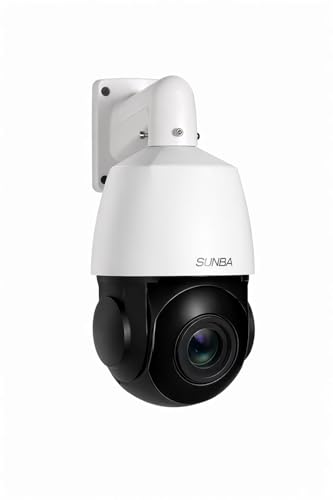 SUNBA 4K 20X Optical Zoom PTZ Camera |
9.1/10 | Buy |
 SeeVision 2K Solar Wireless PTZ Camera |
8.4/10 | Buy | |
| Best Premium |
 aosu 3K 5MP Outdoor PTZ Solar Camera (2-Pack) |
8.4/10 | Buy |
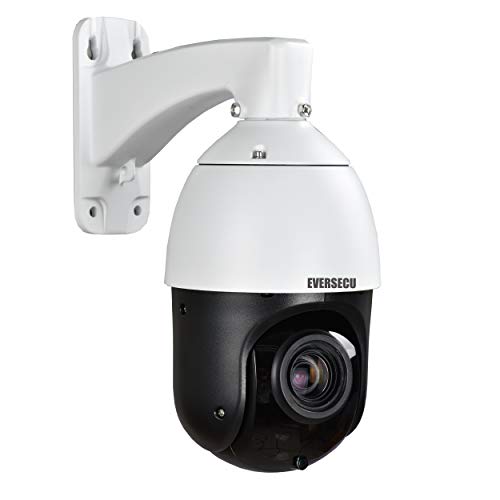 EVERSECU 2MP 20X Zoom PTZ Camera |
8.1/10 | Buy | |
| Best Value |
 SUNBA 405-22X Outdoor PTZ Analog Camera |
8.0/10 | Buy |
 Jennov 4K 20X Optical Zoom PoE PTZ Camera |
7.8/10 | Buy |
Anpviz 6MP 5X Zoom PoE PTZ Camera
Delivering sharp 6MP resolution and 5X optical zoom, this outdoor dome camera provides wide-angle surveillance with flexible night vision options. It suits property owners looking for detailed perimeter monitoring over a reliable PoE connection.
Pros
- High 6MP video resolution captures sharp image details
- Lossless 5X optical zoom preserves visual clarity
- Multiple night vision modes include color and 130ft infrared
- Intelligent person and vehicle detection minimizes false alerts
- Rugged IP66 rating withstands rain and dust exposure
Cons
- Lacks automatic target tracking functionality
- Two-way audio requires a specific Anpviz U Series NVR
- Pan rotation is capped at 280 degrees instead of 360
SUNBA 4K 20X Optical Zoom PTZ Camera
Designed for wide perimeter surveillance, this outdoor camera pairs crisp 4K recording with an expansive 20X optical zoom. Built-in AI tracking and versatile PoE support make it well suited for securing commercial properties or large properties.
Pros
- Crisp 4K video captures facial and vehicle details
- Extensive 20X optical zoom maintains high resolution
- Full pan and tilt controls eliminate blind spots
- PoE support allows single-cable power and data
- Smart AI tracking accurately follows human movement
Cons
- Large physical dimensions require substantial mounting space
- Requires physical wiring for Ethernet or DC power
SeeVision 2K Solar Wireless PTZ Camera
Designed for wire-free property monitoring, this solar-powered camera combines 2K resolution with motorized pan-and-tilt tracking and color night vision. It is a solid fit for homeowners who want perimeter security without the hassle of running power cords.
Pros
- Solar panel provides continuous power without manual recharging
- Wide pan and tilt rotation minimizes viewing blind spots
- AI detection filters out irrelevant motion triggers
- IP66 housing protects against harsh weather conditions
- Dual spotlights enable full-color night recording
Cons
- Operates exclusively on 2.4GHz Wi-Fi networks
- MicroSD storage card is not included
- Free cloud tier limits clips to six seconds
aosu 3K 5MP Outdoor PTZ Solar Camera (2-Pack)
Delivering crisp 3K resolution with complete 360-degree pan-tilt coverage, this solar-powered camera pair is well suited for homeowners seeking hands-off perimeter monitoring. It combines continuous solar charging with responsive motion tracking, full-color night vision, and two-way audio.
Pros
- Crisp 3K 5MP resolution captures fine visual details
- Full 360-degree pan-tilt coverage eliminates blind spots
- Solar power eliminates routine battery recharging chores
- Spotlight enables vivid full-color night recording
- AI noise reduction improves two-way voice clarity
Cons
- Supports only 2.4GHz Wi-Fi networks
- Requires direct sunlight exposure for continuous solar charging
- Bulkier housing than standard fixed outdoor cameras
EVERSECU 2MP 20X Zoom PTZ Camera
Built for wide-area surveillance, this EVERSECU dome camera pairs a 20X optical zoom with 360-degree pan coverage and 263-foot night vision. It serves as a capable upgrade for property owners operating compatible 2MP analog DVR systems.
Pros
- Powerful 20X optical zoom captures distant subjects clearly
- Long-range night vision illuminates up to 263 feet
- Full 360-degree continuous rotation eliminates blind spots
- Durable IP66 housing withstands harsh outdoor conditions
Cons
- Defaults to standard-definition CVBS mode out of the box
- Incompatible with IP NVR systems and 720p-only DVRs
- Requires RS485-compatible equipment for complete PTZ control
SUNBA 405-22X Outdoor PTZ Analog Camera
Designed for legacy surveillance setups, this outdoor dome camera pairs long-range 328-foot night vision with responsive pan-tilt-zoom control. It connects via an RS485 interface to compatible 960H analog DVRs, making it a dedicated choice for expansive perimeter monitoring.
Pros
- Impressive 328-foot night vision range
- IP66-rated weatherproof casing for outdoor use
- Fast pan and tilt tracking speeds
- Extended upward vertical tilt angle
- Backed by a two-year warranty
Cons
- Analog 960H connection rather than digital IP streaming
- Requires dedicated 18-gauge wiring to prevent underpowering
- Requires RS485 wiring for pan-tilt-zoom functionality
Jennov 4K 20X Optical Zoom PoE PTZ Camera
Built for wide-area surveillance, this outdoor dome camera combines sharp 4K resolution with a motorized 20X optical zoom and 320-foot night vision. Single-cable PoE setup and automated human tracking make it well suited for monitoring commercial lots or large residential perimeters.
Pros
- Crisp 4K video with 20X optical zoom capability
- Exceptional night vision range reaching up to 320 feet
- Single cable simplifies power and data connectivity
- Supports customizable patrol routes with multiple presets
- Rugged IP66 weatherproof construction for outdoor use
Cons
- Can only track a single subject at a time
- Incompatible with wireless or WiFi NVR systems
- Lacks a dedicated desktop client for macOS users
Understanding Pan-Tilt-Zoom Surveillance Technology and Performance
A pan-tilt-zoom camera, commonly abbreviated as a PTZ camera, is an active surveillance device equipped with internal electric servo motors and an adjustable motorized lens assembly. Unlike fixed cameras that capture a single unalterable frame, a PTZ camera can rotate horizontally across an expansive arc, tilt vertically up and down, and adjust its focal length to magnify distant objects. Property owners in regions like Tampa frequently utilize these dynamic surveillance platforms to secure broad areas such as commercial yards, waterfront docks, long suburban driveways, and open acreage. By combining wide-area physical movement with high-magnification optics, a single PTZ installation provides expansive situational awareness without requiring multiple stationary cameras along a perimeter.
Motorized Mechanical Mechanics: How Pan and Tilt Assemblies Function
The physical mobility of a pan-tilt-zoom camera relies on precision mechanical gearing driven by stepper motors inside a weather-sealed chassis. High-end commercial models feature endless 360-degree panning capabilities, utilizing internal slip rings that allow continuous horizontal spinning without twisting internal wiring harnesses. Compact or consumer-oriented units frequently offer bounded rotation between 280 and 355 degrees, alongside vertical tilt articulation ranging from 90 to 120 degrees. These mechanical movements can be driven manually by an operator using a virtual joystick on a mobile application, or directed automatically through programmed preset sequences.
Mechanical speed and motor precision directly dictate how effectively a camera tracks fast-moving activity across a wide property. Industrial PTZ domes utilize high-speed gearboxes capable of slewing at rates exceeding 90 degrees per second to jump instantaneously between pre-configured camera coordinates. In contrast, smaller battery or solar-assisted models prioritize energy conservation, employing slower motorized drives to preserve onboard lithium-ion cells while panning across residential yards. Maintaining accurate mechanical positioning requires robust internal calibration sensors so the camera always returns precisely to designated rest positions after completing an automated patrol sweep.
Optical Zoom Optics versus Digital Cropping: The Physics of Focal Length
The zoom capability of a PTZ camera represents one of its most critical technical advantages over standard wide-angle surveillance devices. True optical zoom relies on physical servo motors adjusting the internal glass elements of a motorized varifocal lens to change the optical focal length. For instance, a 20X optical zoom lens shifting between 4.7mm and 94mm physically narrows the field of view while drawing distant objects closer across the camera image sensor. Because the light focusing onto the sensor remains uncompressed, image resolution and edge contrast stay completely intact regardless of the magnification level.
Digital zoom operates under an entirely different optical principle that often leads to disappointment if buyers misunderstand the underlying mechanics. Digital zoom simply magnifies the existing pixels of an image through software interpolation, which inevitably leads to severe pixelation, blurring, and loss of forensic clarity at distance. When monitoring expansive outdoor perimeters, optical zoom allows property managers to read vehicle registration tags or distinguish facial features at substantial distances where a digital crop produces illegible noise. High-magnification optical lenses also feature variable apertures, meaning users must account for reduced light intake at maximum zoom during nighttime surveillance.
DORI Surveillance Standards: Measuring Real-World Identification Ranges
Evaluating the optical performance of a surveillance camera requires objective metrics rather than vague marketing claims regarding visibility range. The international surveillance industry adheres to the IEC EN 62676-4 standard, which defines four distinct optical benchmarks known as DORI: Detection, Observation, Recognition, and Identification. Detection requires 25 pixels per meter to determine if a human or vehicle is present in the frame. Observation increases target resolution to 63 pixels per meter, revealing general actions and clothing styles while maintaining situational context across large outdoor zones.
Forensic investigation requires stepping up to the higher thresholds of Recognition and Identification within the DORI framework. Recognition demands at least 125 pixels per meter, enabling an observer to verify with reasonable certainty whether a recorded individual matches a known acquaintance. Identification represents the most demanding standard at 250 pixels per meter, capturing sufficient facial definition and license plate typography for evidentiary submission to law enforcement. Deploying a PTZ camera with a 20X optical zoom allows users to achieve identification-level pixel density at dozens of yards away, far exceeding the functional identification reach of stationary wide-angle lenses.
Comparing Power Architectures: PoE, Analog RS485, and Solar-Assisted Wireless
Choosing the right power and connectivity infrastructure determines the long-term reliability and operational responsiveness of a PTZ camera system. Power over Ethernet models adhering to IEEE 802.3af or high-power 802.3at PoE+ standards transmit continuous electrical power, digital video signals, and PTZ motor commands over a single Cat5e or Cat6 network cable. Running continuous motorized tracking and infrared illuminators demands substantial electrical wattage, making hardwired power ideal for 24/7 video recording. Property owners configuring comprehensive surveillance often integrate these units into wired poe security camera systems to ensure zero-latency control and uninterrupted continuous recording without saturating local radio frequencies.
Traditional analog setups utilize coaxial cables for high-definition video signals alongside separate two-wire RS485 serial connections to transmit Pelco-D or Pelco-P motor commands. These legacy installations require dedicated low-voltage power supplies, often demanding heavier 18 AWG copper conductors to prevent voltage drop over long wire runs between the central power box and the motorized dome. While analog PTZ hardware lacks modern mobile app ecosystems without a digital video recorder, it provides robust real-time responsiveness and immunity to computer network packet congestion. Many commercial facilities in industrial zones retain analog coax infrastructure due to its resilience against severe interference and signal interruption.
Wire-free solar-assisted PTZ cameras offer an accessible alternative for monitoring remote areas such as detached outbuildings, construction perimeters, and agricultural gates where running physical cables is cost-prohibitive. These models pair low-power brushless motors with rechargeable lithium-ion battery packs and compact monocrystalline photovoltaic panels. Because continuous motor operation and video transmission quickly drain stored energy, solar PTZ cameras operate in a standby state, waking up only when onboard passive infrared sensors detect movement. Users seeking off-grid flexibility frequently select add-on security cameras for nvr setups or standalone solar Wi-Fi hardware to monitor perimeter boundaries without extensive trenching.
Automated Cruise Tours, Presets, and Edge-Based AI Auto-Tracking
Automating camera movements transforms a PTZ unit from a reactive viewer into an active perimeter patrol system. Operators can program dozens of custom preset coordinates, allowing the camera to cycle through automated cruise routes that sweep across gates, loading docks, and side passages at set intervals. Sophisticated models support park actions, which automatically command the camera to resume a default vantage point or pattern scan after an idle period. These automated patrols provide wide-area presence, ensuring that isolated corners of a facility receive regular optical coverage without human dispatch intervention.
Modern PTZ surveillance increasingly incorporates edge-based artificial intelligence to distinguish human forms and motor vehicles from swaying foliage or nocturnal animals. When a target crosses a pre-configured tripwire or enters an intrusion zone, onboard neural processing units calculate vector movement and direct the servo motors to track the subject smoothly. However, property owners must understand the operational trade-offs of single-lens auto-tracking. If a camera turns its physical lens to follow an individual moving across a lawn, it creates a temporary blind spot behind its chassis, potentially missing activity occurring at the original observation point.
Coastal Weatherproofing and Surge Protection for Humid, Storm-Prone Environments
Surveillance hardware installed in coastal Florida faces intense environmental stress from elevated ambient humidity, frequent tropical thunderstorms, and persistent salt-laden sea air. Exterior PTZ enclosures require a minimum Ingress Protection rating of IP66, signifying complete protection against fine dust penetration and resistance to powerful pressurized water jets from severe weather. Moving mechanical joints between the stationary mounting bracket and the rotating turret must incorporate silicone weather seals and internal desiccant packs to prevent moisture condensation on internal optical glass. Without adequate ingress sealing, tropical storm wind-driven rains can seep into the motorized gearbox, causing corrosion and premature motor failure.
Lightning strikes and secondary electrical surges represent another critical hazard for exterior outdoor electronics installed across Central Florida. Long exterior cable runs act as large inductive loops, capturing electrical transients generated by nearby cloud-to-ground lightning discharges during summer convective storms. Commercial PTZ cameras frequently integrate transient voltage suppression hardware, such as TVS 5000V surge arrestors, to clamp high-voltage spikes before electrical damage reaches internal processing boards. Homeowners and commercial installers should always ground outdoor camera chassis properly, install external surge protection modules near building entry points, and maintain silicone drip loops on all exterior wiring.
Network Bandwidth Demands, H.265 Compression, and Local Storage Topology
Streaming high-resolution 4K or 6MP video while transmitting continuous PTZ telemetry places significant throughput demands on residential and commercial local area networks. High-efficiency video coding, known as H.265 or HEVC, reduces video stream bitrates by roughly half compared to older H.264 formats without degrading optical clarity. When an optical zoom lens shifts focal length or the camera rapidly pans across high-frequency visual detail like grass or tree leaves, video compression bitrates naturally spike. Managing this dynamic data overhead requires deploying gigabit Ethernet switches, properly configured subnet routing, and adequate upstream Internet bandwidth to prevent stuttering live streams.
Storage topology plays an equally significant role in managing ongoing system expenses and video data security. Storing high-bitrate video footage locally on high-endurance microSD cards or dedicated Network Video Recorders eliminates recurring monthly cloud subscription fees while preserving full control over visual archives. Standalone NVRs utilizing high-capacity surveillance hard drives support continuous 24/7 video recording alongside automated event logging, ensuring crucial pre-event footage is never lost. Conversely, relying strictly on cloud storage for multiple motorized cameras can quickly exhaust residential monthly Internet data caps and create latency delays during critical live PTZ tracking events.
Practical Placement, Privacy Masking, and Florida Surveillance Legal Boundaries
Proper mounting geometry ensures a PTZ camera captures actionable evidentiary imagery while minimizing optical distortion and harsh sun glare. Mounting an exterior camera between eight and twelve feet above grade establishes an optimal compromise between physical tamper resistance and realistic horizontal facial recognition angles. Mounting a camera excessively high produces steep downward angles that record only the tops of hats and shoulders rather than clear frontal facial features. Installers must also anticipate the sun trajectory across the southern sky, positioning sun shields and configuring wide dynamic range settings to prevent direct solar glare from washing out sensor exposure.
Deploying wide-ranging motorized cameras requires careful adherence to residential privacy expectations and applicable state surveillance statutes. Under Florida law, Chapter 934 establishes an all-party consent requirement for recording oral communications where individuals maintain a reasonable expectation of privacy. While video recording of exterior property visible from public thoroughfares is generally permitted, pointing cameras directly into neighboring bedroom windows, fenced backyard swimming areas, or private interior quarters infringes upon common law privacy rights. Property owners should configure digital privacy masking within camera software to black out neighboring property lines and disable exterior microphone recording when monitoring property borders.
Deploying a pan-tilt-zoom camera provides an effective surveillance solution for properties requiring dynamic, wide-area coverage and high-magnification optical clarity. Balancing mechanical movement, optical zoom capabilities, robust coastal weatherproofing, and responsible privacy practices ensures reliable property protection across residential and commercial perimeters. Carefully evaluating power infrastructure, network bandwidth capacities, and automated tracking routines allows property owners to create a resilient surveillance perimeter that provides dependable situational awareness for years to come.
About the author
John R. Delaney is a veteran technology editor and product reviewer specializing in home security, smart home devices, and wireless networking. With extensive experience evaluating connected security systems, cameras, smart locks, sensors, and networking equipment, he brings a practical testing mindset to consumer technology. His work emphasizes usability, performance, connectivity, and long-term value for homeowners building reliable smart security systems.