
What Is the Best DIY Home Security Camera System: Architecture and Setup Guide for 2026
Understand what is the best diy home security camera system options for local storage, power delivery, and motion alerts in November 2026.
 By Alina Bradford
Updated November 22, 2026


Property owners often struggle with persistent notification fatigue caused by swaying tree branches, shifting shadows, and passing street traffic triggering endless alerts. Determining what is the best diy home security camera system requires looking past basic marketing promises and examining how hardware components function together during critical events. A balanced setup combines responsive visual monitoring with physical perimeter detection, ensuring that entryways remain secure without overwhelming your phone with meaningless notifications. Selecting standalone wireless hardware or an integrated perimeter kit depends heavily on your property layout, exterior power access, and tolerance for ongoing service agreements. Many households prioritize wire-free flexibility to avoid structural drilling, making battery security cameras with local storage an appealing choice for rapid deployment.
Modern self-installed security networks have evolved significantly beyond isolated hardware units with closed firmware ecosystems. Today, homeowners can deploy wireless contact sensors, high-decibel indoor sirens, and outdoor optical sensors that coordinate seamlessly through unified mobile applications. Reliable performance hinges on fundamental engineering elements, including dual-band Wi-Fi stability, energy-efficient power delivery via rechargeable cells or solar panels, and smart detection processing that isolates human silhouettes from ambient environmental motion. Assessing whether you prefer on-premise memory cards or cloud backup helps define long-term operating costs before you mount a single bracket. Understanding these critical architectural differences ensures your chosen hardware provides dependable evidence whenever unexpected property incidents occur.
| Award | Product | SSG Score About SSG ScoreThe SSG Score is our own rating from 0 to 10, based on performance, design and build, ease of use, and value. It reflects independent research and is never influenced by manufacturers, retailers, or affiliate commissions. Learn more › | |
|---|---|---|---|
| Best Overall |
Gianteye 2K Solar Wireless Security Cameras
|
9.2/10 | Buy |
| Best Budget |
 Cove 6-Piece DIY Home Security System |
8.8/10 | Buy |
| Best Premium |
 Ring Alarm 14-Piece Wireless Home Security Kit |
8.8/10 | Buy |
| Best Value |
 PGST A108F 22-Piece Home Security System |
8.6/10 | Buy |
 SimpliSafe 8-Piece Wireless Home Security System |
8.4/10 | Buy | |
 VISION WELL 2K Wireless Security Camera |
8.3/10 | Buy | |
 ELYSOO 2K Solar Security Camera 4-Pack |
7.8/10 | Buy |
Gianteye 2K Solar Wireless Security Cameras
The Gianteye 2K Solar Wireless Security Camera 4-Pack delivers comprehensive outdoor surveillance with motorized 360-degree pan-tilt coverage, dual-band Wi-Fi flexibility, and continuous solar charging. It is an ideal multi-camera system for homeowners seeking expansive perimeter monitoring without running cables or paying forced monthly subscription fees.
Pros
- Four-camera package provides multi-angle coverage across driveways, yards, and entryways with motorized 360-degree pan-tilt mobility.
- Dual-band 2.4GHz and 5GHz Wi-Fi connectivity provides reliable connection options depending on router placement and wall interference.
- Detachable solar panels provide continuous trickle-charging, eliminating the chore of dismounting cameras for manual battery recharging.
- Subscription-free local video storage via onboard MicroSD slots allows homeowners to retain private event footage without recurring fees.
- IP65 weather-resistant rating ensures dependable performance through harsh seasonal rain, snow, and heat.
Cons
- MicroSD storage cards are not included in the package and must be purchased separately for each camera.
- Like most battery and solar-powered surveillance units, it operates on motion-activated recording and does not support continuous 24/7 video capture.
- Smart home voice integration is limited to Amazon Alexa, lacking native support for Apple HomeKit or Google Home.
Cove 6-Piece DIY Home Security System
Designed for simple tool-free installation, this wireless starter kit pairs baseline intrusion sensors with an indoor camera and intuitive mobile app controls. It provides a practical security foundation for renters and homeowners seeking professional dispatch support without long-term contracts.
Pros
- Simple wireless installation requires no special tools
- Includes three months of 24/7 professional monitoring
- Integrated indoor camera covers key living spaces
- Centralized system management via mobile app
- No long-term contract required for ongoing service
Cons
- Professional monitoring requires paid subscription after three months
- System expansion requires purchasing additional sensors separately
- Relies entirely on self-guided user setup
Ring Alarm 14-Piece Wireless Home Security Kit
Designed for 2-4 bedroom residences, this Ring Alarm 14-Piece Kit pairs eight entry sensors and dual motion detectors with two keypads for comprehensive multi-entry coverage. It is a practical DIY wireless security solution for suburban homeowners and renters seeking scalable layout defense with optional 24/7 professional monitoring.
Pros
- Generous 14-piece bundle includes eight contact sensors and two keypads, offering ample coverage for primary and secondary home entryways
- Included wireless range extender helps ensure consistent communication for peripheral sensors across multi-room homes
- Direct integration with the Ring app enables real-time mobile trigger notifications and unified device management
- Alexa voice control support enables convenient hands-free arming and disarming when combined with a Ring Protect plan
- Straightforward DIY wireless setup allows modular placement without requiring professional installation labor
Cons
- Advanced features including cellular backup, Alexa voice arming/disarming, and remote in-app arming require a paid Ring Protect subscription
- Volumetric motion sensors require careful placement away from direct heat sources and high pet traffic areas to minimize accidental triggers
- Professional dispatch services and emergency response require an ongoing paid monitoring tier rather than a zero-cost option
PGST A108F 22-Piece Home Security System
Designed for subscription-free property protection, this PGST kit combines entry sensors and an HD camera with dual WiFi and 4G connectivity. The central color hub delivers tamper resistance and direct mobile alerts without recurring fees.
Pros
- Operates without mandatory monthly subscription fees
- Dual WiFi and 4G cellular alert backup
- Built-in tamper protection triggers instant alerts
- Clear color display on the base unit
Cons
- Does not support 5GHz Wi-Fi networks
- MicroSD card for video recording sold separately
- Cellular features require a separate SIM card
SimpliSafe 8-Piece Wireless Home Security System
The SimpliSafe 8-Piece Wireless Home Security System delivers dependable perimeter and interior protection with wire-free setup, pet-friendly motion sensing, and versatile contract-free monitoring options. It is a practical, adaptable security choice for suburban homeowners and apartment renters alike.
Pros
- Quick, damage-free adhesive mounting makes setup simple for apartments, rentals, and single-family homes
- Calibrated motion detection ignores pets under 60 pounds to help minimize nuisance alarms
- Secret Alerts feature enables discreet monitoring of sensitive cabinets, closets, and interior doors
- Flexible monitoring terms allow complete app management without locking you into multi-year contracts
- Voice assistant integration supports quick system arming via Amazon Alexa and Google Assistant
Cons
- Fast emergency police dispatch and silent panic features require an active professional monitoring subscription
- Voice assistant integration is limited to arming commands and does not support voice-based disarming
- Homes with numerous ground-level windows may need extra entry sensors beyond the pieces included in this starter pack
VISION WELL 2K Wireless Security Camera
The VISION WELL 2K Wireless Security Camera delivers flexible, wire-free surveillance for indoor or outdoor spaces with clear 2K resolution, color night vision, and on-device AI motion filtering. It is a dependable, budget-conscious choice for homeowners and renters seeking reliable entryway deterrence without mandatory monthly fees.
Pros
- Completely wire-free battery installation with included bracket and screws, making it ideal for renters and suburban homeowners.
- Sharp 2K video clarity supported by full-color night vision and a 33-foot illumination range.
- PIR motion detection paired with smart AI filtering for people, vehicles, pets, and packages.
- Local recording support on microSD cards up to 128GB to avoid mandatory monthly subscriptions.
- IP65 weather-resistant rating suitable for exterior perimeter or sheltered entryway mounting.
Cons
- Only connects to 2.4 GHz Wi-Fi networks and does not support 5 GHz frequencies.
- Designed for motion-activated event clips rather than continuous 24/7 video recording.
- MicroSD storage card is not included in the box and must be purchased separately.
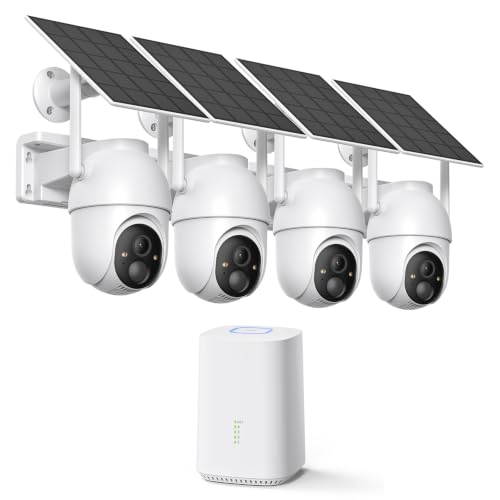
ELYSOO 2K Solar Security Camera 4-Pack
This four-camera setup provides comprehensive outdoor coverage powered by solar charging and dual-band Wi-Fi connectivity. With included 64GB local storage and motorized pan-tilt capability, it suits property owners wanting multi-angle security without recurring monthly fees.
Pros
- Dual-band Wi-Fi connection for stable streaming
- Includes preloaded local storage without monthly fees
- Continuous solar operation with minimal daily sunlight
- Full-color night vision with automatic spotlight
Cons
- Requires adequate direct sunlight exposure to maintain charge
- Weatherproofing is rated at IP65 rather than IP67
Evaluating DIY Home Security Camera Architecture and System Components
Answering what is the best diy home security camera system requires examining how optical coverage, physical entry detection, and data storage align with your living environment. Rather than a single universal product, the optimal DIY setup depends on whether your priority is visual verification around exterior perimeters or integrated intruder deterrence across interior entry points. Modern DIY platforms split into two distinct philosophies: camera-centric systems that focus on video surveillance and hybrid security kits that combine cameras with contact sensors and loud sirens. Balancing these two approaches allows property owners to build a reliable defense without hiring expensive professional installation crews.
Camera-Centric Platforms Versus Hybrid Alarm Ecosystems
Camera-centric platforms focus primarily on visual monitoring, motion alerts, and forensic event recording. Systems featuring multi-camera bundles provide comprehensive visual tracking around exterior perimeters, driveways, and yards using standalone optical units. In contrast, comprehensive security kits like those from Ring, SimpliSafe, and Cove incorporate physical door and window contact sensors, motion detectors, and centralized base stations. These hybrid platforms pair environmental intrusion sensors with indoor or doorbell cameras to trigger immediate audible alarms when an exterior barrier is breached. Deciding between a camera-first array and a whole-home alarm package depends directly on whether you need passive video evidence or active perimeter deterrence.
Hybrid platforms offer distinct advantages for multi-room homes where exterior cameras cannot monitor internal entry paths. Door contact sensors utilize magnetic reed switches that immediately register when a portal opens, sounding an alarm without waiting for an optical camera to identify motion. Ecosystems such as the Ring Alarm fourteen-piece kit or SimpliSafe eight-piece package allow users to pair keypad arming controls with indoor base station chimes. However, basic alarm kits often require separate outdoor camera additions if you want continuous visual deterrence along exterior boundaries. For sprawling properties and detached garages, dedicated camera arrays often deliver superior operational visibility before an intruder reaches a doorway.
Power Architecture: Solar Harvesting, Rechargeable Cells, and Hardwired Power
Power delivery represents a primary decision point when deploying self-installed outdoor surveillance. Wire-free battery cameras eliminate the chore of drilling through exterior walls or routing electrical conduit along exterior siding. Units powered by internal lithium-ion cells can operate for several months between charges under moderate daily motion activity. However, high-traffic driveways or street-facing porches can cause rapid battery depletion due to continuous sensor wake cycles and active Wi-Fi streaming. When frequent battery recharging becomes inconvenient, convenience quickly turns into an ongoing maintenance headache.
Detachable solar panels provide an effective solution for maintaining consistent operational uptime without manual ladder climbs. Modern outdoor units, including models from Gianteye and Elysoo, integrate small monocrystalline solar collectors requiring as little as two hours of direct daily sunlight to sustain daily operation. These solar accessories continuously trickle-charge the internal battery buffer, offsetting daily sensor draws and video processing consumption. Property owners in cold northern regions must still account for sub-freezing winter weather, where battery management systems throttle charging to protect lithium cells. For permanent twenty-four-seven surveillance without battery concerns, hardwired Power over Ethernet camera architectures remain the industry benchmark for uninterrupted video capture.
Optical Resolution, Image Sensor Formats, and DORI Standards
Video clarity involves far more than high megapixel numbers printed across retail packaging. Modern DIY options commonly offer 2K resolution, providing approximately four megapixels of image detail that significantly surpasses standard 1080p video streams. This extra pixel density proves essential when zooming digitally into recorded footage to distinguish license plate characters or clothing emblems. However, true visual identification depends on sensor dimensions and dynamic range management under harsh sunlight. A larger optical sensor captures more ambient light, preventing severe digital noise during dawn, dusk, or deep afternoon shadows.
Security technicians evaluate optical performance using the international IEC DORI standard, which quantifies Detection, Observation, Recognition, and Identification. Detection requires approximately twenty-five pixels per meter, allowing a user to confirm that a human figure has entered the camera view. Recognition demands one hundred twenty-five pixels per meter, which is the density needed to confirm whether a person matches an existing acquaintance. Forensic identification requires at least two hundred fifty pixels per meter to capture indisputable facial traits suitable for law enforcement evidence. DIY systems with wide viewing angles expand coverage area but dilute pixel density across distance, making proper camera placement crucial for capturing actionable identification.
Night Vision Technologies: Infrared Illuminators Versus Active Spotlights
Nighttime video capture presents one of the toughest challenges for self-installed security equipment. Traditional night vision relies on 850-nanometer infrared LED illuminators that cast invisible light across dark yards, producing a monochromatic black-and-white video feed. Infrared lighting works reliably over moderate distances, but it obscures crucial evidentiary details such as vehicle color, jacket shade, and hair tone. Additionally, infrared LEDs mounted near window panes or reflective soffits can cause severe backscatter flare that blinds the camera lens. Choosing hardware with intelligent lighting controls helps mitigate these frequent environmental optical distortions.
Full-color night vision utilizes integrated white LED spotlights that illuminate the immediate viewing zone whenever motion is detected. This illumination provides the optical sensor with sufficient ambient light to record vibrant color footage while acting as an active visual deterrent to trespassers. Systems from Vision Well and Gianteye leverage this approach to deliver full-color clarity up to thirty feet in total darkness. Homeowners seeking continuous nighttime perimeter oversight frequently prefer battery cameras featuring color night vision to maintain forensic image fidelity without adding separate exterior landscape floodlights. However, frequent spotlight activations will increase overall power consumption, requiring balanced sensitivity configurations.
Motion Sensing Mechanisms: Passive Infrared Sensors and Edge AI Detection
Notification fatigue remains one of the primary reasons homeowners disable motion alerts on their mobile devices. Early generations of consumer surveillance cameras relied on crude pixel-change detection, which interpreted shifting cloud shadows, windblown trees, and flying insects as security events. Contemporary DIY systems combat this problem by pairing passive infrared hardware with edge computer vision algorithms. Passive infrared sensors detect thermal radiation shifts caused by warm bodies crossing split optical zones, ignoring non-thermal environmental motion. This hardware-level filter ensures that the camera radio wakes up only when an actual heat-emitting mass moves through the detection path.
On-device artificial intelligence further refines incoming video frames by analyzing geometric shapes before dispatching mobile notifications. Modern neural processing units embedded in camera chips can rapidly categorize silhouettes into human figures, motor vehicles, family pets, and delivery packages. Systems from PGST, SimpliSafe, and Elysoo utilize these intelligent filters to deliver targeted push notifications while suppressing harmless movement. Pet-friendly motion detectors, such as those included with SimpliSafe hardware, are calibrated to ignore household animals under sixty pounds when mounted at recommended wall heights. By tailoring motion sensitivity zones and detection categories, property owners can restore confidence in their daily alert notifications.
Video Storage Topology: Local Memory Cards Versus Cloud Subscription Plans
Storage architecture dictates how your recorded security footage is archived, accessed, and maintained over the lifespan of the system. Local storage solutions, such as high-endurance microSD cards installed directly into camera slots or home base stations, offer complete operational privacy and zero ongoing monthly fees. Hardware packages like the Elysoo system include preloaded memory cards right out of the box, supporting automated loop recording that overwrites the oldest footage when storage fills up. Similarly, the PGST alarm system provides local storage expansion without requiring proprietary cloud plans to retain event logs. This standalone approach ensures that your video archives remain completely within your personal possession.
Cloud storage subscriptions upload encrypted event clips to secure remote server centers immediately upon detection. While cloud plans introduce ongoing recurring costs, they protect video evidence from physical camera theft, destruction, or card corruption during a break-in. Services like Ring Protect or optional SimpliSafe monitoring plans also unlock extended video history, cellular communication failover, and access to twenty-four-seven emergency dispatch operators. Homeowners who travel frequently or manage remote rental units often value the security of off-site cloud backups and live monitoring response. Conversely, privacy-conscious buyers who dislike subscription contracts gravitate toward standalone local recording setups with encrypted on-device memory.
Network Redundancy: Dual-Band Wi-Fi and Cellular Backup Communication
Wireless network stability directly influences live-view streaming speeds, alert latency, and overall camera reliability. Standard 2.4-gigahertz Wi-Fi networks provide exceptional physical penetration through solid structural barriers, including exterior brick walls, thick wood siding, and concrete foundations. However, the 2.4-gigahertz band suffers from severe frequency congestion in dense residential neighborhoods where neighboring routers compete for limited channels. Dual-band systems, supported by cameras from Gianteye and Elysoo, can connect to 5-gigahertz wireless networks to achieve higher data transmission rates and smoother high-definition live playback. Utilizing 5-gigahertz Wi-Fi reduces buffer latency, provided the camera sits within reasonable physical proximity to the primary access point.
Comprehensive alarm units take network redundancy a step further by integrating cellular communication modules into their central hubs. Platforms like the PGST system incorporate 4G LTE SIM card slots alongside standard 2.4-gigahertz Wi-Fi connections to maintain alert transmission during home internet outages. When a broadband service provider experiences an unexpected service interruption or an intruder cuts the exterior cable feed, the system automatically routes emergency push notifications and SMS alarms over cellular towers. Similarly, professional monitoring services from Cove, SimpliSafe, and Ring utilize integrated cellular transmitters to keep base stations connected around the clock. This dual-path communication topology ensures property protection remains completely operational regardless of local broadband health.
Strategic Placement, Mounting Angles, and Tamper Resistance
Physical camera positioning heavily influences whether recorded footage provides actionable forensic evidence or merely a distant silhouette. Exterior cameras should ideally be mounted between eight and ten feet above finished grade to balance facial identification angles against vandalism. Mounting cameras excessively high creates steep downward perspectives that capture only the tops of hats and shoulders rather than recognizable facial characteristics. Furthermore, positioning optical lenses perpendicular to primary walking routes maximizes passive infrared detection accuracy, as thermal sensors respond far more reliably to lateral movement than direct head-on approaches. Avoiding direct angles toward rising or setting sun paths prevents severe sensor flare and washed-out highlights.
Physical security mechanisms protect the DIY equipment itself from unauthorized interference or sudden removal. Many alarm base stations and outdoor units incorporate physical tamper switches that detect when a casing is pried off its mounting bracket. When an unauthorized person attempts to pull down a PGST main unit or a SimpliSafe keypad, an ear-piercing siren triggers immediately while emergency alerts transmit to registered smartphones. For outdoor cameras, choosing durable weather-resistant enclosures with IP65 ingress protection ratings shields internal circuitry from driving rain, freezing snow, and abrasive windblown dust. Ensuring that mounting hardware is firmly anchored into solid wall studs or masonry shields the installation against brute physical removal.
Privacy Boundaries, Data Encryption, and Legal Compliance
Deploying residential surveillance cameras carries important legal and ethical responsibilities concerning personal privacy boundaries. Under United States legal precedents, individuals possess a reasonable expectation of privacy within enclosed living spaces, bathrooms, and fenced backyards shielded from casual public view. While exterior cameras may lawfully capture public sidewalks, curbside streets, and driveway entryways, pointing lenses directly into neighboring bedroom windows can trigger serious civil liability or violation of local voyeurism laws. Utilizing software privacy masking tools allows property owners to black out specific geometric sections of a camera frame, ensuring neighboring windows remain unmonitored. Responsible camera aiming preserves friendly neighborhood relationships while maintaining robust perimeter security.
Audio recording introduces additional legal considerations under both federal wiretap provisions and state-specific eavesdropping statutes. United States federal law under 18 U.S.C. Section 2511 establishes a one-party consent framework for recording oral communications, but several states enforce strict all-party consent laws that prohibit recording private conversations without the knowledge of everyone present. If your outdoor cameras feature highly sensitive two-way microphones, capturing conversations between passersby on public walkways could raise regulatory concerns depending on your state of residence. Disabling audio recording toggles within the device settings or posting visible notice signs helps ensure compliance with state surveillance regulations. Additionally, verifying that your chosen system employs AES-128 or AES-256 data encryption safeguards your video archives against unauthorized external access.
Selecting the most effective DIY home security camera setup ultimately requires weighing physical coverage needs against ongoing operational preferences. Whether you select a modular solar-powered camera network with local memory storage or a comprehensive hybrid alarm system featuring door sensors and professional dispatch monitoring, system reliability depends on proper placement, network bandwidth, and routine maintenance. Taking time to benchmark Wi-Fi signal strength at each mounting location, customize motion detection boundaries, and verify recording continuity during network dropouts ensures long-term operational success. A well-designed self-installed system provides dependable peace of mind and robust property protection without locking you into rigid long-term contracts.
About the author
Alina Bradford is a safety and security expert with more than two decades of experience researching consumer technology and personal safety. She has tested hundreds of security and safety products and brings first-responder training to her practical approach. Her expertise spans home security equipment, cameras, connected safety devices, apps, and emerging security technology, with a focus on making complex products easier for everyday consumers to understand.