
What Is the Best Wireless Security Camera for Outdoors: Practical Guide for 2026
Find what is the best wireless security camera for outdoors for November 2026 with our guide to solar power, local storage, and weatherproofing.
 By John R. Delaney
Updated November 23, 2026


Homeowners facing persistent false motion alerts, unexpected battery drain, or spotty connectivity often wonder how to choose the right surveillance setup. Determining what is the best wireless security camera for outdoors requires balancing power autonomy, wireless network range, and intelligent detection capabilities tailored to your specific yard. Many standard installations struggle with weather extremes or weak signals passing through exterior masonry. Evaluating your property perimeter helps determine whether a compact battery unit, an integrated solar panel, or a high-speed dual-band camera offers the most reliable perimeter defense.
Modern wire-free hardware eliminates the physical labor of running low-voltage electrical lines through exterior walls and soffits. Many property owners look for dependable battery security cameras with color night vision to ensure clear recognition during nighttime hours. Finding the right balance between optical clarity, onboard video storage, and responsive two-way audio helps maintain reliable evidence without incurring unnecessary monthly maintenance headaches. Knowing how these components operate together allows you to safeguard vulnerable entry points with confidence.
| Award | Product | SSG Score About SSG ScoreThe SSG Score is our own rating from 0 to 10, based on performance, design and build, ease of use, and value. It reflects independent research and is never influenced by manufacturers, retailers, or affiliate commissions. Learn more › | |
|---|---|---|---|
| Best Overall |
GALAYOU R6 2K Solar Security Camera
|
9.2/10 | Buy |
| Best Value |
 Blink Outdoor 4 Wire-Free Security 2-Camera System |
9.2/10 | Buy |
| Best Premium |
 Gianteye 2K Solar Wireless Security Cameras |
9.2/10 | Buy |
| Best Budget |
 HITELLARCAM 2K Wireless Outdoor Security Camera |
8.8/10 | Buy |
 SEHMUA 4G LTE Cellular Solar Outdoor Security |
8.6/10 | Buy | |
 VISION WELL 2K Wireless Security Camera |
8.3/10 | Buy | |
 AlkiVision 2K Wireless Solar Security Camera |
8.1/10 | Buy |
GALAYOU R6 2K Solar Security Camera
Combining continuous solar charging with sharp 2K resolution, the GALAYOU R6 provides wire-free surveillance for yards, garages, and driveways. Its motorized pan-and-tilt tracking and integrated siren deliver active property deterrence without hardwired electrical lines.
Pros
- Wire-free setup powered by continuous solar charging
- Sharp 2K resolution with color night vision
- Automated motion tracking across a wide coverage area
- Built-in siren and two-way audio for deterrence
- IP65 weather resistance handles outdoor conditions
Cons
- Limited to 2.4 GHz Wi-Fi networks only
- MicroSD card is not included in the box
- Continuous or extended cloud recording requires paid plan
Blink Outdoor 4 Wire-Free Security 2-Camera System
The Blink Outdoor 4 two-camera system delivers wire-free 1080p HD monitoring with infrared night vision and up to two years of battery life using included lithium cells. It is an accessible, low-maintenance surveillance option for homeowners and renters seeking reliable motion alerts and Alexa integration.
Pros
- Extended battery life rated for up to two years with the included AA lithium batteries
- Completely wire-free hardware enables rapid mounting without complex electrical wiring
- Enhanced dual-zone motion detection delivers prompt mobile push notifications
- Seamless Amazon Alexa integration allows hands-free control and smart display live feeds
Cons
- The bundled Sync Module Core lacks onboard local storage ports for USB drives or microSD cards
- Advanced computer vision person detection requires a paid Blink Subscription Plan
- Battery-powered architecture does not support continuous 24/7 video recording
Gianteye 2K Solar Wireless Security Cameras
The Gianteye 2K Solar Wireless Security Camera 4-Pack delivers comprehensive outdoor surveillance with motorized 360-degree pan-tilt coverage, dual-band Wi-Fi flexibility, and continuous solar charging. It is an ideal multi-camera system for homeowners seeking expansive perimeter monitoring without running cables or paying forced monthly subscription fees.
Pros
- Four-camera package provides multi-angle coverage across driveways, yards, and entryways with motorized 360-degree pan-tilt mobility.
- Dual-band 2.4GHz and 5GHz Wi-Fi connectivity provides reliable connection options depending on router placement and wall interference.
- Detachable solar panels provide continuous trickle-charging, eliminating the chore of dismounting cameras for manual battery recharging.
- Subscription-free local video storage via onboard MicroSD slots allows homeowners to retain private event footage without recurring fees.
- IP65 weather-resistant rating ensures dependable performance through harsh seasonal rain, snow, and heat.
Cons
- MicroSD storage cards are not included in the package and must be purchased separately for each camera.
- Like most battery and solar-powered surveillance units, it operates on motion-activated recording and does not support continuous 24/7 video capture.
- Smart home voice integration is limited to Amazon Alexa, lacking native support for Apple HomeKit or Google Home.
HITELLARCAM 2K Wireless Outdoor Security Camera
The HITELLARCAM 2K wireless outdoor security camera provides wire-free surveillance featuring dual-band Wi-Fi, full-color night vision, and flexible storage via a microSD slot or free SD-quality cloud tier. It serves as an accessible option for suburban homeowners or renters seeking budget-friendly entryway and perimeter coverage without mandatory monthly fees.
Pros
- Dual-band 2.4GHz and 5GHz Wi-Fi support provides flexible home network integration
- Free SD-quality cloud storage option provides clip access without mandatory subscription fees
- Onboard microSD card slot supports up to 256GB for zero-monthly-cost local video storage
- IP66 weather-resistant construction withstands exposure to outdoor rain and dust
- Integrated LED spotlights enable full-color night recording and visual deterrence
Cons
- Free cloud storage tier is limited to standard-definition playback unless upgraded to a paid plan
- MicroSD card is not included with the camera and must be purchased separately
- Battery runtime varies significantly based on trigger frequency, live-view streaming, and cold temperatures
SEHMUA 4G LTE Cellular Solar Outdoor Security
The SEHMUA 4G LTE Solar Security Camera provides true off-grid perimeter protection with 2K resolution, pan-tilt rotation, and continuous 6W solar charging without requiring Wi-Fi. It is an ideal pick for property owners monitoring remote locations such as barns, rural acreage, construction sites, and vacation homes.
Pros
- Operates completely without local Wi-Fi or electrical grid power using 4G LTE cellular data
- Motorized pan-and-tilt rotation provides 360-degree viewing coverage via the Ubox mobile app
- Included 6W solar panel helps maintain continuous battery charge in sunny outdoor locations
- Pre-installed multi-carrier SIM card supports AT&T, T-Mobile, and Verizon cellular coverage
- Crisp 2K resolution with 4X digital zoom and optional full-color night vision illumination
Cons
- Does not support standard home Wi-Fi network connections
- Spotlight for full-color night vision must be manually toggled on inside the Ubox app
VISION WELL 2K Wireless Security Camera
The VISION WELL 2K Wireless Security Camera delivers flexible, wire-free surveillance for indoor or outdoor spaces with clear 2K resolution, color night vision, and on-device AI motion filtering. It is a dependable, budget-conscious choice for homeowners and renters seeking reliable entryway deterrence without mandatory monthly fees.
Pros
- Completely wire-free battery installation with included bracket and screws, making it ideal for renters and suburban homeowners.
- Sharp 2K video clarity supported by full-color night vision and a 33-foot illumination range.
- PIR motion detection paired with smart AI filtering for people, vehicles, pets, and packages.
- Local recording support on microSD cards up to 128GB to avoid mandatory monthly subscriptions.
- IP65 weather-resistant rating suitable for exterior perimeter or sheltered entryway mounting.
Cons
- Only connects to 2.4 GHz Wi-Fi networks and does not support 5 GHz frequencies.
- Designed for motion-activated event clips rather than continuous 24/7 video recording.
- MicroSD storage card is not included in the box and must be purchased separately.
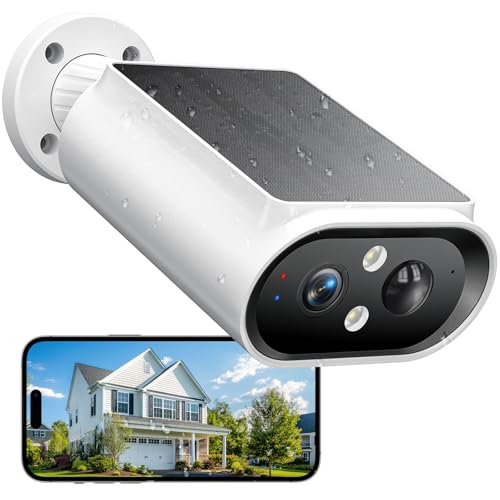
AlkiVision 2K Wireless Solar Security Camera
The AlkiVision Wireless Solar Security Camera combines 2K resolution, spotlight-assisted color night vision, and an IP67-rated exterior powered by a 5000mAh battery and solar panel. It suits budget-conscious homeowners and renters seeking wire-free perimeter monitoring with local microSD storage, though smart AI filtering requires a paid subscription.
Pros
- 2K video resolution paired with spotlight-assisted full-color night vision for enhanced low-light clarity
- Bundled solar panel and 5000mAh internal battery enable convenient wire-free exterior placement
- Certified IP67 weatherproofing provides dependable resistance against rain and dust
- Onboard microSD slot accommodates up to 128GB cards for subscription-free local event recording
Cons
- Smart AI classification (person, vehicle, pet, package) and custom activity zones require a paid Vicohome cloud subscription
- Restricted to 2.4GHz Wi-Fi networks with no support for 5GHz bands or wired Ethernet connections
- Operates strictly on motion-triggered clips up to 20 seconds, lacking continuous 24/7 video recording capability
Key Architectural Factors for Outdoor Wireless Security Cameras
Finding the right outdoor wireless security camera comes down to how well a specific system matches your property layout, available sunlight, and wireless infrastructure. No single camera suits every perimeter, because an off-grid detached barn requires vastly different transmission and power hardware than a compact suburban front porch. The most effective setup delivers consistent uptime, captures usable evidentiary detail, and operates without overwhelming you with false alerts or constant maintenance chores.
Modern wireless systems rely on distinct engineering balances between power conservation and instant responsiveness. Battery-powered devices must sleep between motion triggers to conserve energy, meaning internal components, wireless radios, and optical sensors wake in fractions of a second when activity occurs. Understanding how each functional subsystem operates will help you select a dependable outdoor camera that performs through seasonal weather shifts and network fluctuations.
Power Architecture: Solar Harvesting Versus Replaceable and Rechargeable Cells
Power delivery represents the foundational constraint of any wire-free outdoor camera system. True wireless cameras rely on internal rechargeable lithium-ion cells, replaceable dry batteries, or continuous solar charging via integrated or detached micro-panels. Models equipped with solar panels, such as the GALAYOU R6 or AlkiVision units, harness daily sunlight to maintain battery reserves without requiring you to climb ladders for manual recharging. In areas receiving two to three hours of direct sun exposure daily, solar-assisted architectures can run virtually indefinitely without manual intervention.
Rechargeable internal batteries behave differently when ambient temperatures drop below freezing. Standard lithium-ion chemistry experiences internal resistance in sub-zero winter climates, which temporarily reduces available milliamp-hour capacity and prevents onboard battery management systems from accepting a solar charge below 32 degrees Fahrenheit (0 degrees Celsius). During sustained winter freezes, cameras with modular USB-C charging ports allow for temporary physical retrieval and indoor top-ups. Understanding your regional winter climate helps you plan proper bracket placement in sun-drenched, south-facing locations.
Replaceable cell architectures offer an alternative approach for users seeking extreme operational simplicity. Systems like the Blink Outdoor 4 utilize non-rechargeable AA lithium batteries paired with an ultra-low-power proprietary wireless hub, extending duty cycles up to two years under typical motion loads. This approach eliminates the need for exterior solar panel wiring while avoiding the thermal charging lockouts inherent to rechargeable lithium cells. But frequent activity spikes along busy sidewalks will accelerate battery consumption, requiring earlier cell replacement.
Network Transmission: Dual-Band Wi-Fi Versus Off-Grid Cellular Connectivity
Wireless data transmission dictates how quickly you receive mobile push alerts and whether live video streams cleanly without dropped frames. Most wireless cameras operate over 2.4 GHz Wi-Fi frequencies, which excel at penetrating dense building materials such as brick, stucco, and wood framing. However, congested suburban 2.4 GHz airwaves can introduce transmission latency and signal collisions that slow down alert delivery. Devices supporting both 2.4 GHz and 5 GHz bands, including options from Gianteye and HITELLARCAM, offer greater flexibility by utilizing faster, less-crowded channels when mounted near home access points.
Measuring the received signal strength indicator (RSSI) at the exact mounting location is critical before drilling any permanent bracket holes. An RSSI value weaker than -65 dBm often forces the camera Wi-Fi radio to amplify its transmission power, resulting in rapid battery exhaustion and frequent connection dropouts. Positioning a dedicated Wi-Fi range extender or mesh node on an interior wall closest to the outdoor camera can dramatically improve connection stability. Maintaining a solid link ensures that motion-activated alert clips upload smoothly to the cloud or local storage hub.
Remote perimeters without access to residential broadband require a completely different transmission architecture. Dedicated cellular options, such as the SEHMUA 4G LTE solar camera, bypass local Wi-Fi entirely by utilizing built-in carrier SIM cards compatible with major wireless networks. This design suits off-grid cabins, rural equipment yards, horse barns, and construction sites where traditional broadband cannot reach. Cellular surveillance relies on monthly mobile data allocations, making it essential to monitor carrier signal coverage and data plans at the target installation site.
Video Resolution, Optical Clarity, and DORI Identification Standards
Video resolution plays a vital role in capturing usable evidentiary footage, but raw pixel counts tell only part of the story. Outdoor wireless cameras typically provide 1080p Full HD or 2K Quad HD resolution, producing sharper details on vehicle badging, clothing patterns, and faces. Higher resolutions provide greater digital zoom headroom without turning images into pixelated blocks. Yet optical clarity also depends on image sensor size, lens aperture dimensions, and dynamic range processing that balances harsh daylight shadows against bright skies.
Surveillance effectiveness is professionally measured using the international IEC EN 62676-4 DORI standard, which outlines specific pixel densities for four operational thresholds. Detection requires 25 pixels per meter to determine human presence, while Observation demands 63 pixels per meter to assess characteristic actions. Recognition needs 125 pixels per meter to confirm whether an individual has been seen before, and forensic Identification requires 250 pixels per meter to clearly verify a stranger’s facial features. A wide field of view distributes available pixels across a broader area, effectively reducing your camera forensic identification range down to closer distances.
Nighttime illumination heavily impacts whether your recorded clips meet these forensic DORI requirements. Traditional infrared night vision utilizes 850-nanometer LEDs to produce black-and-white images without revealing bright lights, though it can create washed-out highlights on faces located close to the lens. Modern color night vision cameras use integrated LED spotlights to illuminate the scene, capturing full-color video that accurately records clothing colors and vehicle finishes. Spotlights double as active deterrents, alerting nocturnal intruders that their presence has been actively detected.
Coverage Flexibility: Fixed Lenses Versus Motorized Pan-Tilt Functionality
Camera form factors dictate how much physical property a single device can observe. Fixed-lens outdoor cameras monitor a static zone, typically covering between 110 and 130 degrees of horizontal view. These cameras are ideal for dedicated choke points, such as front entryways, single-car driveways, or side gates, where subjects must pass directly across the frame. Because fixed cameras have no moving mechanical gears, they consume less standby power and feature fewer mechanical components vulnerable to weather wear.
Motorized pan-tilt systems, found on units like the GALAYOU R6 and Gianteye systems, rotate horizontally and vertically to eliminate blind spots across wide yards. You can remotely inspect wide backyards, tool sheds, and perimeter fences through the mobile app without adjusting physical brackets. Some motorized cameras also feature automatic motion tracking, which pans along with a moving subject to keep them centered in the recording frame. If you want expansive perimeter surveillance across large properties, exploring pan-tilt-zoom cameras for driveway surveillance provides deeper insight into managing panoramic property layouts.
Mechanical movement introduces specific trade-offs that homeowners should weigh during planning. Operating pan-and-tilt motors draws significant current from internal batteries, meaning frequent manual panning or continuous tracking can noticeably shorten battery runtimes. Motorized housings also require slightly more clearance and careful mounting to avoid catching on exterior gutters or siding trim. Setting up fixed home presets ensures the camera returns to its primary defensive angle after completing a motion-tracking event.
Motion Detection Mechanisms: Passive Infrared Versus Edge Computer Vision
Reliable motion triggering prevents annoying false alarms while ensuring actual security incidents are captured promptly. Battery-operated cameras rely primarily on passive infrared (PIR) sensors that measure shifts in ambient thermal radiation. When a warm object, such as a human body or vehicle engine, moves across the sensor dual split zones, the temperature differential wakes the camera from its ultra-low-power standby state. PIR sensors detect movement across their field of view far more reliably than motion moving directly toward the camera lens.
Basic PIR sensing alone can struggle on hot summer afternoons when outdoor ambient temperatures approach body temperature, or in windy conditions that blow sun-heated foliage. Advanced wireless cameras combine PIR hardware with onboard or cloud-based artificial intelligence to analyze incoming video shapes. Edge AI models distinguish human outlines, four-legged pets, moving vehicles, and dropped packages before sounding alerts. Filtering non-threatening triggers dramatically reduces notification fatigue and preserves battery reserves by cutting unnecessary cloud uploads.
Custom activity zones allow property owners to fine-tune motion sensitivity even further. By masking out swaying tree branches, public sidewalks, and busy streets, the camera ignores routine background motion. Setting proper activity boundaries ensures that recording starts only when someone steps onto your private property. This calibration also protects your home broadband upload bandwidth from being saturated with dozens of inconsequential video clips throughout the day.
Storage Architectures: Local MicroSD Cards Versus Cloud Subscription Plans
Video storage determines how easily you can review recorded incidents, retrieve forensic evidence, and manage ongoing operational costs. Wireless outdoor cameras generally follow two primary storage paths: local physical media or encrypted remote cloud servers. Local storage options, supporting Class 10 UHS-I microSD cards up to 128GB or 256GB, preserve video recordings on the device itself without requiring monthly subscription fees. Users evaluating standalone recording architectures often prioritize battery security cameras with local storage to avoid recurring costs while keeping private security clips on-site.
Local card storage provides total privacy and functions reliably even if your home internet connection experiences an outage. But physical on-camera storage carries the inherent risk that an intruder could tamper with or steal the camera, taking the evidentiary footage with it. To counter this vulnerability, several manufacturers offer local base stations or sync modules installed securely indoors, which receive wireless clip transmissions and archive them to connected flash drives. Base stations protect your video evidence from outdoor theft while eliminating recurring monthly cloud bills.
Cloud storage plans upload recorded event clips to off-site servers, providing accessible remote backups that remain safe even if outdoor cameras are destroyed. Many manufacturers provide brief rolling cloud trials or basic standard-definition clips for free, reserving extended historical archives and advanced AI detection for paid tiers. Depending on your privacy comfort level and budget, choosing between cloud convenience and local control represents one of the most critical long-term ownership decisions. Evaluating whether key features are paywalled behind a subscription plan prevents frustrating surprises after initial installation.
Weatherproofing and Physical Durability: Ingress Protection Ratings
Outdoor security cameras must endure harsh seasonal environmental shifts, including driving rain, snowstorms, blowing sand, and high summer heat. The physical durability of an outdoor enclosure is verified through standardized Ingress Protection (IP) ratings defined by the International Electrotechnical Commission. An IP65 rating signifies that the camera housing is completely dust-tight and resistant to low-pressure water jets from any direction. IP65 enclosures provide sufficient protection under typical residential eaves, porch ceilings, and sheltered exterior walls.
More exposed locations, such as open fence posts, unsheltered deck railings, or exterior garage peaks, benefit from higher ratings like IP66 or IP67. An IP66 rating resists powerful high-pressure water jets, protecting internal circuitry against driving rain and heavy coastal winds. The IP67 rating found on models like the AlkiVision solar camera offers even greater sealing, withstanding temporary water immersion up to one meter deep. High IP ratings ensure that rubber charging gaskets and lens seals will not deteriorate prematurely from moisture penetration.
Solar panel connections and mounting brackets also require careful environmental management. When running a solar charging cable to an outdoor camera, forming a physical drip loop in the wire prevents rainwater from tracking down the cord directly into the charging port. Exterior housings made with ultraviolet-stabilized plastics resist color fading and embrittlement from relentless sun exposure. Periodic physical inspections to wipe away spiderwebs, dust accumulation, and pollen ensure that optical lenses and PIR covers maintain peak sensitivity.
Legal Compliance and Privacy Boundaries for Residential Surveillance
Deploying outdoor security cameras involves navigating residential privacy expectations and statutory regulations. In the United States, property owners have a recognized legal right to monitor their own property, front entryways, and public curtilage. However, outdoor cameras must not be oriented to peer directly into private living quarters, bathrooms, or bedroom windows of neighboring properties where a reasonable expectation of privacy exists. Utilizing software privacy masks allows you to black out neighboring windows from the recorded video stream, preventing boundary disputes.
Audio recording introduces distinct legal compliance requirements that differ from visual surveillance. Federal wiretap law under 18 U.S.C. § 2511 and varying state eavesdropping statutes govern the interception of oral communications. Many states follow one-party consent rules, while several jurisdictions enforce two-party or all-party consent laws that prohibit recording private conversations without the knowledge of everyone involved. Built-in microphones on outdoor cameras can capture conversations on adjacent sidewalks or neighboring yards, making it prudent to review state regulations and consider toggling off continuous audio recording.
Two-way talk features remain highly useful for greeting delivery drivers, speaking with guests, or warning off potential trespassers in real time. Because two-way communication functions as an active conversation, it typically complies with standard consent principles when participants know an intercom is active. Using audible siren triggers or flashing white spotlights provides non-verbal deterrence that alerts intruders without raising audio wiretap concerns. Understanding these legal frameworks ensures your surveillance system protects your property responsibly and lawfully.
Selecting the best outdoor wireless security camera ultimately depends on matching hardware specifications to your home environment. By assessing your local Wi-Fi signal strength, calculating daily solar exposure, and deciding between subscription cloud archives and private local storage, you can build a resilient security perimeter. Taking the time to properly position brackets between eight and ten feet high optimizes facial identification while keeping equipment safe from physical tampering.
About the author
John R. Delaney is a veteran technology editor and product reviewer specializing in home security, smart home devices, and wireless networking. With extensive experience evaluating connected security systems, cameras, smart locks, sensors, and networking equipment, he brings a practical testing mindset to consumer technology. His work emphasizes usability, performance, connectivity, and long-term value for homeowners building reliable smart security systems.