
What Security Camera System Does Not Require a Subscription: Practical Guide for 2026
Explore what security camera system does not require a subscription in November 2026 to secure video locally without paying ongoing cloud storage fees.
 By Tyler Lacoma
Updated October 28, 2026


Recurring cloud fees create constant frustration for property owners who want reliable video protection without ongoing monthly bills. When researching what security camera system does not require a subscription, homeowners quickly realize that true cost independence depends on dedicated local hardware rather than remote server contracts. Deploying modern battery security cameras with local storage allows you to keep high-definition event recordings securely inside your own home. These setups typically rely on an encrypted base station or internal flash memory, ensuring that you maintain complete ownership over your surveillance archives.
Many residential camera brands lock fundamental capabilities like artificial intelligence human detection, customizable motion zones, and high-resolution video history behind paywalls. Standalone home hubs and wired Power over Ethernet systems bypass these financial traps by running smart computer vision models directly on device processors. Storing video footage on an on-premise hard drive or solid-state memory card also protects your home network from bandwidth congestion caused by constant internet uploads. Understanding how local hub architecture works helps you secure property boundaries effectively while keeping ongoing maintenance costs at zero.
| Award | Product | SSG Score About SSG ScoreThe SSG Score is our own rating from 0 to 10, based on performance, design and build, ease of use, and value. It reflects independent research and is never influenced by manufacturers, retailers, or affiliate commissions. Learn more › | |
|---|---|---|---|
| Best Overall |
aosu 2K Wireless Outdoor Security Camera System
|
9.2/10 | Buy |
| Best Value |
 aosu D1 Classic 4-Cam Wireless Outdoor Security |
9.2/10 | Buy |
| Best Budget |
 Vivideye 4MP Solar Wireless Security Camera System |
8.6/10 | Buy |
| Best Premium |
 ANSQUE Solar 4-Camera 2K Security System |
8.6/10 | Buy |
 aosu D1 Max 4K Solar Security Camera Kit |
8.4/10 | Buy | |
 NOAHVIEW 4MP Wireless Solar Security Camera |
7.8/10 | Buy | |
 ELYSOO 4K Solar Security Cameras Wireless Outdoor |
7.8/10 | Buy |
aosu 2K Wireless Outdoor Security Camera System
The aosu WirelessCam Pro 2-Camera System delivers crisp 2K QHD resolution with an expansive 166-degree field of view and local 32GB base station storage requiring zero monthly subscriptions. It is a practical choice for homeowners and renters seeking broad perimeter visibility and long battery life without recurring fees.
Pros
- Integrated 32GB encrypted base station storage completely eliminates mandatory monthly cloud subscription costs.
- Expansive 166-degree viewing angle monitors wide yards, driveways, or front approaches with minimal distortion.
- Camera-to-camera tracking synchronizes matching event clips across both units for seamless timeline playback.
- Two-way audio includes a voice-changer feature to safeguard personal privacy when communicating with unknown visitors.
Cons
- Actual battery life will decrease in high-traffic zones exceeding the manufacturer baseline of 40 events per day.
- Continuous 24/7 video recording is not supported due to the battery-conserving, event-triggered architecture.
- Solar charging functionality requires purchasing compatible solar panels separately.
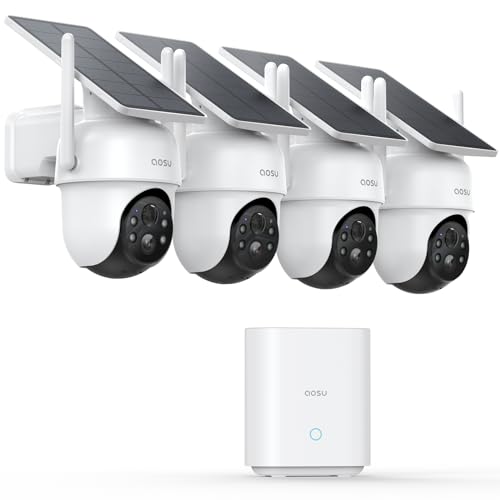
aosu D1 Classic 4-Cam Wireless Outdoor Security
The aosu D1 Classic 4-Cam Kit delivers complete perimeter visual defense using solar-powered 2K pan-and-tilt cameras paired with a dedicated aosuBase hub for subscription-free encrypted local storage. It is an ideal zero-monthly-fee security solution for suburban homeowners looking to monitor entryways, yards, and driveways without wiring hassles.
Pros
- Subscription-free residential security with 32GB of encrypted local loop recording housed safely inside the aosuBase hub.
- Continuous solar charging requires only three hours of sunlight daily, minimizing the need for manual battery recharging.
- 360-degree pan-tilt coverage with automatic motion tracking ensures subjects are actively followed across the camera view.
- Simultaneous four-camera split-screen live viewing and cross-camera event sequencing simplify outdoor perimeter monitoring.
Cons
- Requires sufficient daily sunlight exposure (at least three hours), which may limit optimal placement under deep soffits or shaded tree canopies.
- Lacks cellular backup and relies entirely on local wireless connectivity, meaning remote push alerts depend on home internet uptime.
- Permanent exterior installation requires drilling mounting holes, making it less adaptable for strict drill-free rental balconies.
Vivideye 4MP Solar Wireless Security Camera System
The Vivideye 2-Camera Solar Security System delivers sharp 4MP resolution, 360-degree motorized pan-tilt tracking, and an encrypted 128GB local storage hub that eliminates monthly fees. It is an ideal wire-free solution for suburban homeowners and renters looking for comprehensive perimeter monitoring without recurring subscriptions.
Pros
- Zero ongoing subscription costs with 128GB of pre-installed, encrypted local storage housed safely inside the hub.
- Motorized 360-degree panning combined with innovative cross-camera tracking handoffs across active monitoring zones.
- True wire-free installation powered continuously by bundled 5W solar panels and 8000mAh battery packs.
- Dual-band 2.4GHz and 5GHz Wi-Fi compatibility with factory pre-paired setup right out of the box.
- Rugged IP66 weatherproofing rated to endure extreme seasonal temperatures from -4°F up to 122°F.
Cons
- Mechanical auto-tracking functionality is disabled by default and requires manual activation inside the Truisee app.
- AI human detection range is limited to a maximum distance of 29 feet, which may not suit expansive perimeter properties.
- Smart home voice integration is limited to Amazon Alexa, lacking native support for Google Home or Apple HomeKit ecosystems.
ANSQUE Solar 4-Camera 2K Security System
This wireless four-camera setup delivers comprehensive 360-degree property monitoring with continuous solar power and subscription-free local storage. Featuring 2K color night vision and dual-band base station connectivity, it serves homeowners seeking extensive coverage without ongoing service fees.
Pros
- No monthly subscription fees with encrypted local storage
- Solar panels provide continuous wire-free power
- 360-degree pan-tilt viewing with AI person tracking
- Fast 0.5-second trigger speed with dual-band Wi-Fi
Cons
- Relies on digital zoom instead of optical magnification
- Base 32GB storage fills quickly across four cameras
- Requires direct sunlight exposure for continuous solar charging
aosu D1 Max 4K Solar Security Camera Kit
Delivering 4K resolution and 360-degree pan-tilt coverage, this wire-free kit uses solar power and cross-camera tracking to monitor whole properties without subscription fees. It includes an aosuBase with 32GB of expandable local storage, making it ideal for homeowners seeking multi-angle perimeter security.
Pros
- Sharp 4K video with full-color night vision
- No monthly subscription fees for video recording
- Automated 360-degree motion tracking covers large areas
- Continuous solar power requires minimal maintenance
Cons
- Digital zoom instead of optical magnification
- Included 32GB storage fills quickly across four cameras
- Plate reading range limited to 33 feet
NOAHVIEW 4MP Wireless Solar Security Camera
The NOAHVIEW 4-camera solar security system combines 4MP PTZ coverage with an included 500GB NVR hard drive for dependable, subscription-free property surveillance. Designed with dual-band Wi-Fi, 65-foot color night vision, and continuous solar harvesting, it suits homeowners wanting multi-angle exterior protection without recurring monthly costs.
Pros
- Pre-installed 500GB NVR hard drive provides out-of-the-box local recording with zero mandatory subscription fees.
- Dual-band 2.4GHz and 5GHz Wi-Fi connectivity offers flexible network pairing and improved transmission stability over long distances.
- Full 355-degree pan and 90-degree tilt functionality allows expansive area coverage from a single mounting bracket.
- Independent 4W solar panels and 8000mAh internal batteries eliminate the need for exterior power cabling or frequent manual recharging.
Cons
- Manufacturer specifications do not provide a standardized IP weather-resistance rating (such as IP65 or IP66).
- Solar and battery power architecture relies on motion-triggered event clips rather than continuous 24/7 video recording.
- Advanced vehicle, pet, and package recognition features within the mobile application may require optional software upgrades.
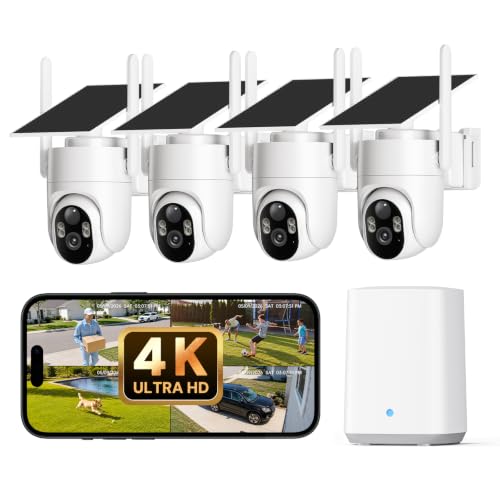
ELYSOO 4K Solar Security Cameras Wireless Outdoor
The ELYSOO 4K Solar Security Camera System pairs four solar-powered PTZ cameras with the ElysooBase hub for 360-degree perimeter protection without ongoing subscription costs. It is an ideal wireless setup for suburban homeowners seeking AI-driven tracking, local video encryption, and flexible Home and Away modes.
Pros
- Local encrypted storage on the ElysooBase hub eliminates mandatory cloud subscription fees
- Solar power panels and internal batteries provide wire-free outdoor installation in roughly five minutes per camera
- AI classification identifies people, vehicles, and animals to reduce false alarms from wind and outdoor motion
- IP65 weatherproof construction operates reliably in extreme temperatures from -4°F to 122°F
- Dual-band 2.4 GHz and 5 GHz Wi-Fi support improves hub connectivity compared to single-band coordinators
Cons
- Lacks automated cellular backup fallback during broadband internet outages
- Digital zoom up to 8x magnifies the image digitally rather than through optical zoom lenses
- Self-monitored system does not include automated municipal police dispatch or central station monitoring
Understanding Subscription-Free Security Camera Architecture
A security camera system that does not require a subscription stores all video footage locally on private physical hardware instead of transmitting files to third-party cloud servers. These standalone setups give property owners direct control over their surveillance archives, permanently eliminating monthly storage bills and surprise renewal fees. Understanding how localized base stations and on-device computing work ensures you can protect your perimeter without sacrificing smart detection capabilities.
The Core Hardware That Eliminates Monthly Cloud Fees
Subscription-free surveillance systems rely primarily on localized storage appliances known as base stations, smart home hubs, or network video recorders. Systems such as the aosu WirelessCam Pro and the ANSQUE 4-Cam kit use an indoor hub equipped with integrated local storage that connects directly to your residential network router. The wireless outdoor cameras communicate directly with this indoor unit, routing video feeds over a private wireless connection before saving files to internal solid-state memory. Because footage stays on your home network, you never have to pay a remote hosting company to view your security clips.
Other standalone architectures, such as the Vivideye Home Hub or the NOAHVIEW system with an integrated hard disk drive, provide larger storage pools that support weeks of event-triggered video loop recording. When the local memory reaches maximum capacity, the operating system automatically overwrites the oldest unsecured video files with new events. This automated loop recording ensures uninterrupted system operation without requiring manual drive maintenance or recurring cloud renewal fees. Hardware owners maintain complete physical custody of the recording media, which keeps private household video isolated from external data leaks.
Base Station Hubs Versus Standalone MicroSD Storage
Property owners evaluating subscription-free options often weigh the differences between individual on-camera memory cards and centralized indoor base station hubs. Cameras that store footage solely on an internal microSD card present an inherent physical vulnerability because an intruder who steals or damages the camera also takes the stored video evidence. Centralized indoor hubs resolve this security flaw by transmitting footage instantly to a secure device placed safely inside the residence. Even if an exterior camera is vandalized, knocked down, or stolen, the recorded event clip remains encrypted and fully accessible on the indoor hub.
Indoor base stations also serve as dedicated signal repeaters and communication controllers for multi-camera deployments. Units like the ElysooBase or AnsqueBase create a dedicated wireless bridge that manages camera traffic, reducing the direct burden on your primary home Wi-Fi router. When evaluating system expansions, pairing add-on cameras for network video recorders or centralized hubs provides a cohesive interface where you can monitor multiple perimeter zones from a single screen. This centralized architecture streamlines device synchronization and ensures that all cameras share a synchronized internal clock for consistent timeline playback.
Edge AI Detection Versus Paywalled Cloud Computer Vision
Many mainstream subscription brands rely on cloud computing to process artificial intelligence algorithms, charging users a monthly fee to distinguish between a person, a passing vehicle, or a swaying tree branch. In contrast, subscription-free systems perform computer vision analysis directly on the camera hardware or within the local base station processor. Edge-based artificial intelligence uses embedded neural processing units to analyze incoming video frames in real time, detecting human silhouettes and vehicle profiles before generating an alert. Because this computational processing occurs on premise, smart alerts remain permanently free of monthly subscription charges.
On-device processing also significantly reduces notification latency by eliminating the need to upload raw video to an off-site cloud server for algorithmic analysis. Systems like the aosu D1 Max utilize on-device vehicle and human detection to trigger instant mobile notifications within fractions of a second. Proactive defense features, such as customizable activity zones and cross-camera tracking, allow the system to link sequential events across different camera angles as an individual moves across your property. By keeping computer vision processing local, these systems eliminate both false alert fatigue and recurring cloud service fees.
Continuous Recording Versus Event-Based Solar Operation
When selecting a subscription-free setup, property owners must choose between continuous recording and event-triggered motion capture. Continuous recording architectures, typically supported by hardwired Power over Ethernet setups or high-capacity network video recorders, capture every single second of activity regardless of motion triggers. However, wire-free systems powered by rechargeable lithium-ion batteries and integrated solar panels operate under strict energy budgets that require power-saving sleep modes. These wire-free cameras remain in a low-power standby state until a passive infrared sensor or radar unit detects thermal motion in the monitored area.
Solar-powered outdoor cameras, including models from aosu and Vivideye, leverage high-efficiency solar panels and internal battery packs to maintain continuous operational readiness without manual recharging. Under normal operating conditions with sufficient direct sunlight exposure, the solar panel replenishes daily energy consumption caused by event detection and live streaming. However, property owners in northern climates must account for cold-weather operating dynamics. Lithium-ion batteries experience reduced chemical efficiency in sub-freezing temperatures, and internal battery management systems will intentionally throttle or pause charging when temperatures drop below freezing to prevent permanent cell damage.
Dual-Band Wireless Networking and Local Outage Survival
Network stability represents a critical factor for any wireless surveillance system operating without a third-party cloud intermediary. Many modern subscription-free cameras support dual-band Wi-Fi connectivity, operating on both the 2.4 gigahertz and 5.0 gigahertz wireless spectrums. The 2.4 gigahertz frequency offers extended physical range and superior structural penetration through exterior brick, stucco, and wood siding, making it ideal for distant perimeter installations. Meanwhile, the 5.0 gigahertz band provides higher data transmission rates and reduced interference from neighboring networks, which helps deliver smooth high-definition video streaming to the central hub.
A major operational advantage of local hub systems is their ability to continue recording video events even when your residential internet connection goes offline. Traditional cloud cameras become completely useless during an internet service provider outage because they cannot transmit video streams to remote hosting servers. In contrast, local systems like the ANSQUE and ELYSOO kits communicate over your private local area network, continuing to capture and store motion-activated clips to the base station memory regardless of external web connectivity. While you will temporarily lose remote smartphone push alerts during an internet outage, your property remains fully protected and all forensic video files are preserved safely on site.
Optical Resolution and Evidence Quality per DORI Standards
Video resolution in subscription-free cameras ranges from 2K Quad HD up to true 4K Ultra HD, representing a substantial step forward in forensic detail compared to older 1080p standards. However, raw megapixel ratings alone do not tell the complete story regarding image quality. Under the international standard IEC EN 62676-4, video surveillance performance is measured using DORI parameters: Detection (25 pixels per meter), Observation (63 pixels per meter), Recognition (125 pixels per meter), and Identification (250 pixels per meter). To identify an unfamiliar individual or capture a crisp license plate, the camera must deliver sufficient pixel density across the target area.
Deploying high-resolution pan-tilt-zoom cameras for driveway surveillance enables comprehensive optical coverage by combining motorized panning with digital zoom capabilities. High-resolution sensors, such as the 8-megapixel lenses found on 4K models, preserve critical visual details when zooming in on distant objects like package labels or vehicle registration tags. At night, integrated white-light spotlights enable full-color night vision, ensuring accurate color rendition of clothing and vehicles rather than relying solely on monochrome infrared illumination. Proper camera positioning at mounting heights between eight and ten feet balances wide area coverage with an optimal downward angle to capture identifiable facial features rather than the tops of headwear.
Residential Privacy Compliance and Audio Recording Regulations
Installing an outdoor surveillance system requires careful consideration of federal, state, and local legal privacy boundaries. Under United States legal doctrine, individuals maintain a reasonable expectation of privacy within interior living spaces and secluded residential curtilage, such as fenced private backyards. When aiming exterior cameras, lenses should focus squarely on your own property boundaries, entry pathways, and driveways, avoiding direct views into neighboring windows or private spaces. Many modern camera companion applications provide digital privacy masking tools, allowing homeowners to blackout sensitive neighboring zones from both live feeds and recorded video files.
Audio recording capabilities require even greater legal diligence due to strict eavesdropping statutes. Under the Federal Wiretap Act (18 U.S.C. § 2511), intercepting oral communications without consent can lead to legal complications, and state laws create a patchwork of one-party versus all-party consent requirements. In all-party consent jurisdictions like California, Florida, and Pennsylvania, recording conversations without the knowledge and consent of all participants is strictly regulated. Property owners utilizing two-way talk features and microphone audio recording should consult local municipal ordinances and post visible surveillance warning signage at property entryways, or disable audio recording toggles in device settings to maintain compliance.
Maintaining Local Drives and Managing Storage Endurance
Operating a subscription-free system requires basic awareness of physical memory health and write cycle endurance. Solid-state flash memory and microSD cards possess finite lifespan limits determined by the total number of program-erase cycles they can handle before sector degradation occurs. In systems utilizing frequent high-bitrate video writes, standard consumer-grade memory cards will wear out prematurely, leading to corrupted video files or missing clips. Choosing high-endurance memory media engineered with specialized wear-leveling firmware ensures stable performance over prolonged multi-year operation.
Base stations with expandable storage options provide greater headroom and reduce the frequency of automated write cycles across individual storage sectors. Performing periodic drive maintenance, including monthly checks of available storage capacity and quarterly file system reformatting through the system mobile application, prevents file fragmentation and verifies recording integrity. Furthermore, downloading critical incident clips directly to a secondary computer, external solid-state drive, or mobile device guarantees that vital evidentiary footage is preserved before loop recording overwrites older files.
Essential Verification Steps for a Zero-Subscription Setup
After physically mounting your cameras and pairing the base station hub, running a series of operational verification checks confirms system reliability before relying on it for daily perimeter security. Begin by measuring the Wi-Fi signal strength at each camera location using the mobile application network diagnostics tool, aiming for a Received Signal Strength Indicator value of minus sixty-five decibels-milliwatts or stronger. A weak wireless signal forces the camera radio transmitter into high-power retry loops, causing delayed push notifications, video buffering, and accelerated battery depletion on solar-assisted models.
Next, walk across each camera detection zone to verify that passive infrared sensors and on-device AI algorithms trigger reliably when motion occurs. Testing both daytime detection and nighttime spotlight activation ensures that subjects are recognized at appropriate distances without generating nuisance triggers from passing road traffic or windblown trees. Finally, simulate an external network interruption by unplugging your broadband modem while walking through a camera coverage zone. Reconnecting the modem and verifying that the recorded incident was successfully saved to the local hub confirms that your subscription-free system will safeguard your home even during unexpected internet downtime.
Investing in a dedicated subscription-free camera system returns control of property surveillance to where it belongs, squarely in your hands. By combining high-efficiency solar hardware, responsive on-device artificial intelligence, and private local hub encryption, you protect your household perimeter effectively without surrendering personal privacy or paying recurring cloud subscriptions. Verifying local storage operation and wireless signal strength ensures that your security setup provides dependable protection day and night.
About the author
Tyler Lacoma is a smart home and home security technology expert with more than a decade of hands-on experience testing connected devices. His expertise includes security cameras, smart locks, home security systems, privacy features, smart-home compatibility, and emerging AI technology. He focuses on translating technical features into practical guidance that helps homeowners understand which security solutions truly fit their homes and everyday needs.