
What Security Cameras Don’t Require A Subscription: Practical Guide for 2026
Explore what security cameras don't require a subscription in November 2026 with our guide to local storage hubs, continuous NVR recording, and wire-free outdoor cameras.
 By John R. Delaney
Updated October 28, 2026


Recurring cloud fees turn home surveillance into an endless monthly utility bill. Many homeowners find that their devices lose essential functionality like event video playback, custom activity zones, or person detection without an ongoing cloud plan. Understanding what security cameras don’t require a subscription allows property owners to retain full ownership of their video data without monthly charges. Choosing modern battery security cameras with local storage or wired local systems keeps surveillance footage private and archived on physical hardware.
Local storage options rely on on-premise hardware, ranging from high-endurance memory cards inside the camera housing to centralized wireless base stations and multi-terabyte network video recorders. These configurations deliver direct access to recorded events without recurring subscription costs or upload bandwidth bottlenecks. In addition to eliminating monthly fees, subscription-free cameras maintain recording continuity even when residential internet service drops. By processing edge-based AI detection directly on internal camera processors, these systems provide responsive alerts while keeping sensitive residential video off remote third-party servers.
| Award | Product | SSG Score About SSG ScoreThe SSG Score is our own rating from 0 to 10, based on performance, design and build, ease of use, and value. It reflects independent research and is never influenced by manufacturers, retailers, or affiliate commissions. Learn more › | |
|---|---|---|---|
| Best Overall |
aosu 2K Wireless Outdoor Security Camera System
|
9.2/10 | Buy |
| Best Premium |
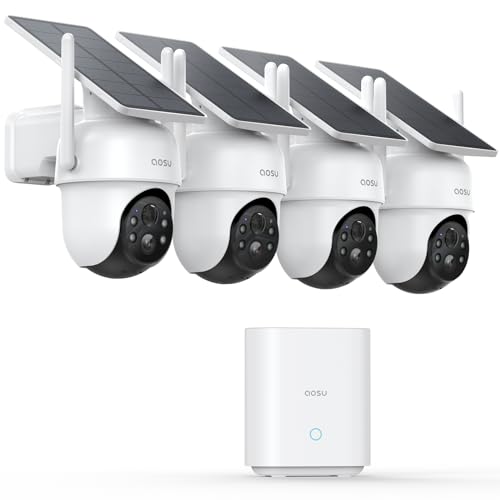 aosu D1 Classic 4-Cam Wireless Outdoor Security |
9.2/10 | Buy |
| Best Value |
 Vivideye 4MP Solar Wireless Security Camera System |
8.8/10 | Buy |
| Best Budget |
 XMSLSPKJ Wireless Security Camera |
8.3/10 | Buy |
 psync MaaX V1 Wired Security Camera |
8.0/10 | Buy | |
 NOAHVIEW 4MP Wireless Solar Security Camera |
7.8/10 | Buy | |
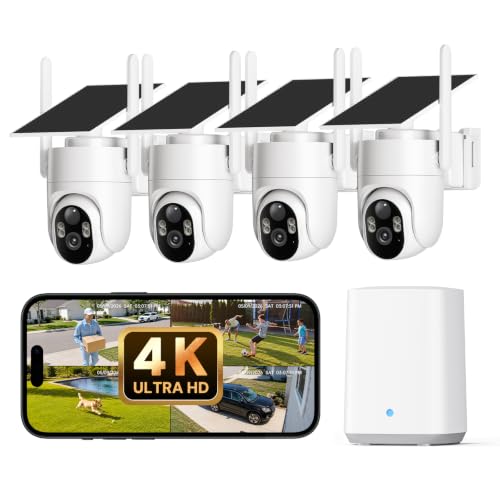 ELYSOO 4K Solar Security Cameras Wireless Outdoor |
7.8/10 | Buy |
aosu 2K Wireless Outdoor Security Camera System
The aosu WirelessCam Pro 2-Camera System delivers crisp 2K QHD resolution with an expansive 166-degree field of view and local 32GB base station storage requiring zero monthly subscriptions. It is a practical choice for homeowners and renters seeking broad perimeter visibility and long battery life without recurring fees.
Pros
- Integrated 32GB encrypted base station storage completely eliminates mandatory monthly cloud subscription costs.
- Expansive 166-degree viewing angle monitors wide yards, driveways, or front approaches with minimal distortion.
- Camera-to-camera tracking synchronizes matching event clips across both units for seamless timeline playback.
- Two-way audio includes a voice-changer feature to safeguard personal privacy when communicating with unknown visitors.
Cons
- Actual battery life will decrease in high-traffic zones exceeding the manufacturer baseline of 40 events per day.
- Continuous 24/7 video recording is not supported due to the battery-conserving, event-triggered architecture.
- Solar charging functionality requires purchasing compatible solar panels separately.
aosu D1 Classic 4-Cam Wireless Outdoor Security
The aosu D1 Classic 4-Cam Kit delivers complete perimeter visual defense using solar-powered 2K pan-and-tilt cameras paired with a dedicated aosuBase hub for subscription-free encrypted local storage. It is an ideal zero-monthly-fee security solution for suburban homeowners looking to monitor entryways, yards, and driveways without wiring hassles.
Pros
- Subscription-free residential security with 32GB of encrypted local loop recording housed safely inside the aosuBase hub.
- Continuous solar charging requires only three hours of sunlight daily, minimizing the need for manual battery recharging.
- 360-degree pan-tilt coverage with automatic motion tracking ensures subjects are actively followed across the camera view.
- Simultaneous four-camera split-screen live viewing and cross-camera event sequencing simplify outdoor perimeter monitoring.
Cons
- Requires sufficient daily sunlight exposure (at least three hours), which may limit optimal placement under deep soffits or shaded tree canopies.
- Lacks cellular backup and relies entirely on local wireless connectivity, meaning remote push alerts depend on home internet uptime.
- Permanent exterior installation requires drilling mounting holes, making it less adaptable for strict drill-free rental balconies.
Vivideye 4MP Solar Wireless Security Camera System
The Vivideye 4-Camera Solar Security System delivers perimeter intrusion deterrence with 4MP pan-tilt coverage and a 128GB local storage hub that eliminates monthly fees. It is a practical choice for suburban homeowners wanting wire-free exterior protection with zero recurring subscriptions.
Pros
- Dedicated 128GB local storage hub keeps video recordings safe indoors without requiring recurring cloud subscriptions
- Dual-band 2.4 GHz and 5 GHz Wi-Fi 6 compatibility helps avoid interference on crowded household routers
- Efficient 5W solar panels and 8000mAh battery capacities provide wire-free power without ladder climbs for recharging
- Motorized pan-tilt mechanics and cross-camera event tracking deliver wide perimeter coverage across exterior entry points
Cons
- Auto motion tracking is deactivated by default out of the box and must be manually enabled in the mobile app
- Three-hole permanent screw mounting makes this hardware less practical for drill-restricted apartment rentals
- Lacks integrated cellular backup, meaning remote smartphone push notifications depend on active home broadband
XMSLSPKJ Wireless Security Camera
The XMSLSPKJ wireless security camera runs on three standard AA batteries and records encrypted footage locally to a built-in SD card with zero monthly subscription fees. Featuring an ultra-wide 159-degree lens and fast 0.4-second PIR motion triggers, it is a practical choice for renters and homeowners prioritizing private, drill-free entryway monitoring.
Pros
- Completely subscription-free with a built-in SD card for over 30 days of local loop recording.
- Operates on standard AA alkaline batteries, eliminating the need to take down the camera for recharging.
- Fast 0.4-second PIR motion trigger helps capture visitors before they leave the frame.
- Expansive 159-degree wide-angle lens provides broad coverage across front doors and porches.
- Includes adhesive mounting pads for clean, non-destructive DIY installation on rental properties.
Cons
- Does not record audio or support two-way talk communication.
- Does not integrate with third-party smart home platforms like Amazon Alexa, Google Home, or Apple HomeKit.
- Footage playback requires a local Wi-Fi or mobile hotspot connection, and transmission may experience latency under weak network conditions.
psync MaaX V1 Wired Security Camera
The psync MaaX V1 provides continuous local recording with integrated 64GB storage and zero mandatory subscription fees. Equipped with an F1.0 aperture and dual-band Wi-Fi, it offers clear color night vision without relying on visible spotlights.
Pros
- Built-in 64GB storage with no subscription fees
- Large F1.0 aperture for spotlight-free color night vision
- Dual-band 2.4GHz and 5GHz Wi-Fi support
- IP65-rated weather-resistant camera housing
Cons
- Requires a continuous wired power source
- Power adapter operates only down to 32 degrees Fahrenheit
NOAHVIEW 4MP Wireless Solar Security Camera
The NOAHVIEW 4-camera solar security system combines 4MP PTZ coverage with an included 500GB NVR hard drive for dependable, subscription-free property surveillance. Designed with dual-band Wi-Fi, 65-foot color night vision, and continuous solar harvesting, it suits homeowners wanting multi-angle exterior protection without recurring monthly costs.
Pros
- Pre-installed 500GB NVR hard drive provides out-of-the-box local recording with zero mandatory subscription fees.
- Dual-band 2.4GHz and 5GHz Wi-Fi connectivity offers flexible network pairing and improved transmission stability over long distances.
- Full 355-degree pan and 90-degree tilt functionality allows expansive area coverage from a single mounting bracket.
- Independent 4W solar panels and 8000mAh internal batteries eliminate the need for exterior power cabling or frequent manual recharging.
Cons
- Manufacturer specifications do not provide a standardized IP weather-resistance rating (such as IP65 or IP66).
- Solar and battery power architecture relies on motion-triggered event clips rather than continuous 24/7 video recording.
- Advanced vehicle, pet, and package recognition features within the mobile application may require optional software upgrades.
ELYSOO 4K Solar Security Cameras Wireless Outdoor
The ELYSOO 4K Solar Security Camera System pairs four solar-powered PTZ cameras with the ElysooBase hub for 360-degree perimeter protection without ongoing subscription costs. It is an ideal wireless setup for suburban homeowners seeking AI-driven tracking, local video encryption, and flexible Home and Away modes.
Pros
- Local encrypted storage on the ElysooBase hub eliminates mandatory cloud subscription fees
- Solar power panels and internal batteries provide wire-free outdoor installation in roughly five minutes per camera
- AI classification identifies people, vehicles, and animals to reduce false alarms from wind and outdoor motion
- IP65 weatherproof construction operates reliably in extreme temperatures from -4°F to 122°F
- Dual-band 2.4 GHz and 5 GHz Wi-Fi support improves hub connectivity compared to single-band coordinators
Cons
- Lacks automated cellular backup fallback during broadband internet outages
- Digital zoom up to 8x magnifies the image digitally rather than through optical zoom lenses
- Self-monitored system does not include automated municipal police dispatch or central station monitoring
How Subscription-Free Security Cameras Operate and Store Video Locally
Security cameras that operate without ongoing subscriptions shift video recording, event processing, and data archiving directly onto hardware located inside your home. Rather than transmitting video clips across residential internet connections to remote server farms, these systems preserve recorded events on physical memory media. This architecture ensures that you maintain full control over video history while eliminating monthly service fees. Getting the most out of subscription-free surveillance requires an understanding of how local storage hubs, on-device memory cards, edge-based artificial intelligence, and power delivery methods work together.
Base Stations and Centralized Indoor Storage Hubs
Centralized base stations represent one of the most reliable architectures for wire-free outdoor cameras operating without subscription fees. In this setup, outdoor camera units communicate wirelessly with an indoor hub that plugs directly into your home network router. The hub houses encrypted flash memory, typically ranging from 32GB to 128GB of internal storage, where motion-triggered video clips are saved securely. Storing video inside the residence provides a significant security advantage over standalone cameras. If an outdoor camera is physically damaged, tampered with, or stolen, the recorded evidence remains completely intact on the indoor base station.
Dedicated base stations also improve the battery longevity and wireless efficiency of connected outdoor units. The indoor hub handles video encryption, file indexing, and communication handshakes, which relieves the outdoor camera processors of heavy computing tasks. Many base stations support multi-camera synchronization, linking clips from adjacent cameras along a unified timeline when motion travels across the property. Homeowners can view simultaneous live feeds from multiple angles on a single screen without paying for multi-camera cloud subscription tiers. Because the hub manages local data looping, the system automatically overwrites the oldest clips once capacity is reached, providing months of continuous event history without user intervention.
Standalone Network Video Recorders with High-Capacity Hard Drives
Network video recorder systems provide the highest storage capacities and longest retention intervals among subscription-free surveillance options. An NVR pairs with multiple IP cameras across a dedicated local network, saving video directly to an internal hard disk drive. Systems equipped with hard drives, such as 500GB units, can store continuous video feeds or thousands of motion events across several channels for months at a time. The video streams stay within the local area network, which preserves home internet upload bandwidth for other household devices. This isolated recording framework ensures that local video capture continues uninterrupted even during prolonged broadband outages.
Scalability is another major advantage of choosing an NVR foundation for home security. When planning an expandable perimeter layout, pairing compatible add-on security cameras for NVR systems allows homeowners to add extra viewing angles to a single central recorder. Most standalone recorders support flexible expansion up to eight or ten separate camera streams without requiring additional licensing or cloud upgrades. The recorder manages video compression, user authentication, and motion alerts locally through its own operating firmware. Property owners can access the system remotely through secure mobile applications that connect directly to the recorder via peer-to-peer protocols without cloud storage subscriptions.
On-Device MicroSD and Integrated Flash Storage
Standalone cameras equipped with on-device memory cards or built-in flash storage deliver a compact, self-contained alternative to centralized hubs. In these designs, memory chips ranging from 32GB to 64GB or removable microSD cards sit directly inside the camera housing. The camera records motion events or continuous streams directly to this local media, bypassing external hubs entirely. This architecture makes installation exceptionally simple, as each unit operates as an independent surveillance station. Homeowners can mount a single camera near an entryway or garage without setting up interior bridge hardware or running long networking cables across the house.
On-device storage also enables offline recording in remote locations where reliable Wi-Fi networks do not exist. A standalone camera can monitor a detached workshop, rural gate, or temporary construction site, saving motion clips directly to its internal memory whenever movement occurs. You can view playback later by connecting locally to the camera with a mobile device or smartphone hotspot. The primary limitation of on-device storage is physical vulnerability, since an intruder could steal the camera along with its memory card. Homeowners can mitigate this risk by mounting standalone cameras out of arm reach and choosing units that feature password-protected local encryption.
Continuous 24-7 Recording Versus Motion-Triggered Wake Cycles
Deciding between continuous recording and motion-activated clip capture is an important distinction when evaluating subscription-free cameras. Wired cameras connected to continuous AC power or Power over Ethernet lines can record around the clock without depleting power reserves. This continuous recording capability ensures that you never miss context leading up to an incident, including subtle background movements that might fail to trigger motion sensors. Cameras with built-in storage designed for continuous recording archive video in looping blocks, giving homeowners complete coverage of every second of the day.
Battery-powered cameras cannot record continuously because constant image sensor processing and Wi-Fi transmission would drain the battery pack within a single day. Instead, wire-free cameras remain in a low-power sleep state until an integrated passive infrared sensor detects a moving heat signature. Once triggered, the camera wakes up, initiates video recording, and transmits a mobile push notification within fractions of a second. High-speed passive infrared sensors can trigger recording in as little as 0.4 seconds, capturing individuals before they leave the field of view. While motion-triggered recording conserves battery power, it requires careful sensor positioning to avoid clipped beginnings during rapid movement.
Edge-Based Artificial Intelligence Without Cloud Processing
Traditional subscription camera brands frequently lock advanced artificial intelligence behind monthly paywalls, claiming that cloud servers are necessary to analyze video frames. Modern subscription-free cameras challenge this model by incorporating dedicated neural processing units directly onto the camera circuit board. Edge AI models evaluate video frames in real time, distinguishing human silhouettes, vehicles, and animals directly at the hardware level. This local processing dramatically reduces false alerts caused by shifting shadows, windblown tree branches, or flying insects. Because the analysis occurs locally, notifications arrive on your smartphone faster than alerts routed through distant cloud servers.
Edge-based intelligence also supports advanced security features like automated motion tracking and cross-camera subject handoffs. Pan-tilt cameras can identify a person entering the driveway and physically rotate their lens mechanism to follow the individual across the yard. When multiple cameras are paired to a local base station, the system can automatically link corresponding video clips from the same time period. To maintain clear nighttime identification without cloud enhancement, pairing edge AI with battery security cameras with color night vision provides full-color video using integrated white LED spotlights or wide-aperture optical lenses.
Network Bandwidth Management and High-Efficiency Video Coding
Transmitting high-resolution video streams across residential networks requires efficient data management to prevent Wi-Fi congestion and buffering delays. High-resolution sensors capturing 2K or 4MP video generate large file sizes that can overwhelm older network equipment. Subscription-free systems frequently implement High Efficiency Video Coding, also known as H.265 compression, to reduce bandwidth consumption. The H.265 codec compresses video data up to fifty percent more efficiently than older H.264 formats while maintaining sharp image clarity. This compression efficiency doubles the recording capacity of local storage drives and reduces upload demands during live mobile streaming.
Wireless frequency selection also plays a vital role in maintaining stable camera connections through exterior walls. Dual-band cameras supporting both 2.4 GHz and 5 GHz Wi-Fi frequencies allow homeowners to balance transmission range against data throughput. The 2.4 GHz band provides superior wall penetration, making it ideal for distant outdoor cameras mounted on detached structures or perimeter fences. The 5 GHz band offers faster transmission speeds and lower latency, which helps eliminate stuttering when viewing multi-camera live feeds. Choosing the appropriate wireless frequency ensures that local video streams load promptly without interfering with other household streaming devices.
Power Delivery Options and Environmental Weather Resistance
Subscription-free security cameras utilize diverse power delivery methods designed to match different physical mounting locations and maintenance preferences. Wired cameras plugged into standard electrical outlets deliver uninterrupted power, eliminating the need to monitor battery levels or schedule recharge cycles. For wire-free installations, solar-assisted cameras integrate rechargeable lithium-ion battery packs, often rated around 8000mAh, with compact exterior solar panels. Under typical conditions, two to three hours of direct daily sunlight provides enough energy to sustain perpetual operation. Other battery-operated units run on standard alkaline AA batteries, using ultra-low-power microcontrollers to deliver extended operational intervals without external wiring.
Operating cameras outdoors requires attention to seasonal climate extremes and weatherproofing standards. High-quality outdoor cameras carry IP65 weather-resistance ratings, protecting delicate internal electronics against heavy rain, dust ingress, and blowing debris. Operating temperatures present distinct challenges, particularly for lithium-ion battery packs in cold climates. Most lithium batteries feature internal management systems that prevent charging below 32 degrees Fahrenheit to prevent cell damage, meaning solar charging pauses during winter freezes. Alkaline-powered units and hardwired cameras maintain reliable performance across broader temperature spans, operating effectively from sub-zero winter chills up to high summer heat.
Placement Strategy, Mounting Heights, and Audio Legal Compliance
Optimizing camera placement ensures that local recordings capture actionable evidence while avoiding common optical pitfalls. Mounting outdoor cameras between eight and ten feet off the ground strikes an ideal balance between physical security and facial identification. Placing cameras too high produces steep downward angles that record only the tops of hats and shoulders rather than recognizable facial features. Angling cameras slightly downward avoids direct exposure to sunrise or sunset glare, which can blind image sensors and wash out recorded details. Homeowners should also position passive infrared sensors across typical walking paths rather than pointing them directly head-on, as sensors detect lateral movement much faster.
Audio recording capabilities require careful legal consideration under United States federal and state surveillance statutes. Under the Federal Wiretap Act, codified at 18 U.S.C. Section 2511, recording oral communications without proper consent can carry legal liability. State laws vary between one-party consent frameworks and all-party consent statutes, where every individual in an audio recording must agree to being captured. While visual recording of private driveways and front porches generally carries no expectation of privacy, sensitive audio capture across property lines can trigger disputes. Homeowners should review local recording laws, disable microphone recording if coverage extends into neighboring spaces, and utilize digital privacy masks to block adjacent windows.
Deploying security cameras without monthly subscriptions provides long-term financial savings and complete control over private household video data. By pairing encrypted local storage hubs or high-capacity NVRs with on-device edge AI detection, homeowners achieve robust perimeter protection without recurring fees. Evaluating power options, verifying Wi-Fi signal strength at mounting locations, and configuring detection zones properly ensures reliable surveillance for years to come.
About the author
John R. Delaney is a veteran technology editor and product reviewer specializing in home security, smart home devices, and wireless networking. With extensive experience evaluating connected security systems, cameras, smart locks, sensors, and networking equipment, he brings a practical testing mindset to consumer technology. His work emphasizes usability, performance, connectivity, and long-term value for homeowners building reliable smart security systems.