
What Security Cameras Record 24/7: Continuous Recording Guide for 2026
Explore what security cameras record 24/7 options in November 2026 to find reliable hardwired NVR setups, smart solar AOV models, and subscription-free local storage.
 By Rachel Cericola
Updated November 5, 2026


Property owners frequently struggle with battery cameras that sleep between events, often missing the critical moments right before an incident occurs. Understanding what security cameras record 24/7 is essential for anyone who needs continuous surveillance coverage rather than brief, fragmented motion clips. While traditional wire-free cameras enter low-power sleep cycles to conserve their internal cells, modern surveillance options now provide genuine around-the-clock observation. Evaluating power requirements, storage longevity, and network transmission speeds ensures you select a system capable of uninterrupted operation without overwhelming your home infrastructure.
Continuous recording architectures generally split between dedicated hardwired platforms and advanced solar setups equipped with adaptive frame rate technology. Many homeowners prefer standalone units like battery security cameras with local storage to avoid recurring subscription costs while maintaining control over their private video archives. However, running cameras non-stop introduces unique technical demands, including sustained power delivery, high-volume memory card endurance, and strategic local drive capacity. Identifying how these systems balance power consumption against recording fidelity helps property owners establish reliable security that never drops offline.
| Award | Product | SSG Score About SSG ScoreThe SSG Score is our own rating from 0 to 10, based on performance, design and build, ease of use, and value. It reflects independent research and is never influenced by manufacturers, retailers, or affiliate commissions. Learn more › | |
|---|---|---|---|
| Best Overall |
LVQ 5MP Solar Outdoor Security Camera
|
9.2/10 | Buy |
| Best Premium |
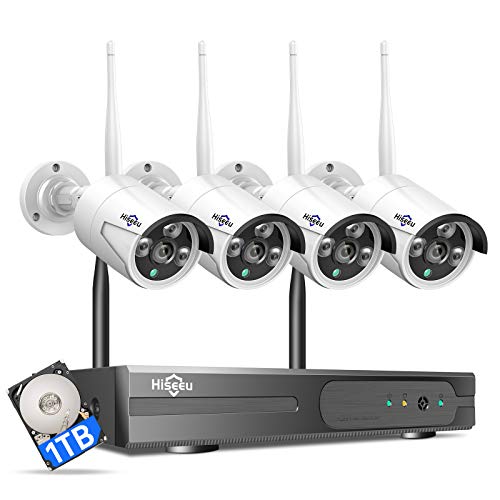 Hiseeu 4-Cam Wireless Security System (1TB NVR) |
9.1/10 | Buy |
| Best Value |
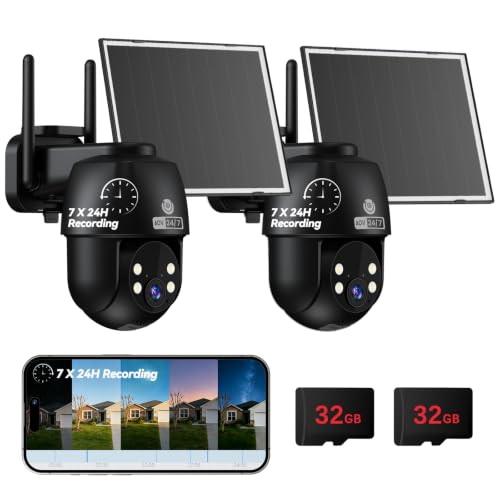 MUBVIEW 4MP Solar Security Camera 2-Pack |
8.6/10 | Buy |
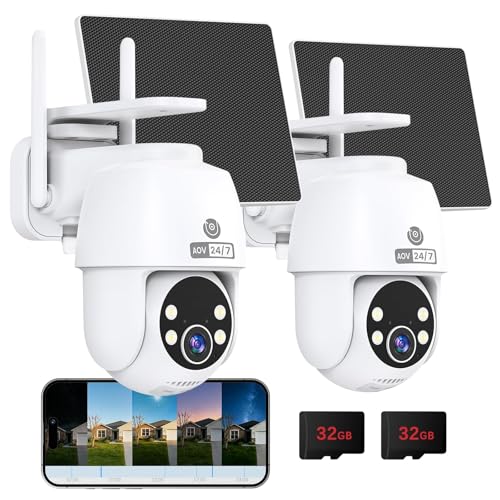 MUBVIEW 4MP Solar Security Camera 2-Pack |
8.4/10 | Buy | |
| Best Budget |
 ZEEPORTE 4G Cellular Solar Security Camera |
8.1/10 | Buy |
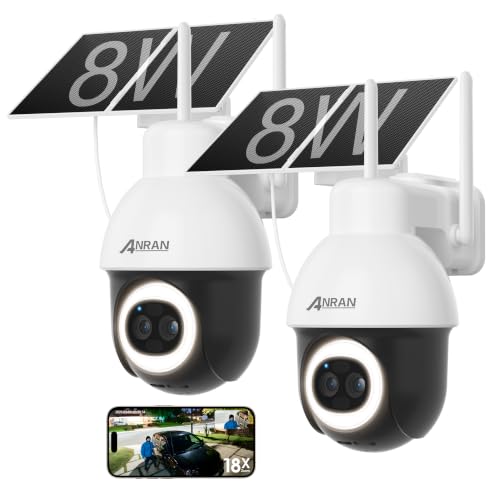 ANRAN 5MP Solar Outdoor Security Camera 2-Pack |
8.0/10 | Buy | |
 Obligz S2 2K Solar Security Camera (2-Pack) |
7.8/10 | Buy |
LVQ 5MP Solar Outdoor Security Camera
Built for wide property monitoring without hardwiring, this solar unit pairs adaptive 24/7 recording with dual-lens pan and tilt capability. Its 98-foot detection range and wire-free design make it well suited for monitoring driveways, yards, and detached garages.
Pros
- Continuous 24/7 recording with power-saving frame rates
- Solar panel provides wire-free continuous power
- Expansive 98-foot AI detection range
- Dual-lens mechanism minimizes coverage blind spots
- H.265 video compression optimizes local storage
Cons
- Solar performance requires adequate direct sunlight placement
- IP65 weatherproofing is lower than IP67 outdoor standards
Hiseeu 4-Cam Wireless Security System (1TB NVR)
This Hiseeu surveillance kit combines a 4K 10-channel NVR with four 3MP plug-in outdoor cameras, offering continuous 24/7 recording directly to an integrated 1TB hard drive. It provides a practical, subscription-free option for homeowners seeking reliable local storage, dual-band Wi-Fi, and AI-assisted human detection.
Pros
- Pre-installed 1TB hard drive requires no subscription fees
- Expandable NVR supports up to 10 camera channels
- Dual-band Wi-Fi supports both 2.4GHz and 5GHz networks
- IP66 weatherproof rating handles extreme outdoor temperatures
- AI human detection effectively reduces false motion alerts
Cons
- One-way audio lacks two-way talk capability
- Cameras require nearby power outlets for plug-in operation
- Included bullet cameras record in 3MP rather than 4K
MUBVIEW 4MP Solar Security Camera 2-Pack
Built for persistent perimeter monitoring, this solar-powered dome camera delivers continuous 24/7 recording with a heated battery engineered for freezing climates. Its 4MP resolution, 360-degree pan-tilt mechanics, and included local storage make it an effective off-grid security solution.
Pros
- Continuous recording with automatic low-power event fallback
- Heated battery charges in sub-freezing temperatures
- Includes 32GB microSD card with no required subscription
- Full 360-degree pan and 100-degree tilt coverage
- Long-range detection alerts up to 98 feet
Cons
- Only connects to 2.4GHz Wi-Fi networks
- Fixed lens field of view is narrow at 80 degrees
- Continuous recording runtime depends heavily on sunlight exposure
MUBVIEW 4MP Solar Security Camera 2-Pack
MUBVIEW pairs continuous 24/7 solar-powered recording with a sub-zero heated battery, delivering outdoor surveillance without requiring monthly subscription fees. Its 4MP resolution, 360-degree pan-tilt mechanics, and included local storage make it an adaptable choice for cold-climate property monitoring.
Pros
- Continuous recording via solar power setup
- Heated battery charges in sub-freezing temperatures
- Includes 32GB local storage right out of the box
- Full 360-degree pan and 100-degree tilt rotation
- Detection alerts reach up to 98 feet
Cons
- Supports 2.4GHz Wi-Fi only, not 5GHz
- Motion frame rate maxes out at 15fps
- Needs extra mounting clearance for full rotation
ZEEPORTE 4G Cellular Solar Security Camera
Designed for off-grid properties without Wi-Fi or electrical wiring, this solar-powered camera provides 360-degree pan-tilt monitoring and optional 24/7 continuous recording over cellular networks. It serves as a dependable remote watchdog for farms, cabins, or job sites, though ongoing operation requires a recurring data subscription.
Pros
- Operates completely independent of home Wi-Fi and power outlets
- Solar panel provides continuous maintenance-free battery recharging
- Wide 360-degree pan and tilt view minimizes blind spots
- Local 24/7 continuous recording capability on storage cards
Cons
- Incompatible with standard Wi-Fi networks
- Requires a paid cellular subscription for network functionality
- MicroSD card for local storage is sold separately
ANRAN 5MP Solar Outdoor Security Camera 2-Pack
This wireless outdoor system pairs continuous 24/7 solar charging with 5MP resolution and 18X optical zoom for expansive perimeter monitoring. It provides property owners with full 360-degree coverage, smart tracking, and active deterrence without battery swaps.
Pros
- Non-stop 24/7 recording powered by solar energy
- Powerful 18X optical zoom reveals distant details
- Full 360-degree pan-tilt coverage minimizes blind spots
- Fast, reliable connection using WiFi 6 technology
- Durable IP66 weatherproof rating withstands harsh climates
Cons
- Does not support 5GHz Wi-Fi networks
- Cloud storage supports event clips rather than continuous footage
Obligz S2 2K Solar Security Camera (2-Pack)
Designed for continuous perimeter monitoring, the Obligz S2 delivers 2K video and dynamic 24/7 recording via adaptive frame rates. Its 355-degree auto-tracking and onboard AI make it a capable option for homeowners seeking wide-area coverage without subscription fees.
Pros
- 24/7 continuous recording with variable frame rates
- Free onboard person and vehicle AI detection
- 355-degree pan and tilt with human motion tracking
- Full-color night vision with built-in spotlights
Cons
- Incompatible with 5GHz Wi-Fi networks
- Cannot connect to external base stations
How Continuous 24/7 Video Surveillance Operates Across Modern Hardware
Choosing a security camera capable of nonstop surveillance requires a clear understanding of hardware engineering and power management. Most traditional battery cameras cannot record continuously because active sensors, image processing chips, and network transmitters deplete a standard lithium-ion cell in just a few days. To solve this limitation, the industry relies on two primary architectures: corded hardwired systems that draw constant current from electrical outlets, and innovative solar-assisted units using Always-On Video (AOV) technology to throttle frame rates when areas remain calm. Determining which setup matches your perimeter requires examining how power delivery, storage endurance, and network bandwidth interact in real-world environments.
Corded Plug-In and PoE Systems: Unthrottled 24/7 Video Capture
Hardwired surveillance systems remain the benchmark for property owners requiring true, uncompromised continuous recording. These systems draw constant electricity from household AC outlets or low-voltage Power over Ethernet cables, removing all battery life constraints. Because power is always available, the camera hardware keeps its image sensor, image signal processor, and infrared night vision emitters permanently active. This continuous state eliminates the wake-up latency common in sleep-mode cameras, ensuring that every second of activity is captured with zero delay.
Standalone Network Video Recorder configurations, such as multi-camera corded plug-in systems, manage this intensive workload by streaming video over dedicated local connections directly into a central console. If you are planning an extensive property perimeter setup, investing in PoE security camera systems allows for stable transmission across long cable runs without cluttering your residential Wi-Fi network. The NVR houses a dedicated surveillance-grade hard drive, often pre-installed with 1TB or more of storage capacity, capable of storing dozens of days of continuous footage from multiple channels. Systems utilizing advanced H.265 or H.265+ video compression reduce bandwidth consumption and storage footprints by up to 50 percent compared to older H.264 formats while maintaining crisp 3MP or 4K visual clarity.
Operating a dedicated NVR also provides superior operational independence during home internet failures. Because the cameras link directly to the recorder over an isolated local subnet or direct cables, the system continues to capture, encode, and archive video even if your broadband connection goes down completely. Property owners can still view live feeds and review archived footage directly on a local monitor connected via HDMI or VGA without an internet connection. Remote smartphone streaming and instant push alerts do require active network connectivity, but the underlying evidentiary record remains intact on the physical hard drive.
Always-On Video Architecture: Solar Continuous Recording
Until recently, wire-free solar and battery cameras were strictly limited to motion-triggered recording clips, shutting down their processors between events to survive. The emergence of Always-On Video technology has changed this dynamic by introducing intelligent, adaptive frame rate scaling. Instead of entering a deep dormancy state, an AOV camera operates its sensor continuously at a very low frame rate, typically between 1 and 7 frames per second, while no movement is detected. The moment onboard AI algorithms spot a person, vehicle, or other target, the camera instantly shifts to a standard high-speed frame rate, such as 15 to 25 frames per second, ensuring smooth action capture.
This dynamic throttling slashes power consumption during quiet daylight hours and dead-of-night periods, allowing a high-capacity lithium-ion battery paired with an external solar panel to sustain around-the-clock recording. Standard implementations combine an 8W to 10W solar panel with large rechargeable battery banks, often rated around 9,000mAh. Many outdoor solar units also incorporate intelligent low-power fallback profiles. If prolonged stormy weather prevents the solar panel from recharging the internal reservoir and battery capacity drops below a critical safety threshold, the firmware temporarily steps down from continuous AOV mode to conventional event-only recording rather than shutting down entirely.
Solar placement and daily sunlight access dictate the real-world success of any wire-free continuous surveillance deployment. Solar panels must be oriented toward unobstructed sunlight, ideally facing south or southwest in North America, angled to catch direct rays throughout the seasonal arc. Shadowing from roof gutters, overhanging tree limbs, or architectural trim can drastically drop electrical wattage generation, creating an imbalance where the camera consumes more energy than the panel gathers. Regularly wiping accumulated pollen, dust, and snow off the panel glass is necessary to maintain the consistent energy inflow required for nonstop monitoring.
Storage Media Demands: Surveillance Drives vs. High-Endurance MicroSD
Recording video 24/7 places extreme mechanical and electrical stress on storage media due to continuous, uninterrupted write cycles. Standard consumer microSD cards designed for digital cameras or smartphones rely on standard flash cells that quickly degrade under continuous security camera workloads, often leading to drive corruption within a few months. For standalone wireless or cellular cameras that record continuously to local cards, installing specialized High Endurance microSD media rated for Class 10, UHS-I Speed Class 3 (U3), and Video Speed Class 30 (V30) is crucial. These cards use resilient storage controller firmware and heavy-duty memory cells engineered specifically to withstand years of looping overwrite cycles.
Capacity planning directly determines how many days of recorded history remain accessible before older files are overwritten. A 32GB microSD card recording at high resolution with adaptive frame rates typically holds several days of mixed video history, whereas expanding to a 128GB or 256GB card provides extended review windows for vacation properties or remote structures. Standalone NVR platforms offer vastly superior retention because their 3.5-inch SATA surveillance hard drives are built to handle simultaneous multi-channel writes 24 hours a day. A 1TB surveillance hard drive connected to a four-camera system using H.265 compression can frequently retain more than 30 to 45 days of unfragmented, continuous video history without requiring any recurring subscription costs.
While local recording eliminates recurring cloud subscriptions, off-site cloud vaults provide essential protection against physical equipment theft or fire damage. Many continuous systems offer optional rolling cloud clips for quick mobile previews while keeping the heavy, full-length continuous data stream on the local storage media. Property owners expanding existing hardware often search for compatible add-on cameras for an NVR to maximize their local hard drive storage while managing camera resolutions across different exterior zones.
Network Bandwidth Impact: Managing Wi-Fi, Ethernet, and Cellular LTE Feeds
Continuous video transmission places significant demands on residential networking equipment, particularly when multiple cameras stream simultaneous high-resolution feeds. A single 2K or 4K camera uploading an uninterrupted stream to offsite servers can consume between 2 Mbps and 8 Mbps of continuous upload bandwidth. On standard asymmetric home internet connections, where upload speeds are significantly lower than download speeds, multiple continuous cloud cameras can congest the network, causing latency spikes, video buffering, and dropped packets. Choosing cameras that store video locally on an internal card or local NVR isolates this high-volume data traffic within your local area network, preserving your broadband connection for personal use.
Wireless frequency selection also plays an essential role in connection stability. Most wireless continuous cameras operate exclusively on the 2.4 GHz Wi-Fi band because its longer radio wavelengths penetrate exterior brick, stucco, and wood framing much better than higher-frequency 5 GHz signals. Newer models featuring Wi-Fi 6 technology improve spectral efficiency, reduce transmission latency, and maintain stronger connections in environments with congested radio spectrum. Some advanced dual-band NVR systems also integrate 5 GHz connectivity or proprietary mesh links to facilitate high-throughput streaming directly between paired cameras and the base recorder without passing through your main home router.
For remote acreage, construction yards, and rural barns where neither Wi-Fi nor hardwired broadband is available, 4G LTE cellular security cameras provide an alternative continuous surveillance pathway. These units utilize built-in cellular SIM cards that automatically connect to national wireless carriers such as Verizon, AT&T, or T-Mobile. However, continuous 24/7 video streaming over cellular networks requires massive data transfers, which is why cellular models typically record continuous footage directly to an onboard microSD card while using cellular data strictly for live remote viewing, configuration adjustments, and event notification alerts.
Detection Precision and AI Filtering in Continuous Monitoring
While continuous 24/7 recording ensures no incident escapes documentation, reviewing hundreds of hours of static footage to locate a specific event can be exhausting. Effective continuous systems incorporate smart detection hardware and on-device artificial intelligence to index video timelines accurately. Passive infrared (PIR) thermal sensors detect shifts in heat signatures across their field of view, while onboard computer vision processors analyze silhouette geometry to distinguish humans and moving vehicles from harmless environmental motion. This multi-layered filtering reduces notification fatigue, ensuring your phone receives alerts only when an actual person or vehicle approaches your perimeter.
Advanced pan-tilt-zoom (PTZ) cameras enhance continuous coverage by rotating their lenses dynamically to follow identified subjects. With 355-degree to 360-degree horizontal panning and wide vertical tilt capabilities, a single motorized camera can monitor broad zones that would otherwise require multiple fixed-lens units. When human movement enters a designated target zone, the tracking algorithm automatically pans the housing to keep the individual centered in the frame throughout the encounter. Many cameras also support preset patrol points, allowing the mechanism to cycle automatically between your driveway, front porch, and side gate before returning to a designated home resting position.
Detection range metrics heavily influence how early an approaching visitor triggers high-frame-rate recording and mobile notifications. While budget event cameras frequently struggle to identify motion past 30 feet, high-performance outdoor units feature optical sensors and algorithms capable of detecting human activity at 98 feet, 100 feet, or even up to 230 feet across open yards. Combining extended detection ranges with high-magnification optical zoom allows the camera lens to capture crisp facial details and vehicle markings at long distances without the pixelation common to digital-only zoom enlargement.
Environmental Durability: Weatherproofing and Cold-Weather Operation
Exterior surveillance hardware must withstand relentless exposure to rain, blowing dust, and seasonal temperature swings. When evaluating outdoor cameras for continuous duty, check the manufacturer’s Ingress Protection rating. Enclosures rated IP65 provide complete dust sealing and protection against low-pressure water spray from garden hoses and rainfall, making them suitable for sheltered soffits and covered entryways. Cameras with rugged IP66 ratings deliver enhanced protection against high-pressure water jets, driving downpours, and heavy snowstorms, ensuring internal electronics remain bone dry when mounted on exposed fence posts, barn walls, or open roof fascias.
Operating continuous battery-powered cameras in freezing climates introduces severe chemical hurdles for lithium-ion battery cells. When ambient temperatures drop below 32 degrees Fahrenheit (0 degrees Celsius), internal lithium-ion chemistry changes, causing internal resistance to rise sharply and preventing the cells from accepting a charge safely. Standard battery management systems automatically block solar charging during freezing conditions to avoid permanent dendrite formation and cell damage, which can leave a continuous camera without power during prolonged winter freezes. Premium cold-weather solar cameras integrate internal heating elements that warm the battery reservoir before accepting incoming solar current, allowing continuous charging throughout sub-zero winters.
High summer heat poses an equally challenging environment for continuous surveillance hardware. An outdoor camera operating under direct sunlight in 100-degree Fahrenheit ambient heat experiences significant internal thermal buildup from its active optical sensor, image processor, and infrared night vision LEDs. Hardwired bullet cameras constructed with cast-aluminum housings dissipate internal heat much more efficiently than sealed plastic enclosures, preventing thermal throttling or premature image sensor degradation. Always verify that a camera’s listed operational temperature window, often ranging from minus 13 degrees to 122 degrees Fahrenheit or broader, accommodates the historical climate extremes of your geographic region.
Audio Recording Legality and Residential Privacy Boundaries
Deploying continuous 24/7 video and audio recording introduces significant legal responsibilities under United States federal and state statutes. In outdoor residential areas, courts generally recognize that individuals walking down public sidewalks, traversing driveways, or approaching front doors possess a reduced expectation of privacy compared to interior residential spaces. However, angling a continuous camera so that its lens peers directly through a neighbor’s bedroom, bathroom, or private backyard patio can violate state voyeurism statutes and trigger actionable tort claims for invasion of privacy. Property owners should adjust mounting brackets and configure software privacy masking zones to black out adjacent residential properties from the recorded frame.
Continuous audio recording is governed by far stricter legal requirements than silent video surveillance. Under the federal Wiretap Act (18 U.S.C. Section 2511) and corresponding state eavesdropping laws, capturing private oral conversations without proper consent is strictly prohibited. While most states enforce one-party consent statutes, allowing recording if one participant agrees, roughly a dozen states require all-party consent, making it illegal to record conversations unless every participant provides clear permission. Because outdoor security microphones pick up passing neighborhood conversations without warning, homeowners in two-party consent jurisdictions must review their camera settings and consider disabling continuous audio recording.
Some systems address this legal challenge by incorporating one-way listen-only audio feeds or fully controllable two-way intercom modules. One-way audio enables property owners to listen to ambient exterior sounds on demand without broadcasting their own presence, while two-way audio allows active conversation with delivery drivers or unexpected guests. Several modern outdoor cameras also include built-in voice distortion filters, allowing users to mask their natural voice during live intercom interactions to protect their identity and maintain household privacy. Always consult local municipal ordinances and state wiretap laws before enabling nonstop audio archiving on exterior cameras.
Practical Setup and Ongoing Verification Procedures
Finalizing your surveillance strategy requires matching your property layout with the appropriate continuous power architecture. If your residence allows easy access for running low-voltage wiring through attics, crawlspaces, or conduit, hardwired plug-in NVR or PoE systems provide unmatched reliability, massive multi-terabyte storage retention, and immunity to wireless interference. For remote perimeter gates, detached workshops, rental homes, or exterior walls where drilling is prohibited, solar-powered AOV cameras deliver wire-free flexibility while maintaining around-the-clock observation through smart frame-rate scaling. Evaluating your willingness to manage local hard drives versus solar panel positioning helps narrow down the most effective hardware platform.
Once your continuous cameras are mounted, conducting a series of operational verification checks ensures the system performs as expected when an incident occurs. Mount cameras between 8 and 10 feet above ground level to balance facial identification angles against physical tampering risks. Test your local recording failover by temporarily disconnecting your main broadband router cable while walking across the camera’s detection zone, then verify that the recorded footage appears intact on the local hard drive or microSD card. Regularly auditing your playback timeline, wiping optical lenses with microfiber cloths to prevent night vision glare, and verifying solar charging levels ensures your 24/7 surveillance system delivers continuous, dependable protection throughout every season.
About the author
Rachel Cericola is an experienced smart home writer and product tester with extensive hands-on experience evaluating connected devices. Her expertise includes security cameras, video doorbells, smart-home platforms, video storage, privacy, and everyday device usability. She approaches home security from a consumer-first perspective, helping readers understand how products perform beyond specifications and what features matter most in daily use.